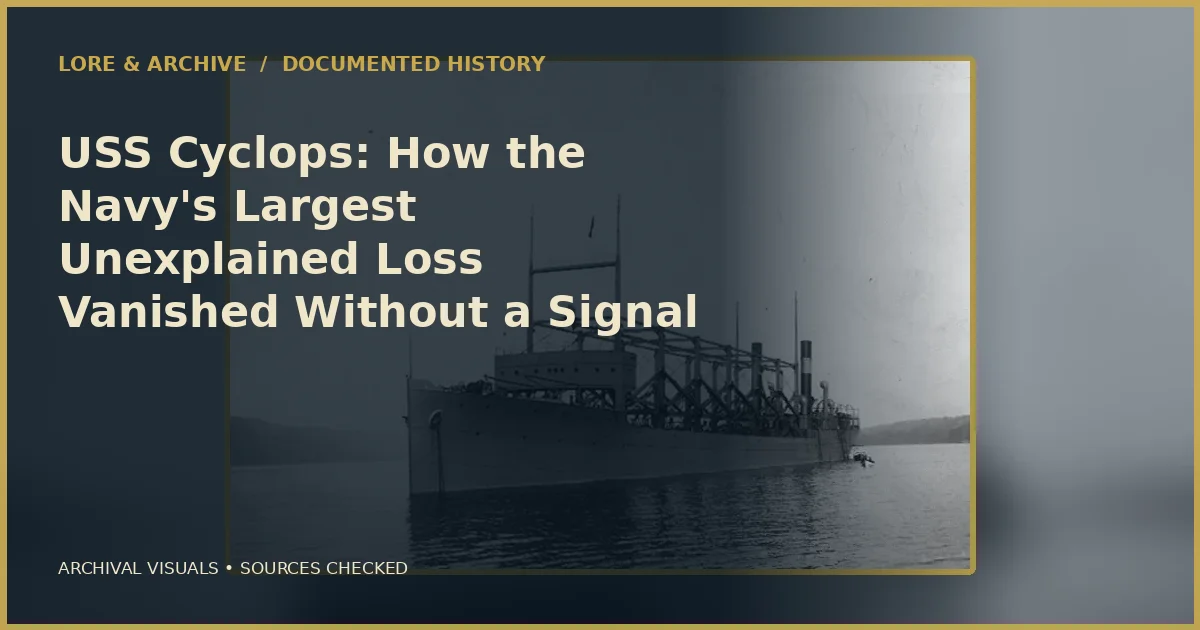
The ship disappeared during wartime, yet German records offered no attack and the Atlantic returned no verified debris. Its cargo and structural condition provide plausible mechanisms, not a final location.
Archive record
- Last departure: Barbados, March 4, 1918
- People aboard: 306
- Cargo: approximately 10,800 tons of manganese ore
- Official status: ship and all aboard presumed lost
A workhorse built to carry impossible weight
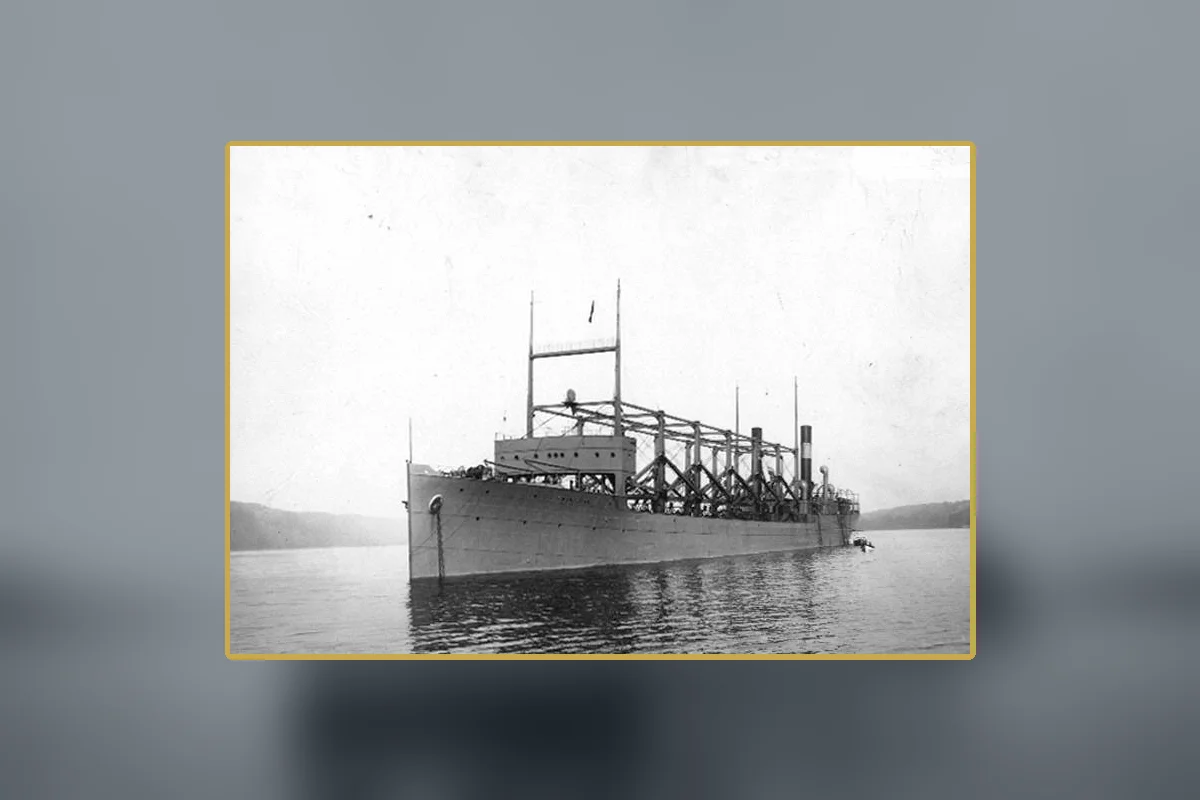
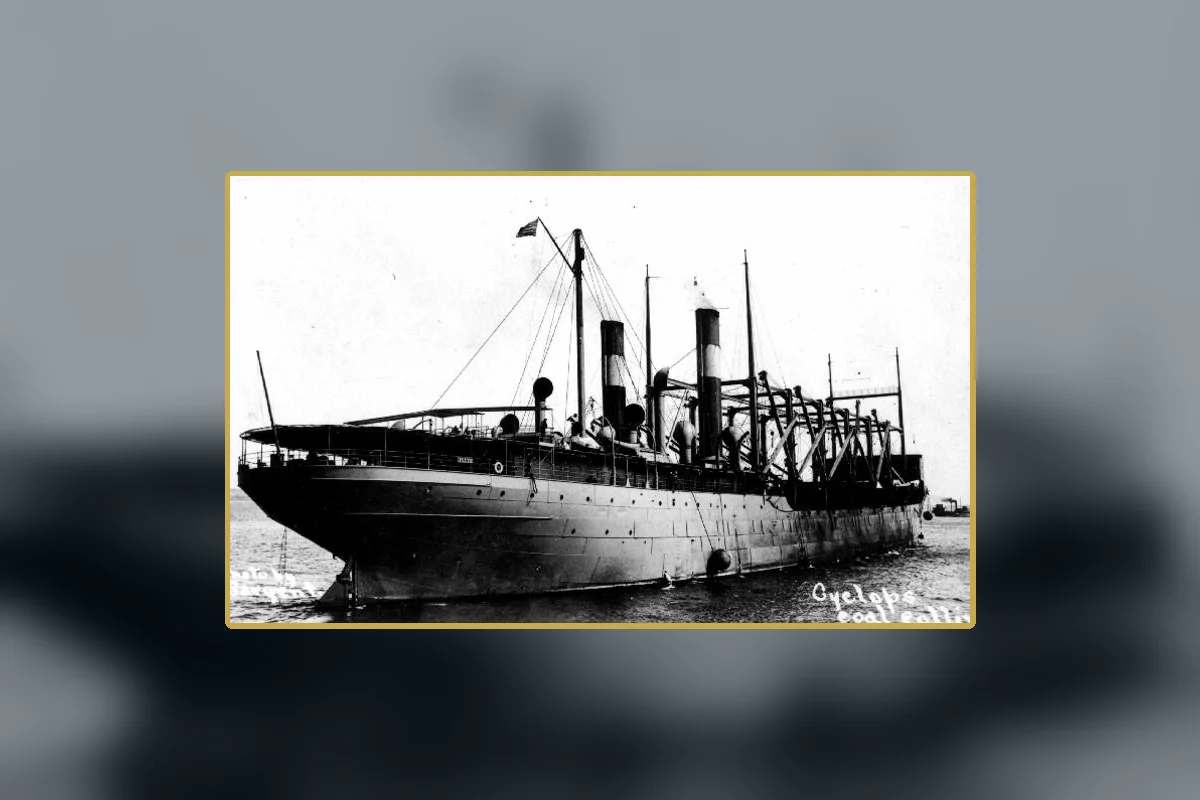
USS Cyclops was a Proteus-class collier, a ship designed to deliver coal to a fleet that still depended on it. Nearly 550 feet long, with large cargo holds and cranes rising above the deck, she served as mobile infrastructure. By 1918, the ship had shifted from carrying coal to transporting dense manganese ore used in steelmaking.
That cargo behaved differently. Weight distribution mattered, and loose material could shift if improperly loaded or if water entered a hold. Cyclops left Rio de Janeiro, stopped at Bahia, then reached Barbados with one engine reportedly out of service. She departed for Baltimore on March 4 and was not seen again.
No SOS, no debris field, no survivor
The ship did not send a confirmed distress call. Searches found no wreckage that could be conclusively tied to Cyclops. With 306 passengers and crew aboard, including the U.S. consul general at Rio, the disappearance became the greatest noncombat loss of life in U.S. Navy history.
Silence is often made to sound supernatural, but maritime disasters can become sudden. A structural failure, cargo shift, or rapid capsize can eliminate the time or electrical capacity needed for radio. In 1918, position reporting was sparse and ocean searches lacked sonar, satellites, and reliable long-range aircraft.
Wartime suspicion and the German-record problem
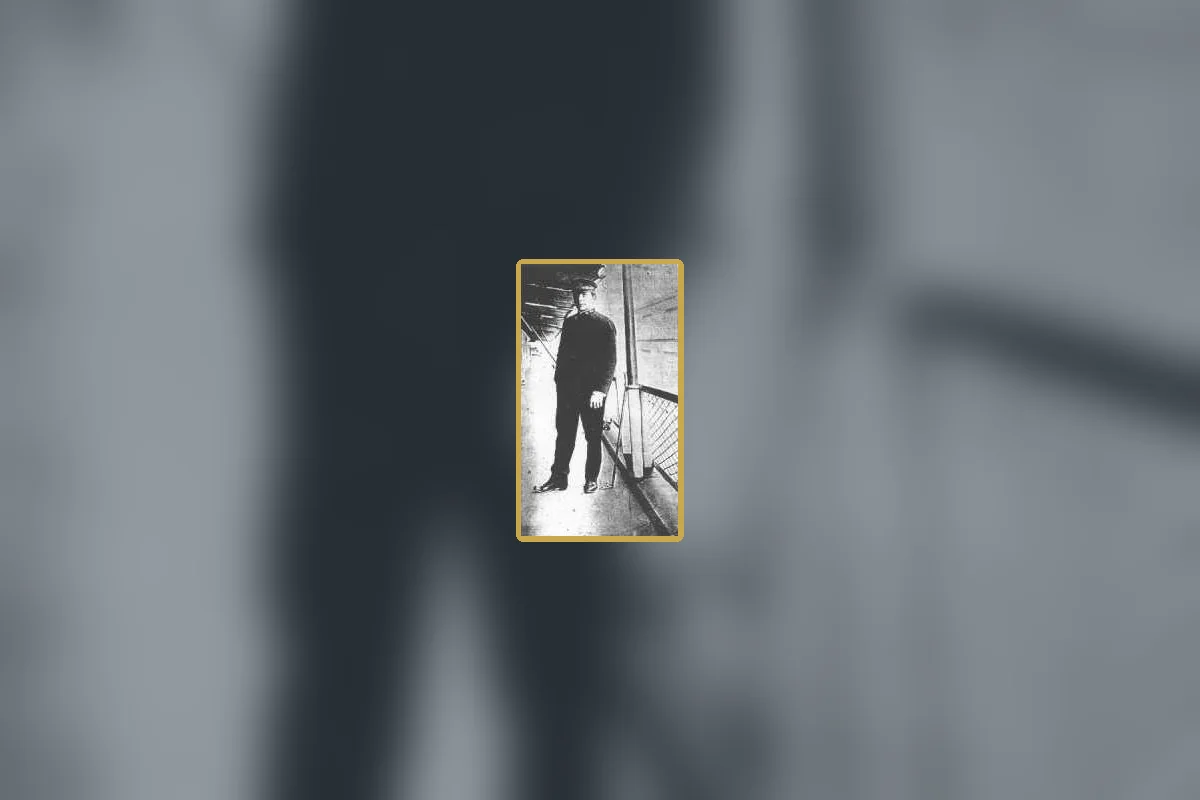
Because the United States was at war, sabotage and submarine attack were obvious possibilities. Captain George Worley had been born in Germany, and later accounts mined his background and difficult reputation for suspicion. Yet postwar examination of German records did not reveal a U-boat claim or operation explaining the loss.
Enemy action cannot be disproved in the abstract, but a theory should explain more evidence than it invents. No explosion was reported, no debris was recovered, and no German documentation supports a successful attack. The wartime context explains why the idea arose; it does not make it the leading account.
Cargo, structure, and weather
The Navy had reasons to worry about the class. Sister ships Proteus and Nereus later vanished during the Second World War while carrying heavy ore, strengthening concern about structural or loading vulnerabilities. Cyclops was overloaded by some assessments and had experienced mechanical trouble. A dense cargo could impose severe stresses if distributed unevenly.
Reports of rough seas along portions of the route add a trigger without proving a sequence. Investigators have proposed a cracked hull, shifting ore, engine failure combined with heavy weather, or capsizing. Each fits known vulnerabilities; none identifies the exact time and place. The wreck has not been publicly confirmed.
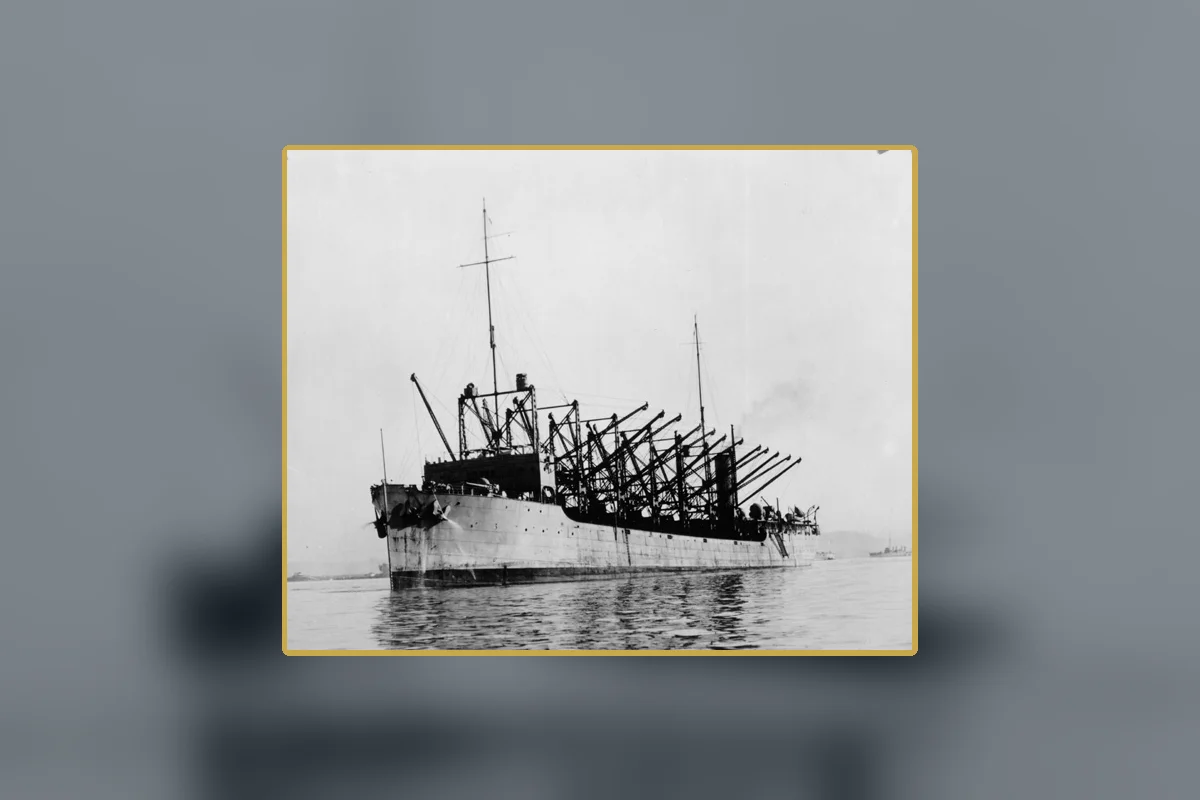
How the Bermuda Triangle claimed a ship retrospectively
Cyclops is frequently placed inside the Bermuda Triangle, a region popularized decades later and never formally defined by the U.S. government. The ship's route from Barbados to Baltimore crossed waters that triangle writers could include. That retrospective label turns an engineering and search problem into evidence for a mysterious zone.
The triangle adds no mechanism. Tropical and winter weather, ocean depth, heavy maritime traffic, navigation limits, and rapid sinking already explain why ships can disappear without recoverable traces. Cyclops deserves investigation on its own evidence, not as a supporting character in a later marketing category.

What would finally change the case
A verified wreck could reveal hull failure, cargo distribution, impact damage, or the position of key machinery. Identification would require more than a large ship-shaped sonar target: dimensions, distinctive cranes, artifacts, and location would need to align. Until then, reported discoveries remain claims.
The archive supports a sober hierarchy. Accidental loss involving structure, cargo, machinery, or weather is plausible; enemy action lacks confirming records; paranormal geography explains nothing. The central mystery is the wreck site and failure sequence, not whether the Atlantic is capable of erasing a vulnerable ship.
What the record supports—and what it does not
USS Cyclops was not proven to be a victim of the Bermuda Triangle, a German submarine, or sabotage. Navy history records an unexplained wartime loss with serious mechanical and cargo-related risk factors. Those factors support accidental scenarios but do not establish a single cause without the wreck.
Evidence ledger
- DEPARTURE — Barbados, March 4, 1918: Cyclops sailed for Baltimore after reporting mechanical trouble on the voyage north.
- ABOARD — 306 people disappeared: No verified survivor, distress transmission, or debris field was recovered.
- CARGO — Dense manganese ore: Loading and shifting ore could impose forces unlike the coal the collier was built to carry.
- WAR RECORD — No German claim matches: Postwar records did not support a U-boat attack on Cyclops.
- MYTH CHECK — The Triangle came later: A retrospective geographic label adds no physical cause to the loss.
- OPEN EVIDENCE — The wreck remains unconfirmed: A verified site could distinguish structural, cargo, and collision scenarios.
How this reconstruction was built
Navy movement records fix Cyclops's route, load, mechanical trouble, and disappearance; later German records weaken the submarine theory. The missing wreck prevents investigators from testing structural failure, cargo shift, or capsize directly. Comparisons with sister ships are relevant but not identical experiments. The evidence therefore supports a family of accidental mechanisms more strongly than sabotage while leaving the failure sequence and final position open.
To audit the account, open the source links below and compare dates, quantities, and the wording used by the institutions themselves. Look for the earliest recoverable record, then distinguish it from later summaries created after the story became famous. The five visuals in this article are archival photographs, maps, documents, objects, or clearly identified editorial diagrams selected to illuminate the surviving record. Each caption identifies its source and rights information; no reconstruction is presented as a historical photograph. That transparency is part of the Lore & Archive method.
Why this story matters
The case shows how missing physical evidence creates room for a famous label to replace engineering questions. Returning to the ship's design, ore load, mechanical condition, and communications limits produces a better mystery—one that a future wreck discovery could actually test.
Continue in the archive
- The Flannan Isles Lighthouse Mystery: What the Missing Keepers Left Behind
- The Franklin Expedition: What the Wrecks and Inuit Knowledge Changed
- Lake Nyos and the Invisible Cloud
Sources and further reading
- Naval History and Heritage Command — H-Gram 016
- National Museum of the U.S. Navy — USS Cyclops mystery
- Naval History and Heritage Command — USS Cyclops photographs
Editorial note: Lore & Archive distinguishes contemporary evidence, later institutional synthesis, and unresolved inference. Where sources disagree or the record is incomplete, the uncertainty is stated rather than converted into a dramatic fact.