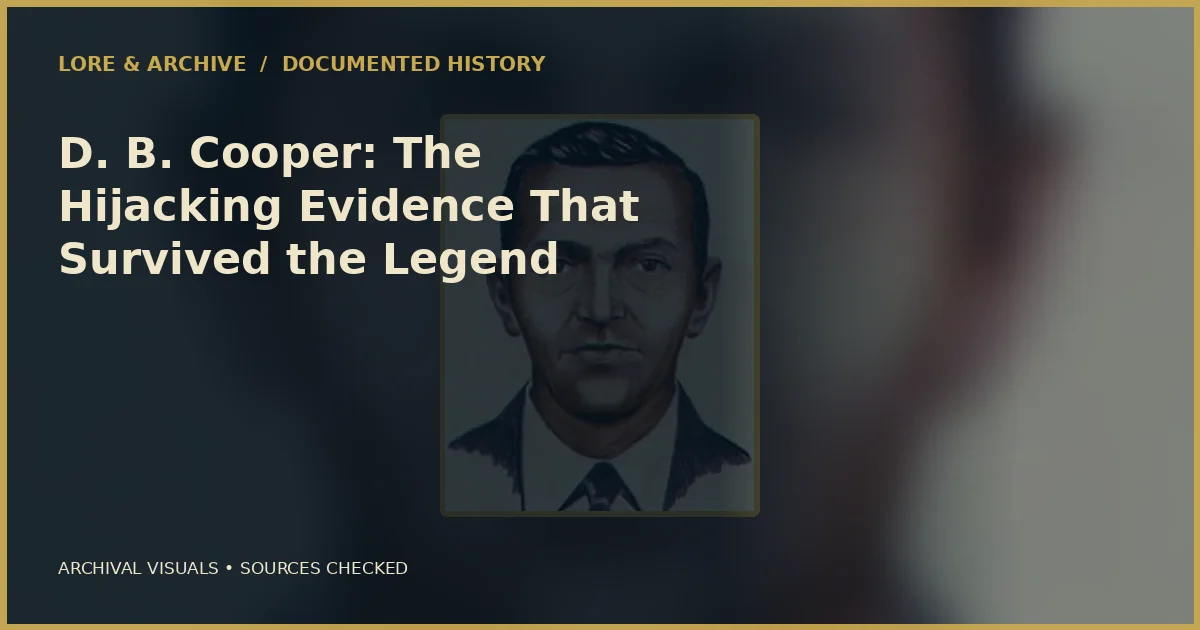
The only unsolved commercial-airline hijacking in United States history produced a clip-on tie, a parachute jump, and $5,800 buried beside a river. Almost everything else is an argument.
Archive record
- Date: November 24, 1971
- Flight: Northwest Orient 305
- Ransom: $200,000 and four parachutes
- Status: FBI redirected resources from active investigation in 2016
The passenger called himself Dan Cooper
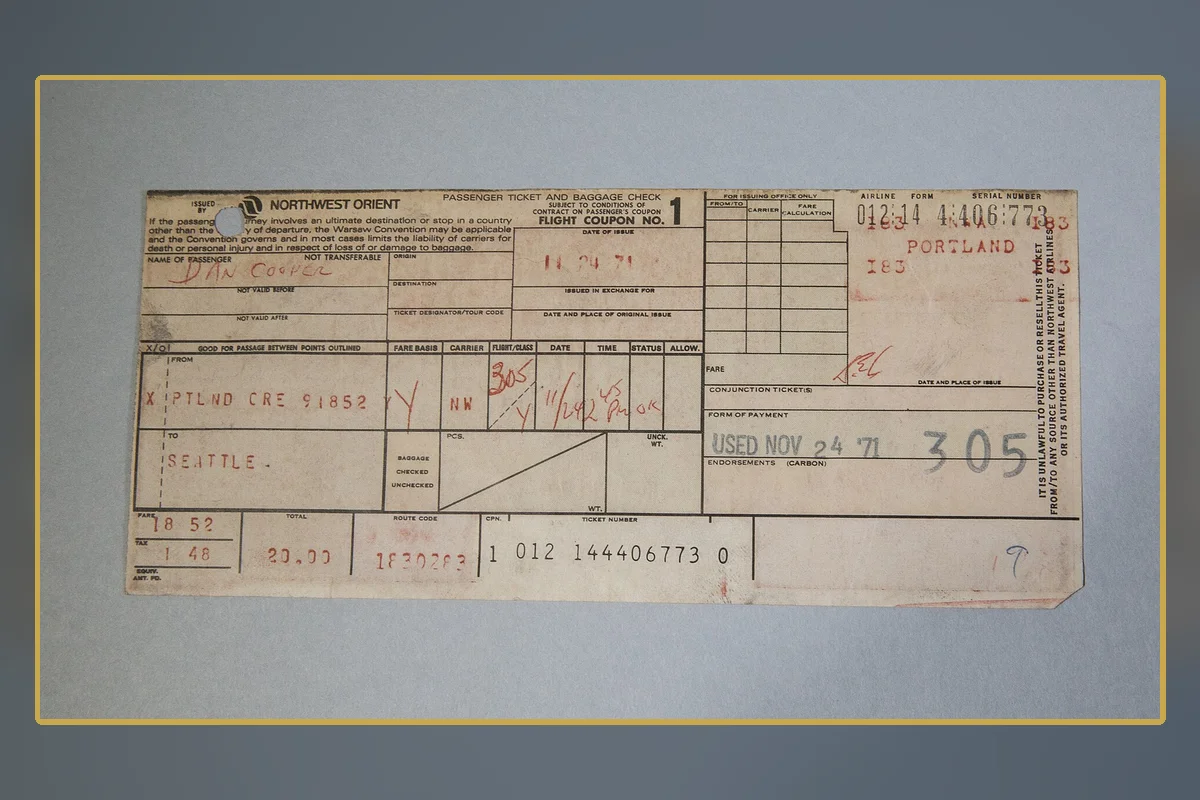
A man in a dark suit bought a one-way ticket from Portland to Seattle using the name Dan Cooper. Once Northwest Orient Flight 305 was airborne, he handed flight attendant Florence Schaffner a note and showed her what appeared to be a bomb. He demanded $200,000, four parachutes, and a fuel truck waiting in Seattle.
The crew complied while passengers were told the landing involved a mechanical problem. After the ransom and parachutes arrived, Cooper released the passengers and some crew. He ordered the Boeing 727 south toward Mexico City at low altitude and slow speed, with the landing gear down and the rear stairs available.
A jump into weather and darkness
Sometime after 8 p.m., while the aircraft crossed southwestern Washington, a pressure change and movement of the rear stairs indicated that Cooper had left. The exact jump point could only be calculated from flight data, wind, and timing. Below were forests, rivers, rough terrain, rain, and limited visibility.
Cooper wore business shoes and did not request specialized skydiving gear. He chose an older reserve parachute and left another chute behind. Those details have fueled competing interpretations: expert who deliberately appeared ordinary, amateur who made dangerous mistakes, or trained jumper forced into imperfect choices. The evidence supports risk; it does not reliably grade his expertise.

What investigators recovered
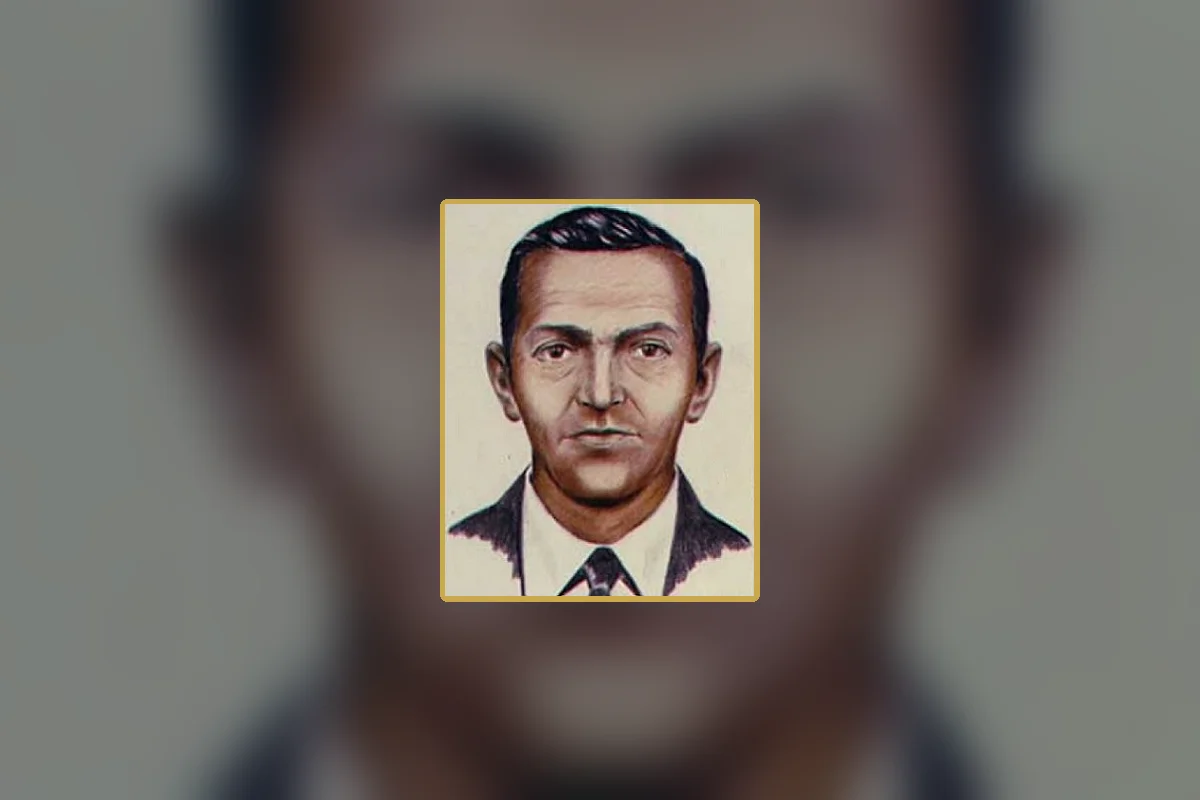
Cooper left a black clip-on tie, tie clip, and some parachute-related material aboard the aircraft. The FBI collected witness descriptions and issued a composite sketch. Search teams examined large areas along the presumed flight path. No body, parachute, or confirmed landing site was found.
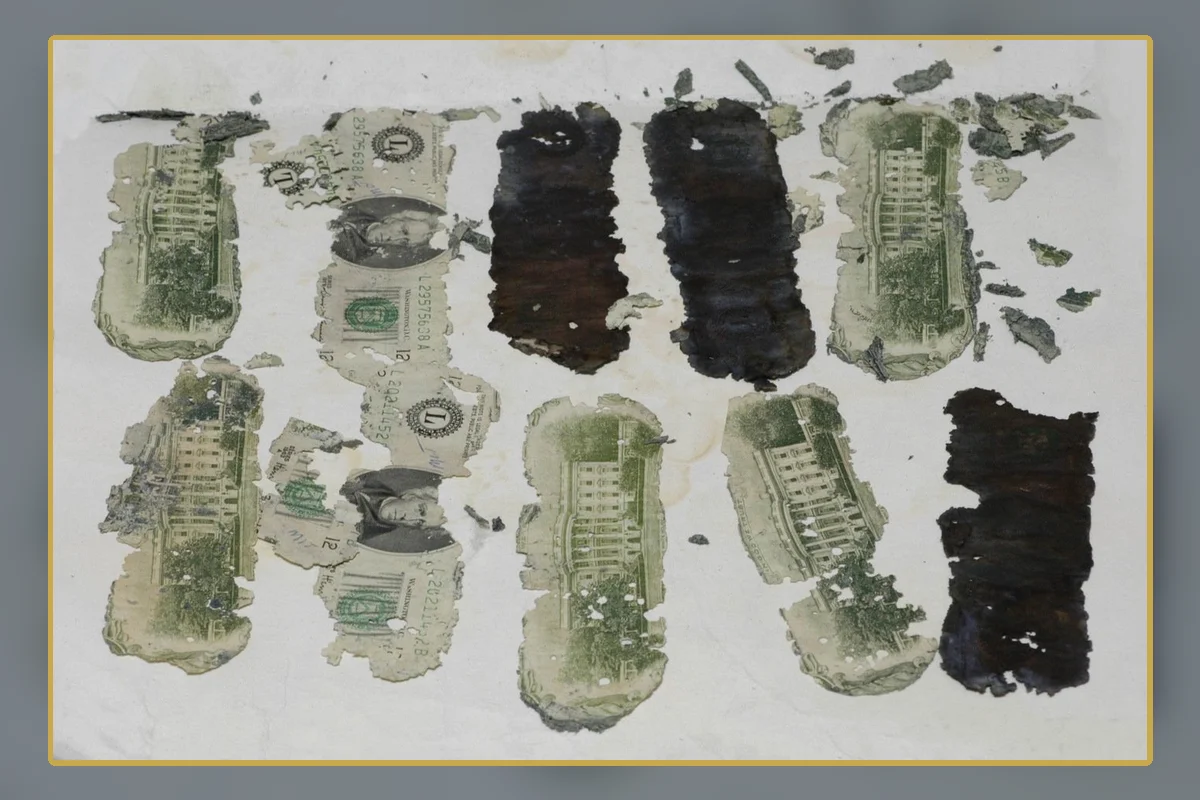
In 1980, eight-year-old Brian Ingram uncovered deteriorating bundles of $20 bills at Tena Bar on the Columbia River. Serial numbers matched the ransom. The $5,800 find proved that at least a small portion of the money entered the river environment, but it did not reveal when, where, or how. Hydrology and dredging history complicated every proposed route.
The name the media accidentally created
The hijacker identified himself as Dan Cooper, not D. B. Cooper. A separate early suspect named D. B. Cooper was quickly cleared, but the initials entered news coverage and became permanent. Even the world's preferred name for the man is therefore an artifact of reporting rather than evidence from the flight.
Thousands of suspects followed. Many fit a few traits—age, military service, aviation experience, resemblance—while failing others. Confessions and family stories often arrived after a candidate had died, limiting verification. A compelling biography is not identification unless it connects to physical evidence, travel, money, or a detail unavailable to the public.
Did he survive?
The FBI emphasized the dangers of the jump and considered it possible Cooper died. No confirmed remains and no broad spending of the ransom have surfaced. Yet absence works both ways: a wilderness death should perhaps leave gear, while a survivor who carefully avoided the bills might leave little. Neither outcome is proved by silence.
The recovered river money is frequently used as a decisive clue, but it supports multiple scenarios. Cooper could have lost packets during the jump, hidden money that later moved, or died near water. Natural transport and human intervention are both debated. The find narrows the story only slightly.
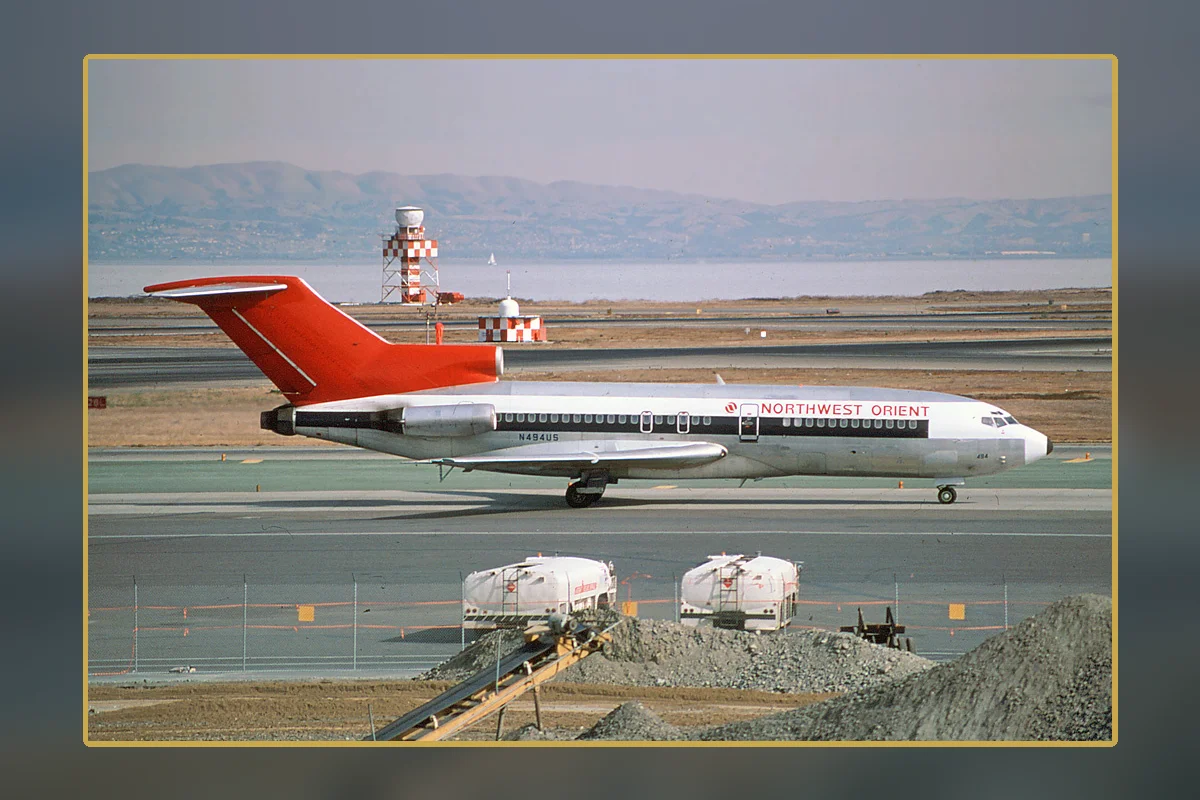
A closed investigation, not a solved case
In 2016 the FBI announced it would redirect investigative resources, while preserving the evidence for specific new leads such as parachutes or ransom money. The decision reflected priorities after decades of work and hundreds of examined suspects. It did not identify Cooper or declare a final survival scenario.
The responsible conclusion is spare. A real hijacker obtained ransom, left the aircraft by the aft stairs, and was not identified. Some money reached Tena Bar. The jump's outcome remains unknown. The legend expands precisely where that factual line ends.
What the record supports—and what it does not
The case is not a blank page, and the popular name is not even the alias used by the hijacker. The FBI record fixes the sequence aboard the aircraft and the ransom serial numbers. It does not prove that Cooper was a master parachutist, that he died, or that any familiar suspect was the man on Flight 305.
Evidence ledger
- ALIAS — He said Dan Cooper: The initials D. B. entered coverage through confusion with an early, quickly cleared suspect.
- DEMAND — $200,000 and four parachutes: The passengers were released in Seattle after the ransom and equipment arrived.
- EXIT — The Boeing 727's rear stairs: A pressure change indicated the hijacker left the aircraft over southwestern Washington.
- EVIDENCE — A clip-on tie remained: Physical evidence survived aboard the aircraft, but none has yielded a public identification.
- RECOVERY — $5,800 at Tena Bar: Matching ransom bills appeared beside the Columbia River in 1980.
- STATUS — Inactive is not solved: The FBI redirected resources in 2016 while retaining evidence for specific new leads.
How this reconstruction was built
The firm record comes from crew testimony, aircraft operations, ransom serial numbers, items left aboard, and the money recovered at Tena Bar. Suspect biographies are a separate evidence class. Resemblance, parachuting experience, or a posthumous family story may generate a lead but cannot identify the hijacker without a physical or documentary connection. The same discipline applies to survival theories: plausibility is not proof in either direction.
To audit the account, open the source links below and compare dates, quantities, and the wording used by the institutions themselves. Look for the earliest recoverable record, then distinguish it from later summaries created after the story became famous. The five visuals in this article are archival photographs, maps, documents, objects, or clearly identified editorial diagrams selected to illuminate the surviving record. Each caption identifies its source and rights information; no reconstruction is presented as a historical photograph. That transparency is part of the Lore & Archive method.
Why this story matters
Cooper is an ideal test of how a mystery grows. Once the event became famous, resemblance and narrative coherence began masquerading as evidence. The most interesting discipline is learning to stop at the boundary between what fits and what connects.
Continue in the archive
- The Bermuda Triangle: How a Bestseller Turned Busy Waters Into a Mystery Zone
- USS Cyclops: How the Navy's Largest Unexplained Loss Vanished Without a Signal
- The Night Niagara Falls Went Silent
Sources and further reading
Editorial note: Lore & Archive distinguishes contemporary evidence, later institutional synthesis, and unresolved inference. Where sources disagree or the record is incomplete, the uncertainty is stated rather than converted into a dramatic fact.