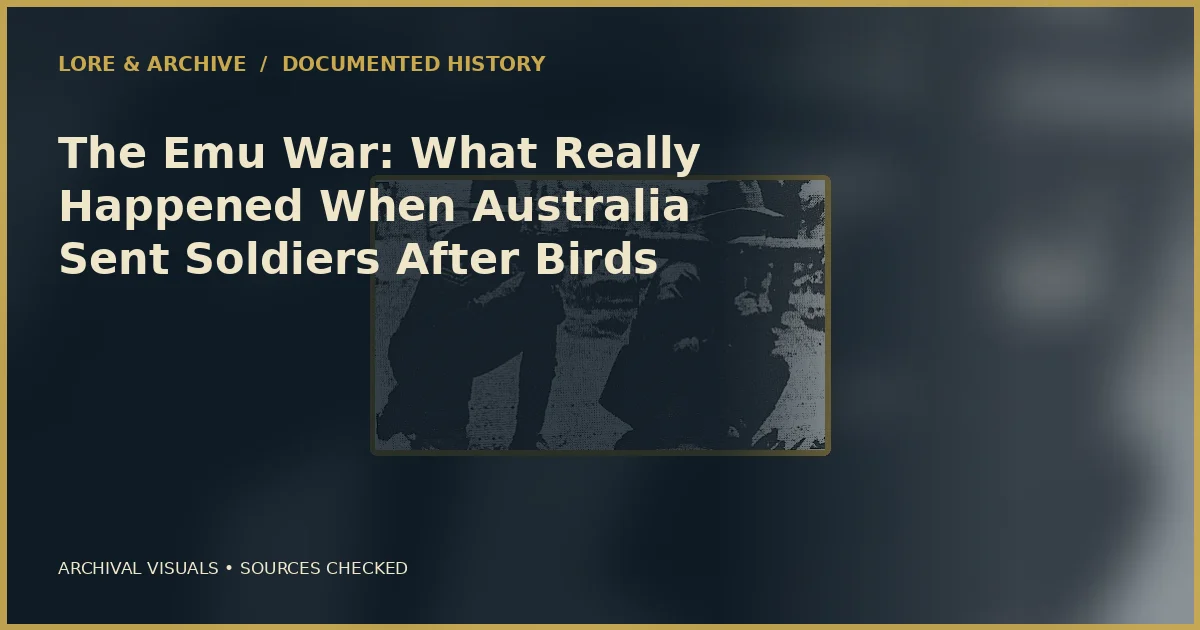
The famous punch line—'the emus won'—captures the failure of machine guns against scattered wildlife. It hides veterans, debt, drought, low wheat prices, and a government searching for a visible answer.
Archive record
- Place: Campion district, Western Australia
- Date: November–December 1932
- Force: Major G. P. W. Meredith, soldiers, and two Lewis guns
- Outcome: short military cull abandoned; bounty and fencing policies continued
Soldier-settlers on difficult land
After the First World War, Australian settlement schemes placed veterans on farms, including marginal land in Western Australia's wheat belt. They were expected to clear acreage, borrow for equipment, and produce grain. By the early 1930s, drought and collapsing wheat prices had made many holdings precarious.
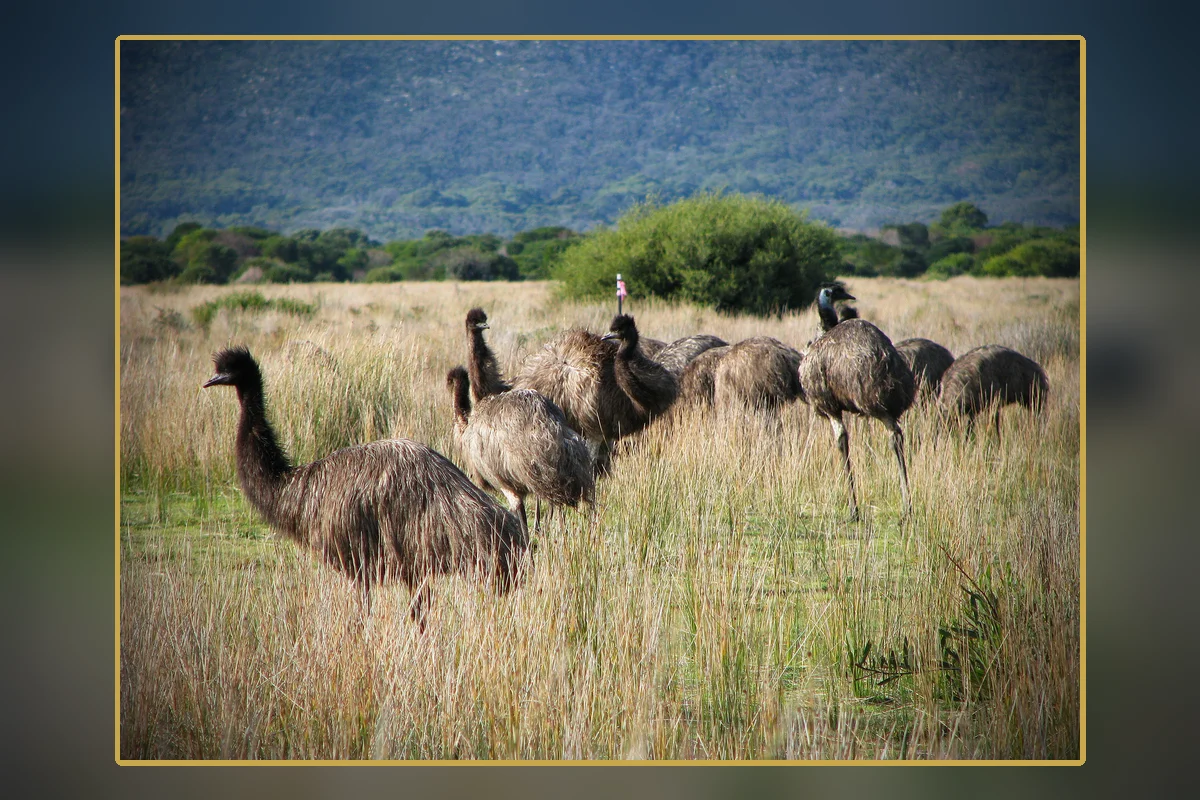
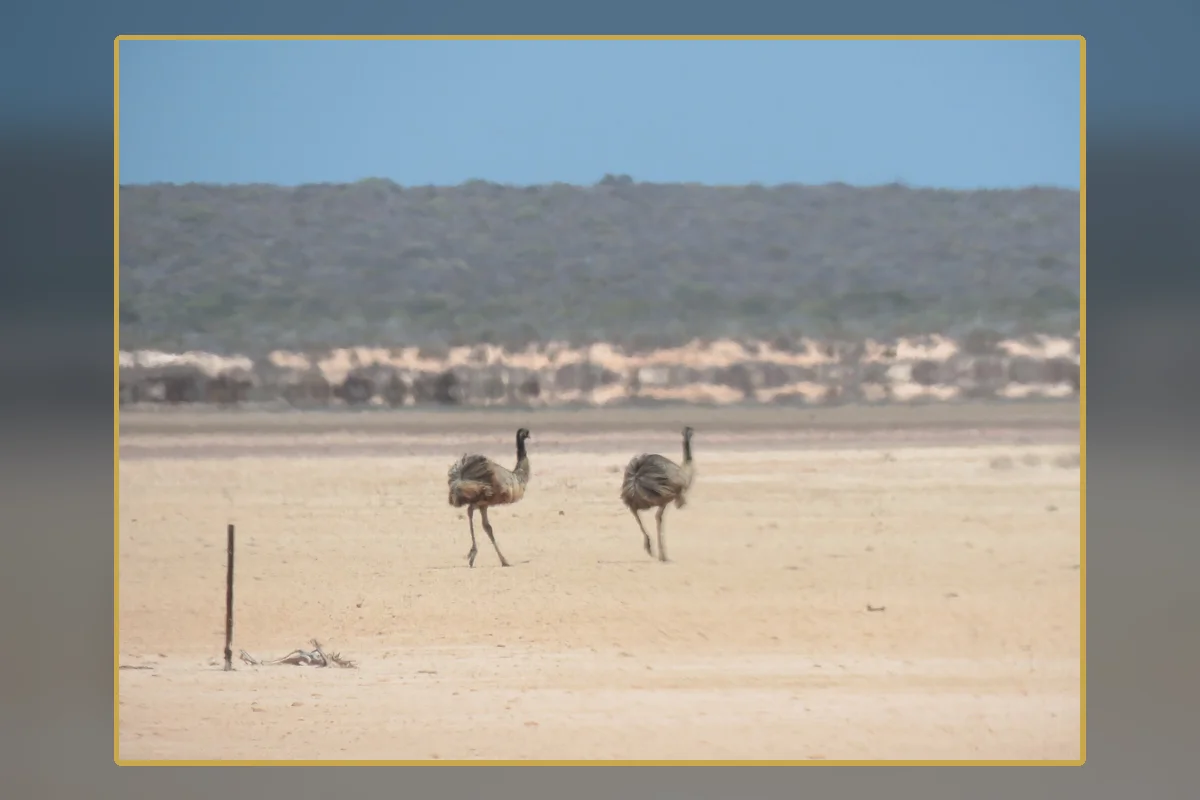
Large groups of migrating emus moved through the district after breeding, finding crops and water. They damaged wheat and opened fences that also admitted rabbits. Farmers who had served in the military asked the federal government for machine guns, framing the birds as an enemy that ordinary methods could not contain.
Two guns meet a moving landscape
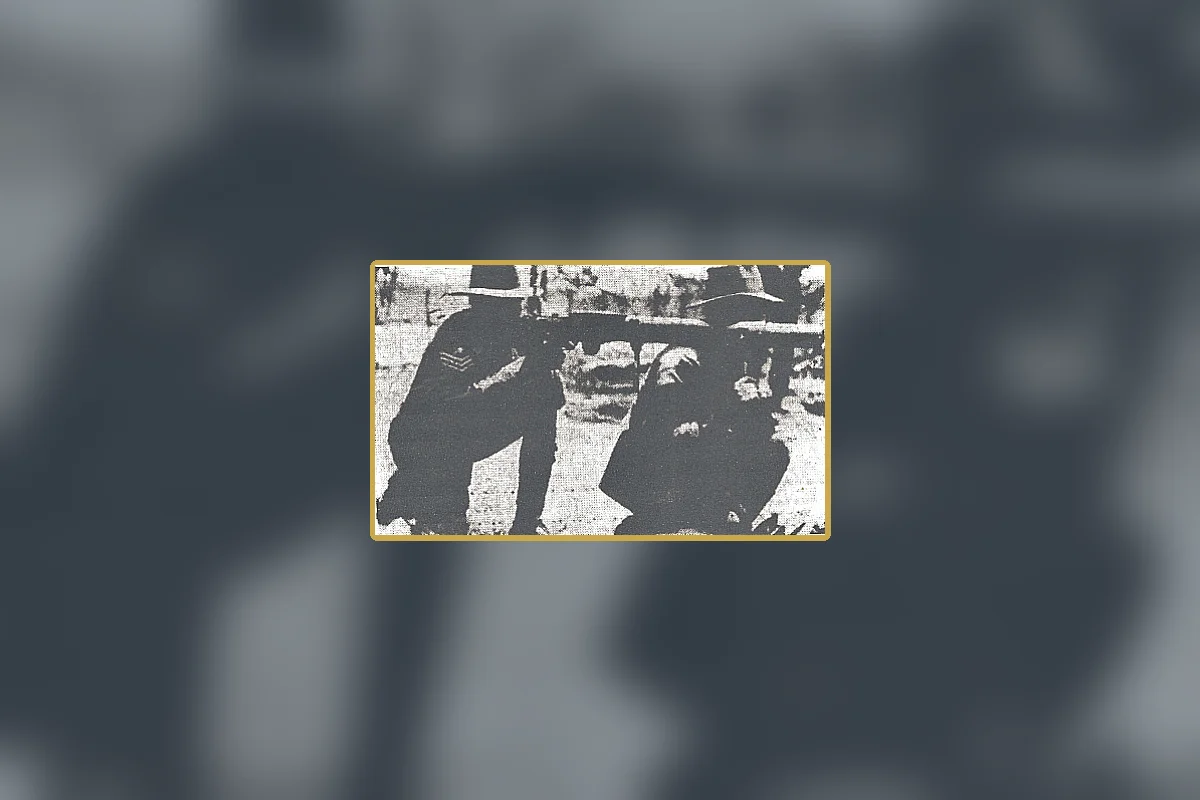
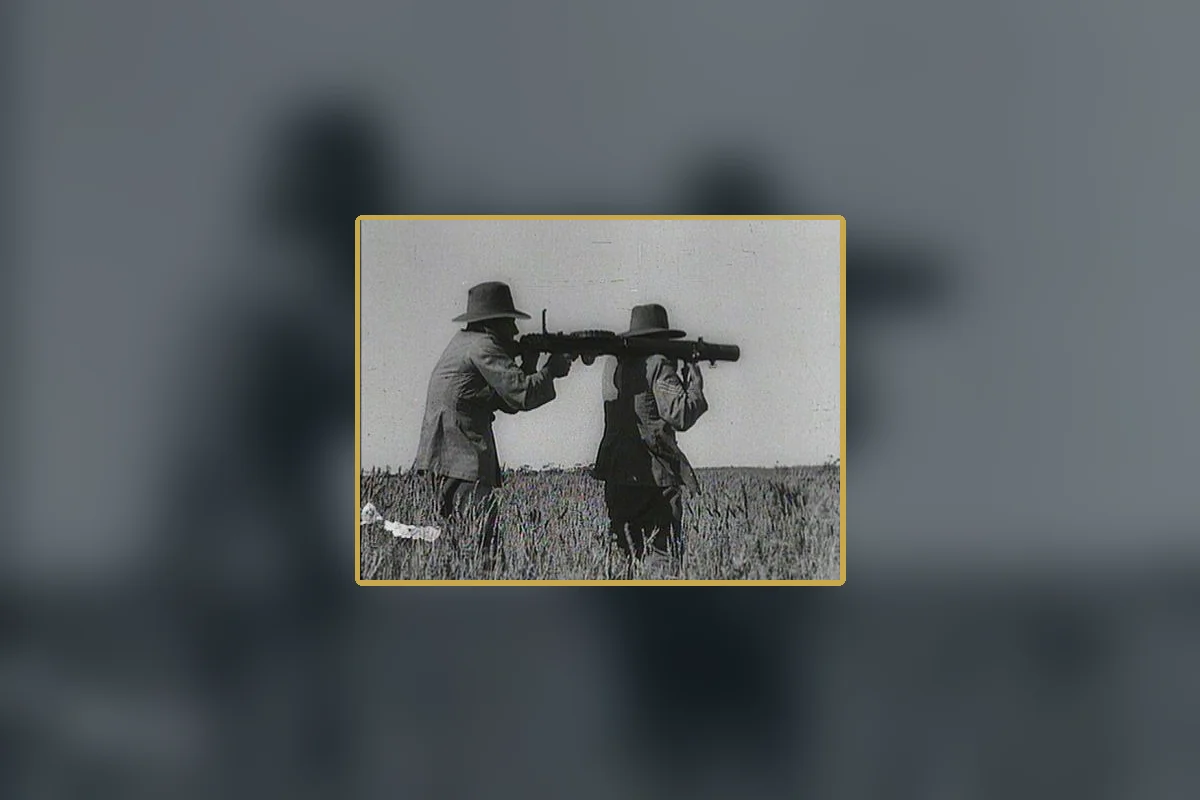
Defence Minister George Pearce approved a small deployment under Major Meredith. The soldiers brought two Lewis guns and ammunition, while farmers supplied transport and support. Rain delayed the start. When firing began, emus scattered into small, fast groups, making sustained fire and accurate range difficult.
Attempts to herd birds toward an ambush failed. One gun jammed during a promising engagement. Mounting a weapon on a truck produced a vehicle that bounced too violently to aim while the emus outran or outmaneuvered it. Newspaper reports turned the mismatch into irresistible military comedy.
Counting birds and bullets
Reports of the number killed vary by period and source. Meredith's final accounting claimed just under 1,000 confirmed kills from nearly 10,000 rounds, with additional birds expected to die from wounds. Earlier ratios looked worse, and public criticism forced a temporary withdrawal before operations briefly resumed.
The figures do not describe a conventional battle. Emus did not attack a defended position or strategically defeat troops; they dispersed across terrain for which concentrated automatic fire was poorly suited. The operation failed as efficient pest control and was discontinued in December.
How newspapers invented a war
Journalists applied military language from the beginning: campaigns, enemy tactics, casualties, and reports that each flock seemed to have a lookout. Meredith himself compared the birds' maneuverability and endurance to an army. Humor was a way to criticize public spending and administrative judgment.
The nickname survived because it compresses policy failure into a simple reversal: a modern military loses to birds. Today's meme exaggerates the event into a national war, sometimes claiming the government surrendered. In reality, a tiny detachment conducted a cull within a long-running agricultural conflict.
What replaced the machine guns
Farmers continued requesting military help, but later proposals were refused. A bounty system rewarded destruction of emus, and barrier fencing became a more durable—if expensive and ecologically consequential—method. The state moved from spectacle toward routine wildlife management.
None of those policies erased the underlying tension between agriculture and animal migration. Fences alter ecosystems, bounties distribute killing, and crop expansion changes access to food and water. The 'war' was one episode in a larger contest over how humans reorganized the wheat belt.

The joke and the archive
It is fair to say the emus defeated the tactical premise: machine guns could not efficiently solve a dispersed wildlife problem. It is misleading to treat the birds as combatants or the episode as proof that Australia declared a formal war. The operation's absurdity does not need inflation.
Reading past the joke recovers the people who asked for help. Veterans faced debt and crop loss during the Depression; officials chose a militarized demonstration; journalists exposed its weakness through satire. The birds became the most memorable actors because they were the only participants untouched by the press coverage.
What the record supports—and what it does not
Australia did not formally declare war on emus, and the birds did not compel a national surrender. A small military detachment conducted an inefficient cull for several weeks. Calling it a 'war' began as contemporary satire and remains a useful joke only if the farming crisis and policy failure stay visible.
Evidence ledger
- CRISIS — Veterans, debt, and damaged wheat: Emu migration struck farms already weakened by drought and Depression-era prices.
- FORCE — Two Lewis guns: Major Meredith led a very small detachment, not an army-sized campaign.
- TACTICS — The targets scattered: Fast birds in small groups neutralized concentrated machine-gun fire.
- RESULT — Nearly 10,000 rounds: The final report claimed under 1,000 confirmed kills before the operation ended.
- MYTH CHECK — No formal war or surrender: The label was contemporary satire for an ineffective pest-control mission.
- POLICY — Bounties and fences followed: Less theatrical methods continued the larger conflict over crops and wildlife.
How this reconstruction was built
Government files and contemporary newspapers document the deployment, ammunition, reported kills, criticism, and withdrawal. The word 'war' belongs to the period's satirical coverage, but the internet later made it sound formal. Kill totals vary by report and phase, so ratios should be labeled rather than polished into one perfect score. The consistent conclusion is tactical mismatch: concentrated fire was inefficient against fast, dispersed wildlife.
To audit the account, open the source links below and compare dates, quantities, and the wording used by the institutions themselves. Look for the earliest recoverable record, then distinguish it from later summaries created after the story became famous. The five visuals in this article are archival photographs, maps, documents, objects, or clearly identified editorial diagrams selected to illuminate the surviving record. Each caption identifies its source and rights information; no reconstruction is presented as a historical photograph. That transparency is part of the Lore & Archive method.
Why this story matters
The episode shows how a meme can preserve a real event while stripping away scale and cause. The archive makes it funnier and more serious at once: military tools were genuinely deployed, and they were genuinely mismatched to the problem.
Continue in the archive
- Codex Gigas: The Giant Medieval Book Behind the Devil's Bible Legend
- Inside the Greenbrier Bunker: Congress's Secret Cold War Refuge
- Lake Nyos and the Invisible Cloud
Sources and further reading
- National Archives of Australia — Environmental issues and the Emu War
- National Library of Australia Trove — Contemporary newspaper page
Editorial note: Lore & Archive distinguishes contemporary evidence, later institutional synthesis, and unresolved inference. Where sources disagree or the record is incomplete, the uncertainty is stated rather than converted into a dramatic fact.