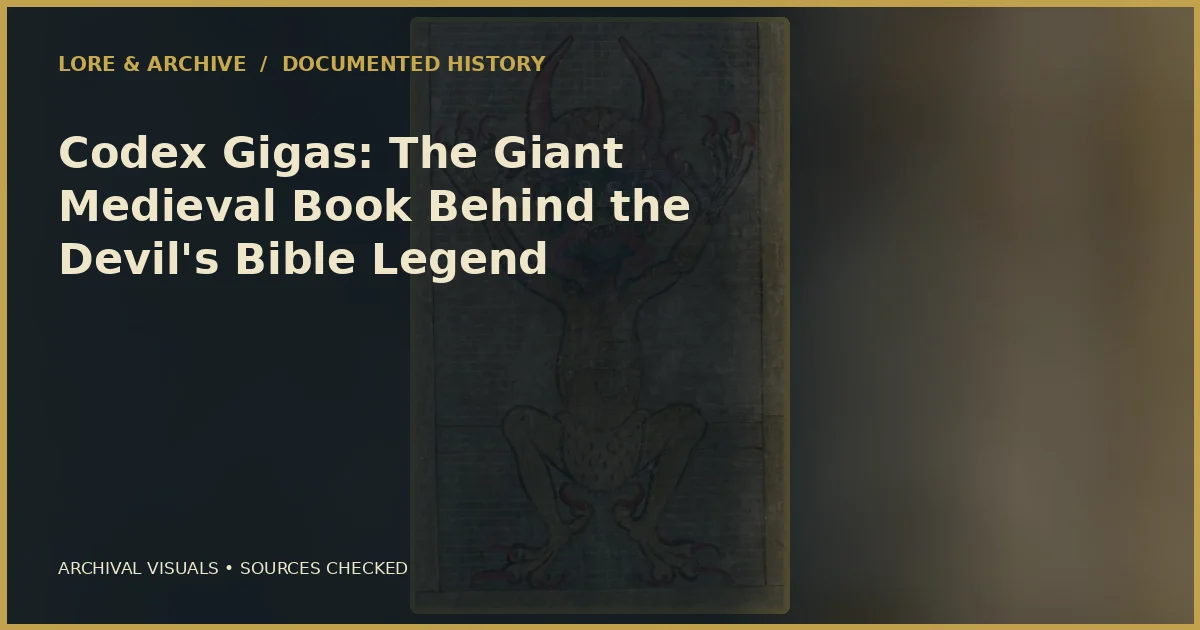
A book this large invites an equally large story. The surviving pages show remarkable consistency, but handwriting analysis and missing leaves point toward sustained human labor—not a supernatural bargain.
Archive record
- Created: Bohemia, approximately 1204–1230
- Size: about 89 cm tall
- Weight: about 75 kg
- Surviving leaves: 310 parchment folios
A library compressed into one volume
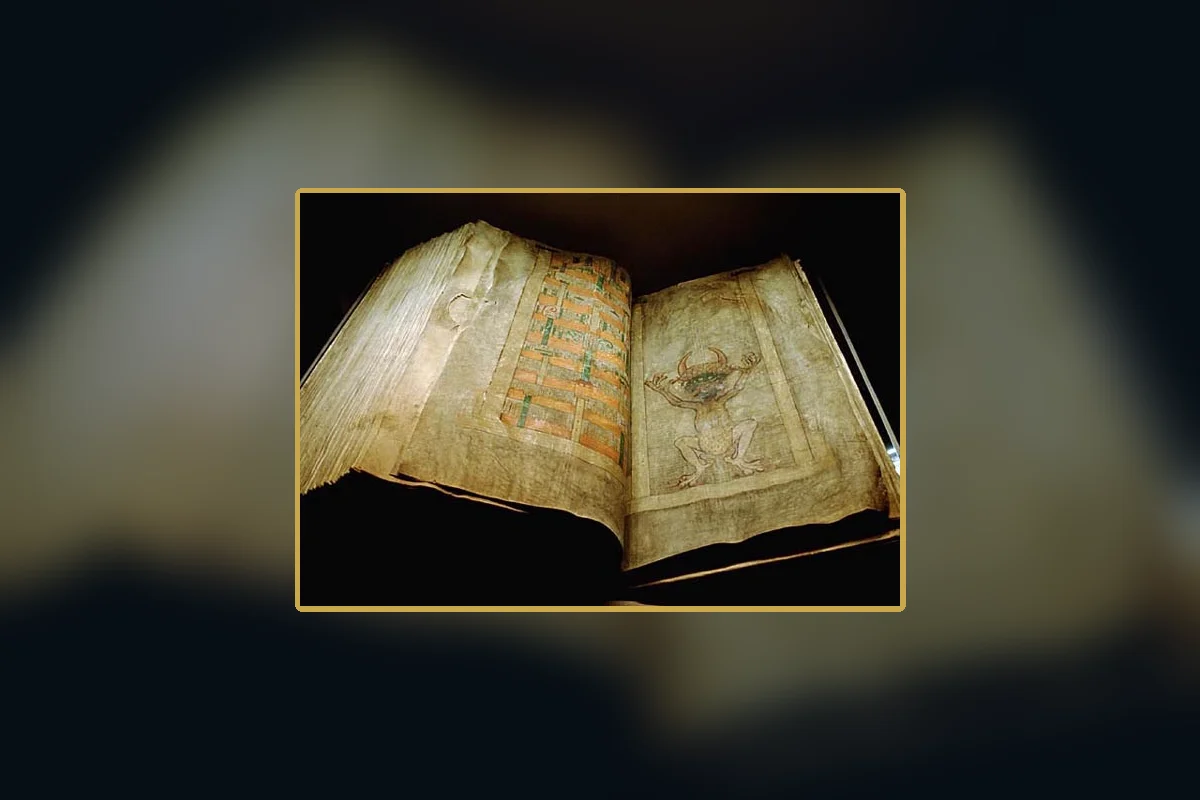
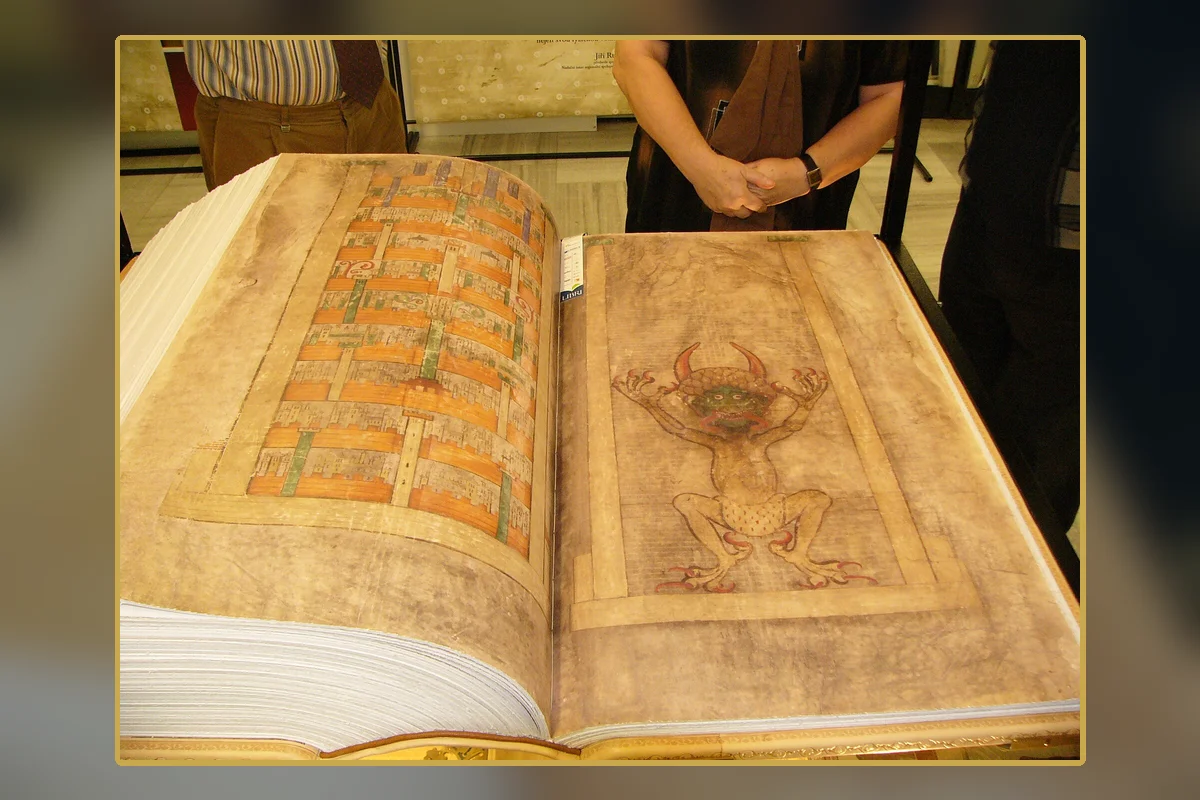
Codex Gigas means 'giant book,' and the name is literal. The manuscript is the largest surviving medieval codex by physical dimensions. Its hundreds of parchment leaves required skins from many animals, a major material investment before a scribe wrote a word.
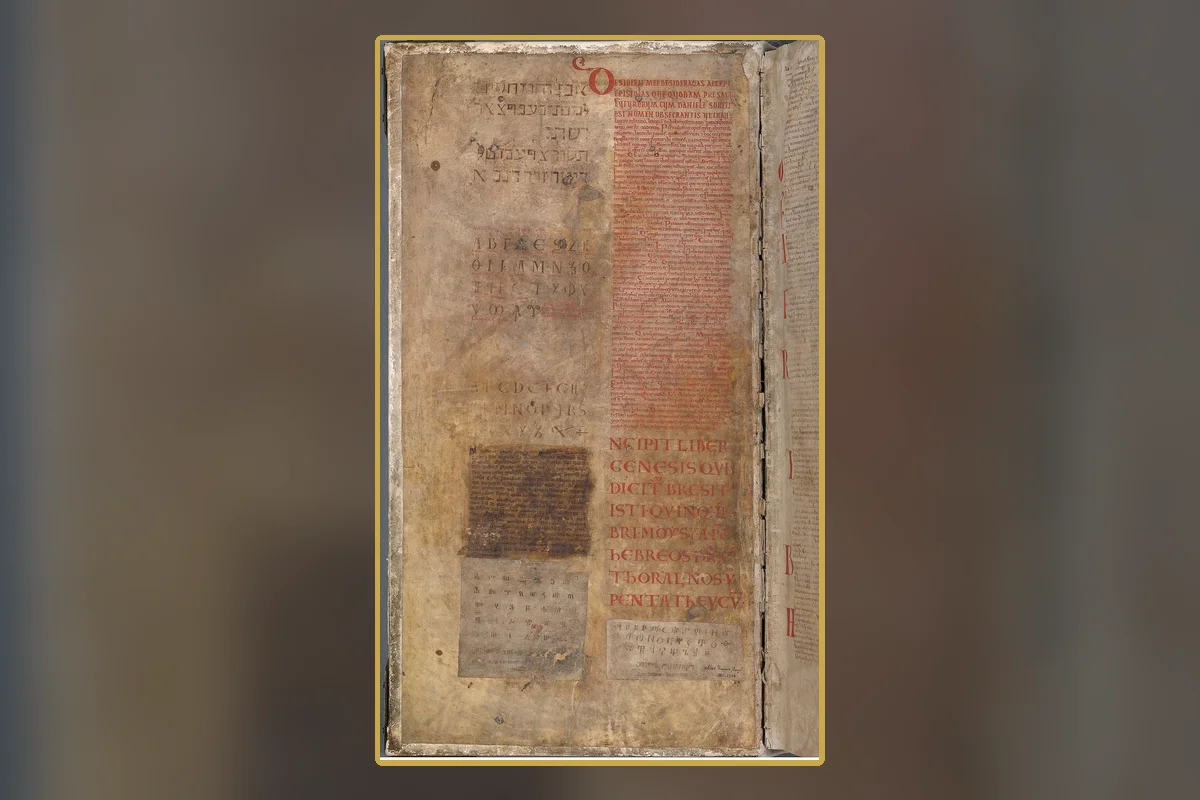
The contents extend beyond a Bible. They include historical works by Josephus, Isidore of Seville's encyclopedia, a chronicle of Bohemia, medical texts, calendars, penitential material, and formulas associated with magic or exorcism. The book assembled a working library rather than one continuous composition.
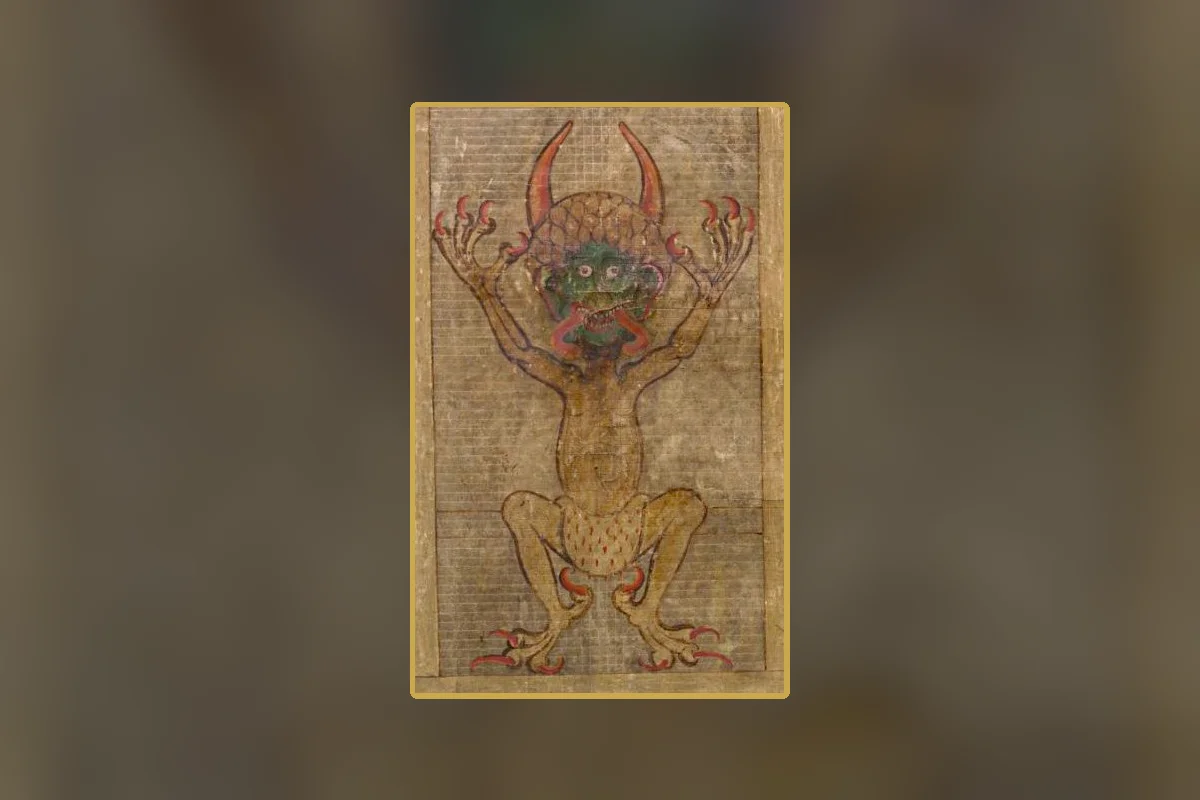
The Devil facing the heavenly city
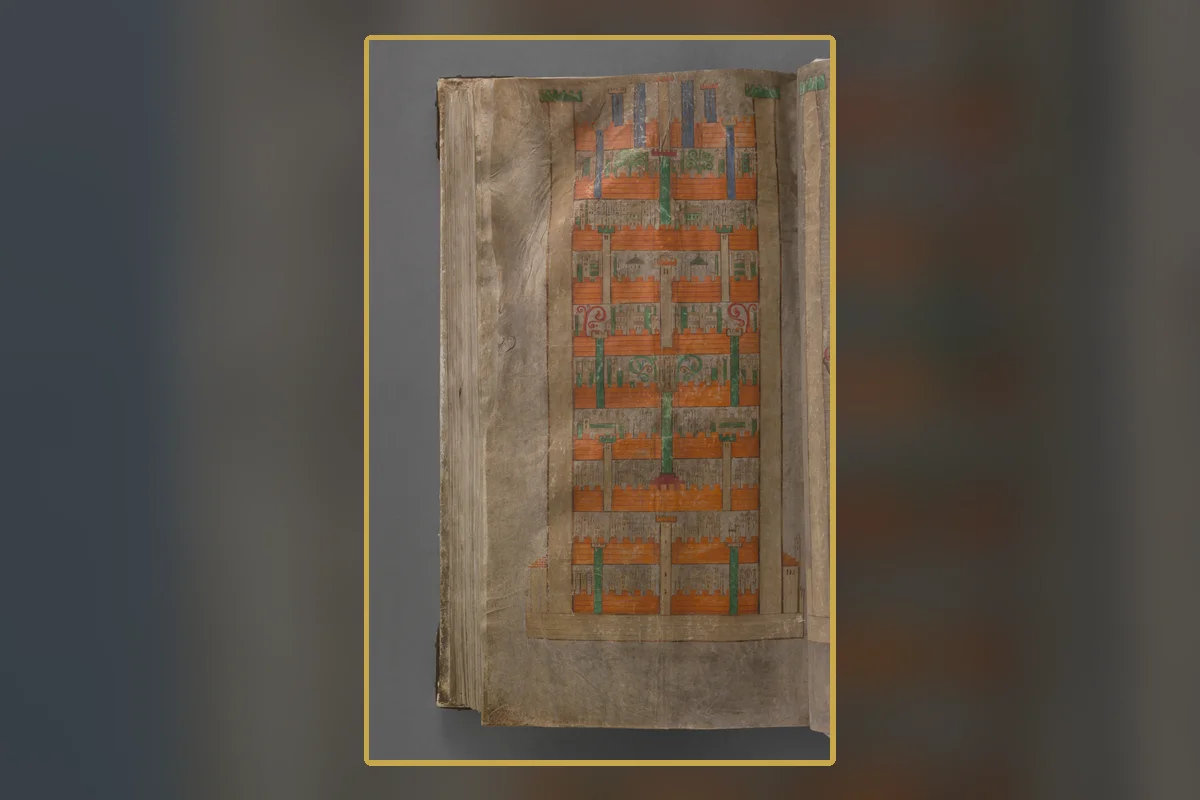
Near the center, two full-page images confront each other: the Heavenly City and a large frontal Devil. The Devil crouches alone against a dark field, with horns, claws, and an ermine-like garment. Empty margins intensify the figure because most medieval manuscript pages are crowded with text or decoration.
The portrait generated the nickname 'Devil's Bible,' but a depiction of evil inside a religious manuscript is not evidence of devotion to it. The opposing heavenly image and nearby texts place the figure within a moral and penitential structure. Medieval readers encountered warning, cosmology, history, and medicine in the same object.
Could one person have written it?
Paleographic analysis finds striking consistency across the manuscript, making a single principal scribe plausible. The letterforms, spacing, and overall execution change less than we might expect across such a vast project. Consistency, however, does not mean completion in a single burst.
Estimates based on writing, ruling, decoration, and parchment preparation suggest years or decades of labor. A scribe could maintain a trained hand over a career. The manuscript's scale is evidence of persistence and institutional support, not superhuman speed.
The monk's impossible bargain
Legend says a monk broke his vows and was sentenced to be walled alive. To escape, he promised to make a book containing all human knowledge in one night. Near midnight, realizing the task was impossible, he summoned the Devil, traded his soul for help, and painted the portrait in gratitude.
No contemporary record verifies the punishment or pact. The legend explains scale through miracle because ordinary labor feels insufficiently dramatic. Yet the material evidence—careful ruling, consistent ink, multiple textual units, and long production time—points back to a workshop and sustained copying.
War, theft, and a missing section
The codex moved among Bohemian monasteries and entered Emperor Rudolf II's collection in Prague. During the Thirty Years' War, Swedish forces took it as booty in 1648 and carried it to Stockholm, where the National Library of Sweden now preserves it.
Several leaves are missing, including material believed to have contained a monastic rule. Their removal has inspired speculation that a forbidden secret was cut out. There is no evidence for that dramatic claim. Missing pages in old books can result from censorship, reuse, damage, collecting, or practical decisions that leave no explanatory note.
What the giant book actually proves
Codex Gigas is extraordinary without supernatural authorship. It preserves choices about which texts belonged together, how knowledge was organized, and how a community invested labor and animals into one monumental object. Its biography also records war and royal collecting.
Digital access now lets readers inspect every surviving page without moving a 75-kilogram volume. Magnification makes the evidence against the one-night story visible: page after page of planned, ruled, patient work. The Devil is the manuscript's most famous image, but endurance is its true marvel.
What the record supports—and what it does not
Codex Gigas was not written in one night and contains no evidence of a pact with the Devil. A consistent hand may indicate one principal scribe, but the physical preparation and writing required years. The full-page Devil belongs to a broader Christian moral program opposite the Heavenly City.
Evidence ledger
- SCALE — About 75 kilograms: The largest preserved medieval manuscript stands nearly 90 centimeters tall.
- MATERIAL — 310 parchment leaves survive: Producing the writing surface alone required an extraordinary investment.
- CONTENTS — A library, not only a Bible: History, medicine, calendars, and formulas share the giant volume.
- IMAGE — The Devil faces a heavenly city: The famous portrait belongs to a moral contrast, not proof of worship.
- MYTH CHECK — One hand does not mean one night: Consistency can reflect a trained scribe working for years.
- JOURNEY — Bohemia to Stockholm: Swedish forces took the codex from Prague in 1648 during the Thirty Years' War.
How this reconstruction was built
The manuscript itself is the decisive source: parchment, ruling, ink, handwriting, contents, missing leaves, and the relationship between the Devil and Heavenly City pages. Its ownership trail is supported by library and wartime history. The one-night legend explains none of those material features and has no contemporary corroboration. A consistent principal hand supports sustained authorship, not impossible speed. High-resolution digitization lets readers inspect that patient consistency directly rather than depending on the nickname.
To audit the account, open the source links below and compare dates, quantities, and the wording used by the institutions themselves. Look for the earliest recoverable record, then distinguish it from later summaries created after the story became famous. The five visuals in this article are archival photographs, maps, documents, objects, or clearly identified editorial diagrams selected to illuminate the surviving record. Each caption identifies its source and rights information; no reconstruction is presented as a historical photograph. That transparency is part of the Lore & Archive method.
Why this story matters
The legend replaces invisible labor with a supernatural shortcut. Looking closely restores the more impressive achievement: sustained medieval craftsmanship at a scale almost unmatched among surviving books.
Continue in the archive
- The Great Moon Hoax: How a Newspaper Filled the Moon With Bat-People
- The Bermuda Triangle: How a Bestseller Turned Busy Waters Into a Mystery Zone
- The Voynich Manuscript: What Is Known
Sources and further reading
Editorial note: Lore & Archive distinguishes contemporary evidence, later institutional synthesis, and unresolved inference. Where sources disagree or the record is incomplete, the uncertainty is stated rather than converted into a dramatic fact.