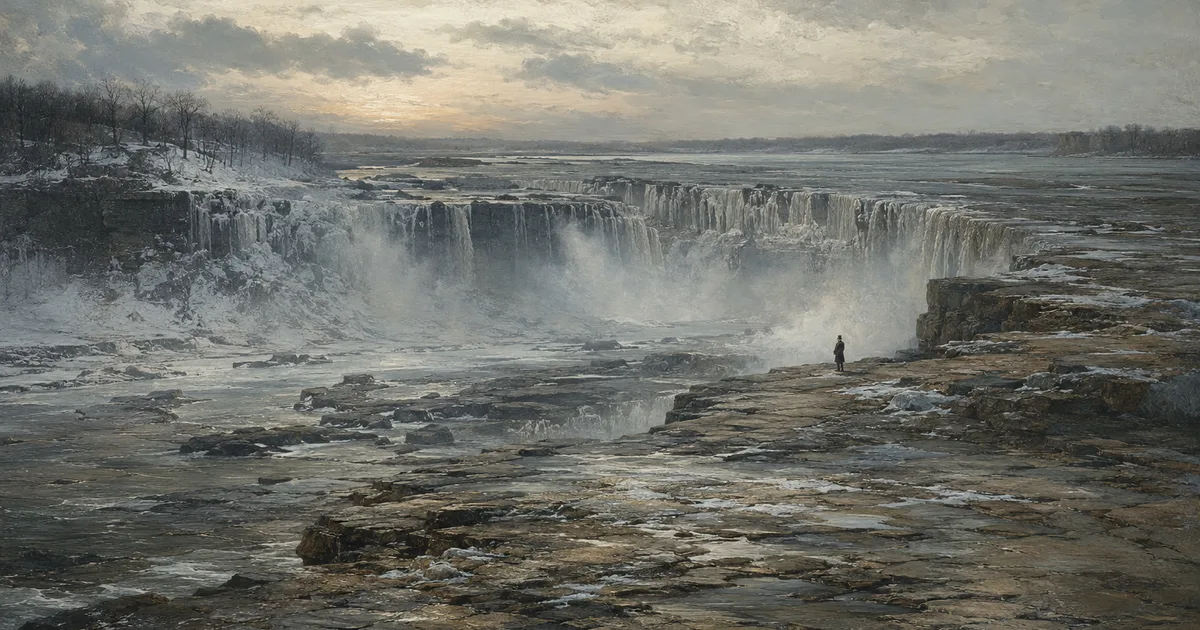
The first warning was not a crash, a tremor, or a shout. It was the absence of a sound that people living along the Niagara River had heard every day of their lives. In late March 1848, the immense, continuous roar of Niagara Falls weakened—and then, for roughly 30 hours, nearly disappeared.
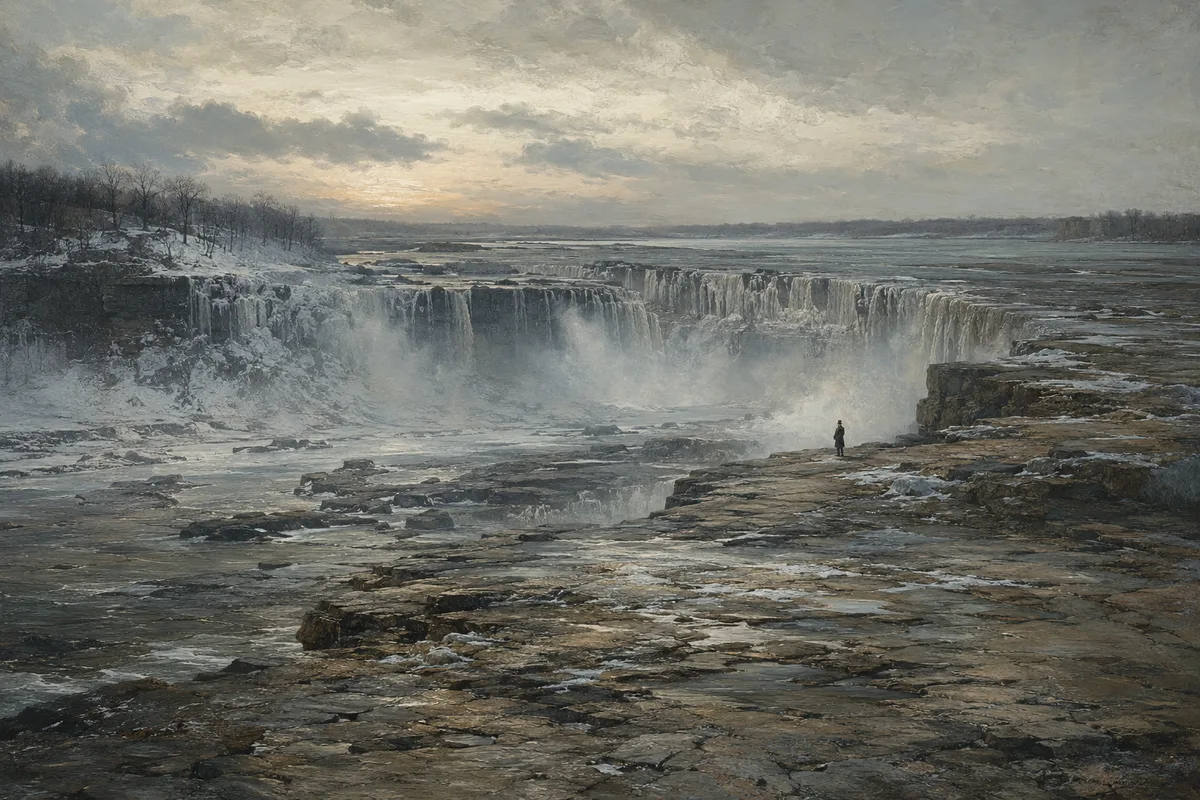
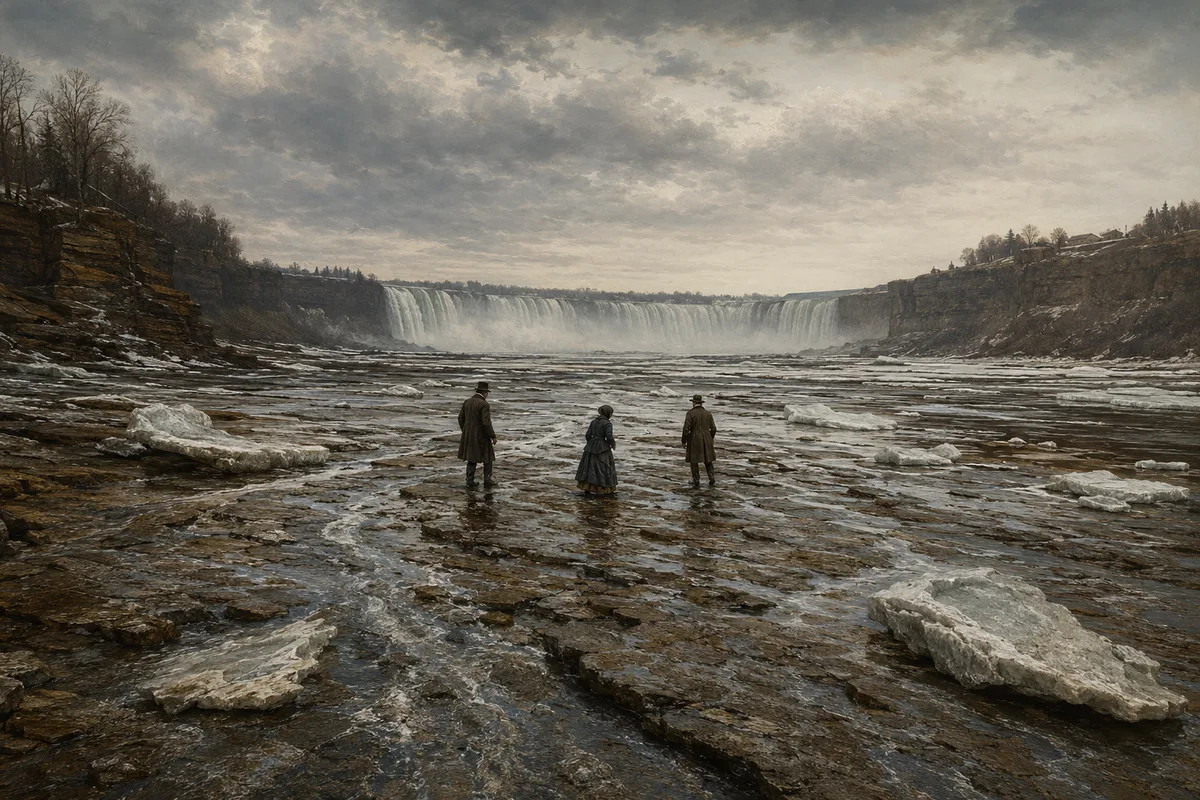
What followed looked impossible. Mills lost their water power. The river above the falls shrank dramatically. Portions of the riverbed emerged into daylight, and people ventured onto ground that normally lay beneath a fast-moving international river. Yet the falls had not frozen solid. The real obstruction was miles upstream, where wind and lake ice had briefly closed the river at its source.
The archive record
- When: The night of March 29–30 through March 31, 1848
- What happened: The Niagara River’s flow fell to a trickle for about 30 hours
- Cause: Wind-driven ice formed a temporary dam at the outlet of Lake Erie
- What did not happen: The waterfall itself did not simply freeze from top to bottom
- Why it is unlikely today: A floating ice boom has helped control lake ice near the river’s entrance since 1964
A waterfall begins far upstream
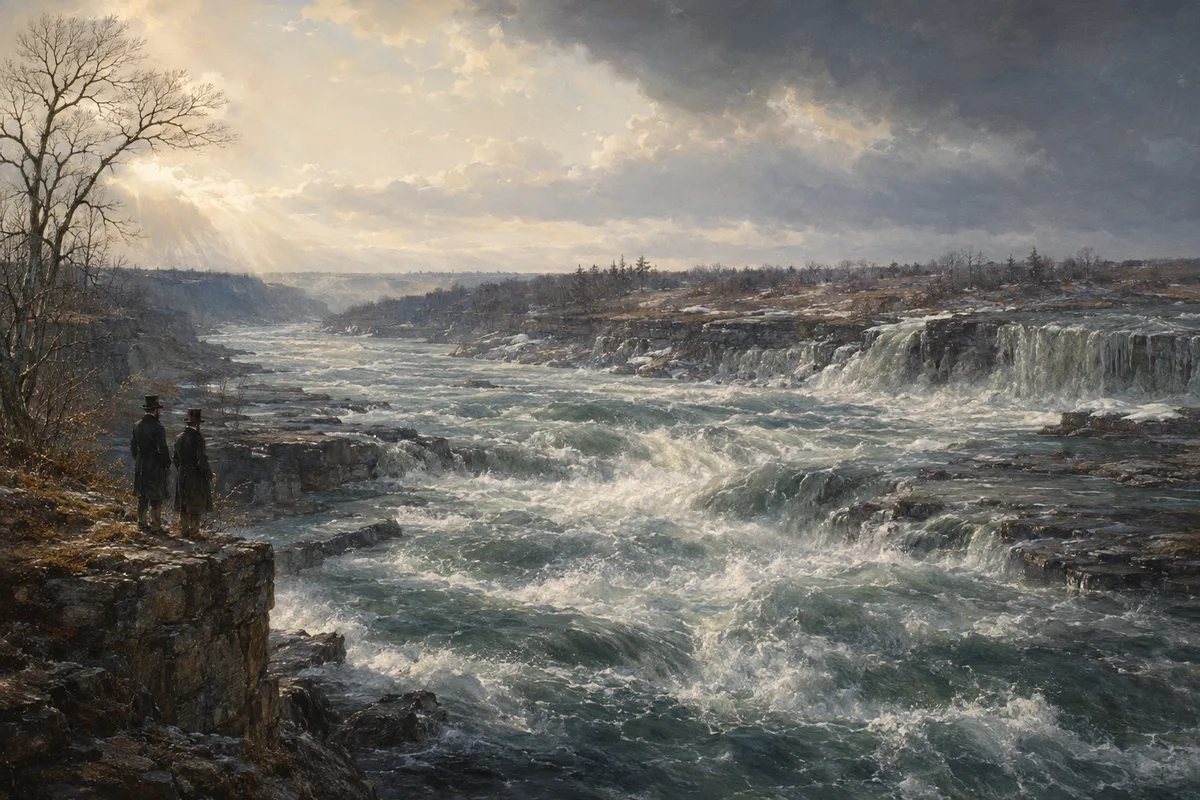
To understand how Niagara could fall silent, it helps to look away from the cliff. The Niagara River carries water from Lake Erie northward to Lake Ontario. The famous drop is only one dramatic stage in that journey. If the entrance to the river is obstructed near Buffalo and Fort Erie, the effect travels downstream.
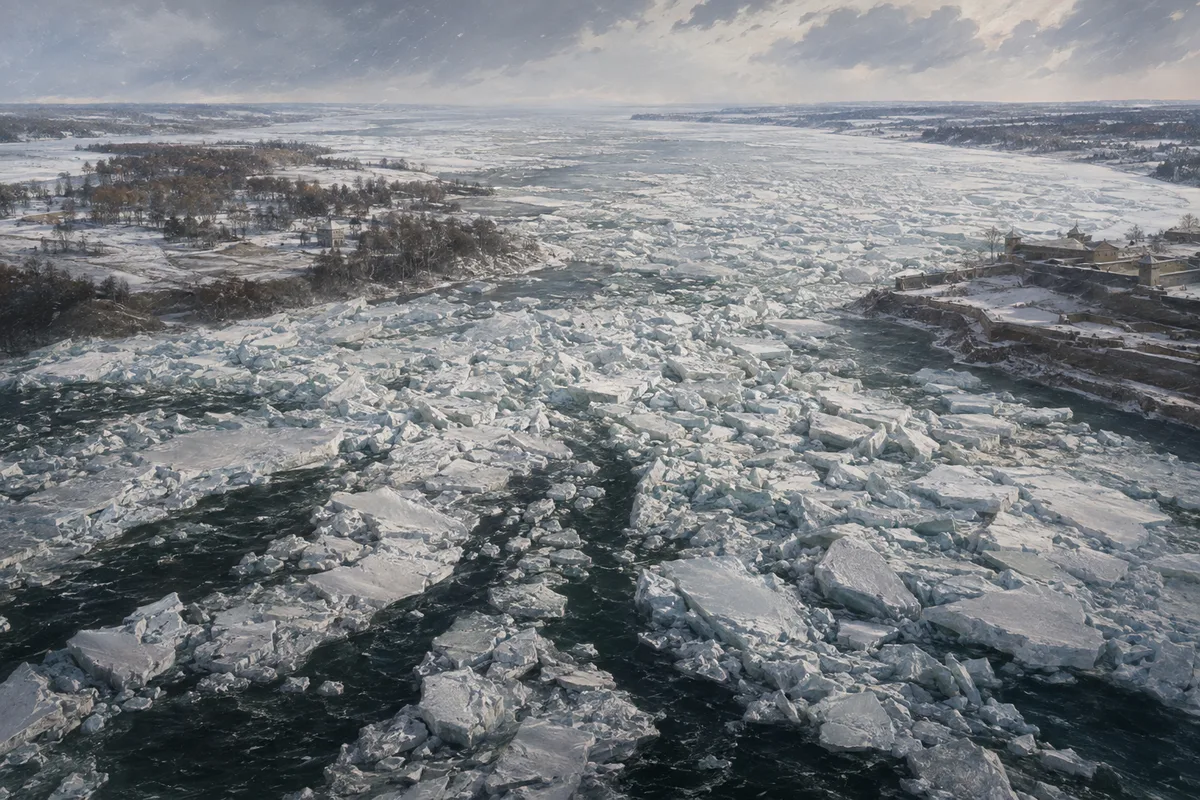
Winters on Lake Erie can produce enormous fields of floating ice. In the era before modern ice-control structures, strong winds could drive that ice toward the lake’s northeastern outlet. Usually, pieces continued into the Niagara River. In March 1848, however, a powerful wind shifted a vast mass of lake ice into the narrowing channel and packed it tightly enough to behave like a temporary dam.
The exact hour-by-hour sequence is difficult to reconstruct. Contemporary reporting did not produce the kind of instrument record we would expect today, and later retellings often turn estimates into precise timestamps. What the historical accounts consistently preserve is the central event: around March 29 and 30, the river fell drastically, remained abnormally low for approximately 30 hours, and returned when the ice blockage gave way.
When the roar vanished
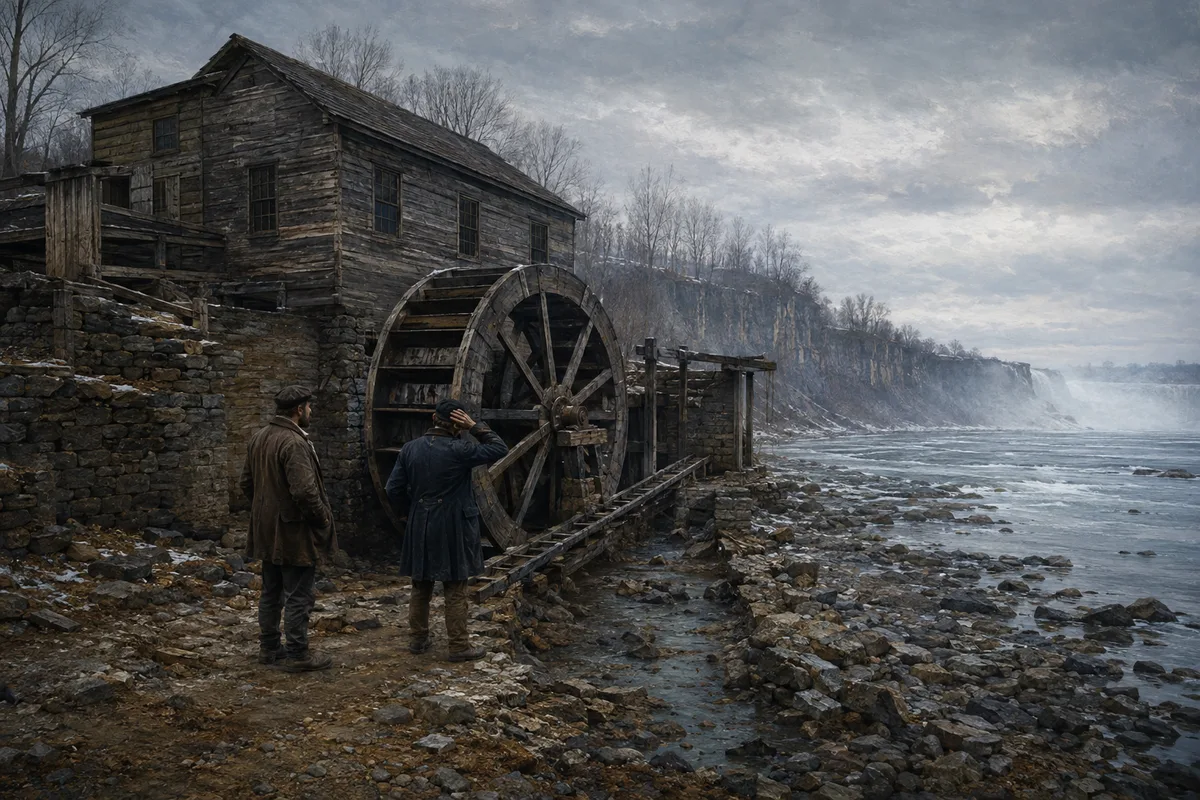
For communities built around the river, the silence was more than eerie. Water powered mills and other machinery along the channel. As the current weakened, work stopped. At the falls, the familiar moving curtain became scattered streams and exposed rock. The absence of the roar made the landscape feel wrong before anyone nearby understood the cause.
Reports describe residents entering sections of the uncovered basin on foot and horseback. Such accounts should not be read as proof that every channel was dry or that the entire river became safe to cross. Niagara is divided by islands and multiple channels, and a greatly reduced flow can expose broad areas while water continues elsewhere. The return of the river was also unpredictable, which made any exploration hazardous.
Niagara’s strangest silence was caused not at the falls, but at the place where a Great Lake narrows into a river.
News from Buffalo eventually supplied the explanation. Ice had crowded the head of the river. Niagara Parks describes high winds moving Lake Erie’s ice fields until millions of tons lodged at the river’s source. Once that blockage became known, the uncanny scene had a physical cause—but no one standing on the exposed riverbed could know precisely when the dam would fail.
The river comes back
A temporary ice dam is not a stable wall. Water continues pressing against it, while wind, temperature, and the motion of the lake rearrange the mass. Late on March 31, the jam loosened. The Niagara River began reclaiming its channel, and the falls recovered their voice.
Later versions sometimes describe a single towering wall of water racing toward unsuspecting crowds. The safer conclusion is less cinematic: flow returned as the obstruction released, and the river rose back toward normal. The spectacle was still dangerous. The people who had crossed onto exposed ground were betting that a natural dam they could not see would hold.
Did Niagara Falls actually freeze?
Not in the way the phrase usually suggests. Mist and surface water routinely form spectacular ice around the falls during severe winters. Photographs can make the cascades appear locked in place even while tremendous volumes of water continue beneath or behind the ice.
The 1848 stoppage was different. The primary cause was an upstream ice jam that sharply reduced the water entering the Niagara River. Cold weather helped create the ice, but the falls did not simply solidify because the air temperature dropped. This distinction matters because “the falls froze” is an irresistible caption—and an incomplete explanation.
The other time people “turned off” Niagara
Another famous dry-Niagara image comes from 1969, but it records a separate event. Engineers built a cofferdam above the American Falls and diverted that channel’s water toward the Horseshoe Falls. The goal was to study erosion and the enormous pile of fallen rock at the American Falls’ base. For months, visitors saw a deliberately dewatered American Falls while the larger Horseshoe Falls continued flowing.
The comparison helps sort three different phenomena that are often blended online:
- Winter ice formations: the falls look frozen, but water continues to move.
- The 1848 natural stoppage: lake ice blocked the river’s source for roughly 30 hours.
- The 1969 engineering project: the American Falls were intentionally dewatered while the Horseshoe Falls remained active.
Why a repeat is far less likely
Beginning in 1964, authorities began installing a seasonal ice boom across the outlet of Lake Erie between Buffalo and Fort Erie. The structure uses floating steel pontoons to restrain large fields of ice while allowing water to pass. It does not eliminate ice from the river, but it reduces the kind of damaging movement that once threatened bridges, power facilities, shorelines—and, in 1848, the river’s flow itself.
That engineering detail gives the story a revealing ending. Niagara did not become more dependable because nature changed. It became more manageable because people learned where the system was vulnerable.
Why the silence still matters
Niagara Falls feels permanent because its scale overwhelms a human lifetime. The 1848 ice jam exposed that permanence as an illusion. A change at the edge of Lake Erie transformed a landscape many miles downstream, stopped machinery, redrew the riverbed, and erased one of North America’s loudest natural sounds.
The responsible version of the story needs no embellishment. Niagara nearly stopped. People walked where the river normally ran. Then an unseen barrier of ice failed, and the water returned. For approximately 30 hours, an entire region discovered how unsettling the world can become when a familiar sound disappears.
Continue in the archive
- Lake Nyos: The Night an Invisible Cloud Killed More Than 1,700 People
- The Great Molasses Flood Was a Preventable Industrial Disaster
- The Day the BBC Decided There Was No News
Sources and further reading
- Niagara Parks, “The Frozen Falls”
- Niagara Falls USA, facts and historical overview
- Niagara Falls USA, the 1969 dewatering of the American Falls
- Library of Congress, historic images of frozen Niagara
Editorial note: Contemporary records do not establish a perfectly precise timeline for every stage of the 1848 stoppage. Approximate durations and dates are identified as such, and later folklore is not presented as eyewitness fact.