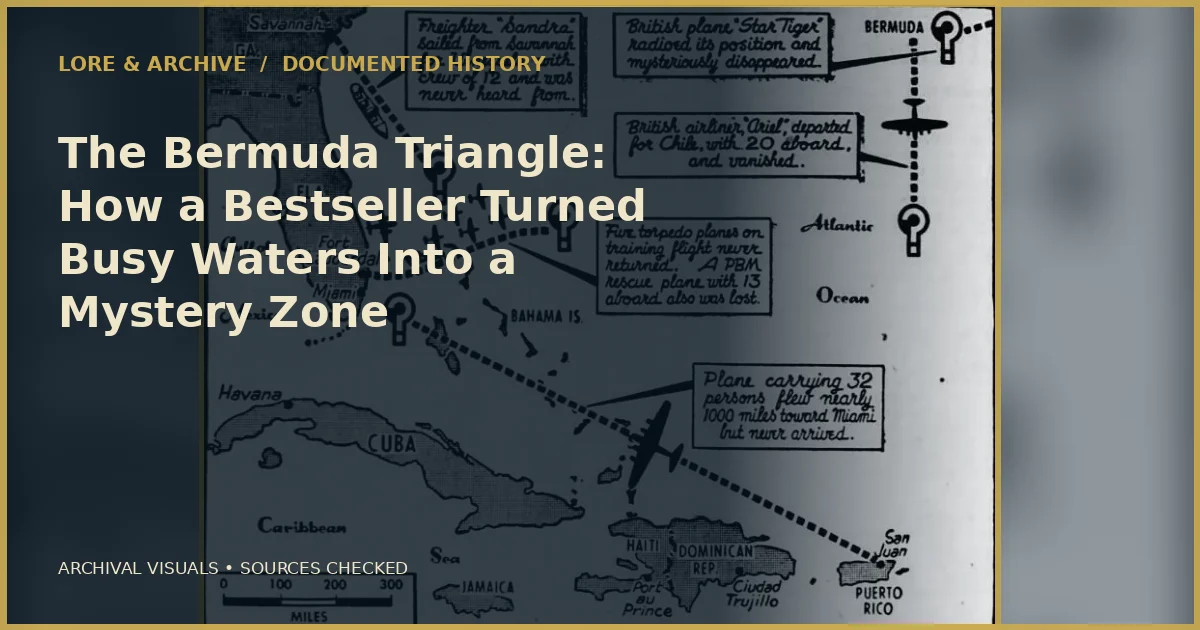
Ships and aircraft have genuinely disappeared in the western North Atlantic. The unsupported leap is that their losses form one anomalous phenomenon caused by a place with fixed borders.
Archive record
- Popular vertices: Miami, Bermuda, and Puerto Rico
- Official boundary: none
- Government assessment: no recognized special hazard
- Most famous case: disappearance of Flight 19 on December 5, 1945
Drawing a shape after the losses
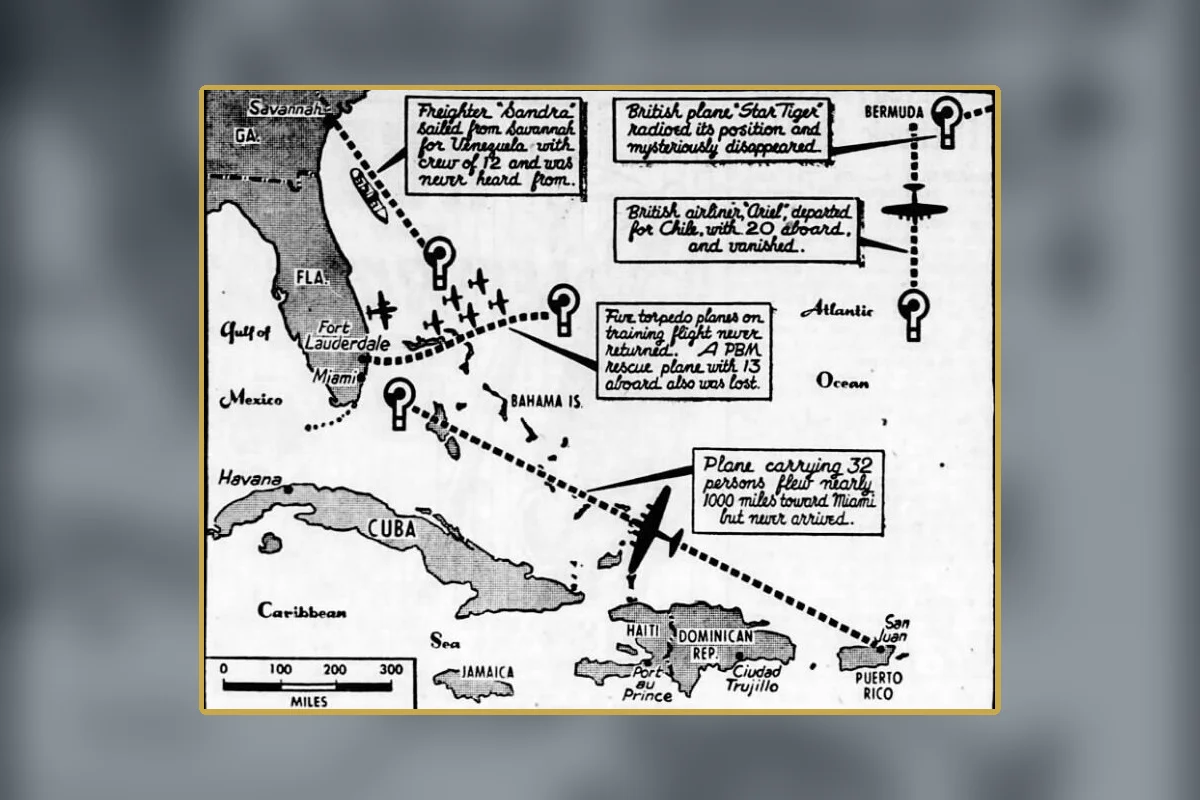
The Bermuda Triangle is usually drawn between Florida, Bermuda, and Puerto Rico, but maps vary widely. Some writers stretch the region to include cases that serve a narrative. The name gained currency in the 1960s, and Charles Berlitz's 1974 bestseller made it a global brand.
A flexible border creates a statistical problem. If the zone expands to capture disappearances and contracts when calculating traffic, almost any loss can become evidence. Neither the U.S. Coast Guard nor the Navy recognizes the Triangle as an official geographic area of unusual danger.
Flight 19: five aircraft become a symbol
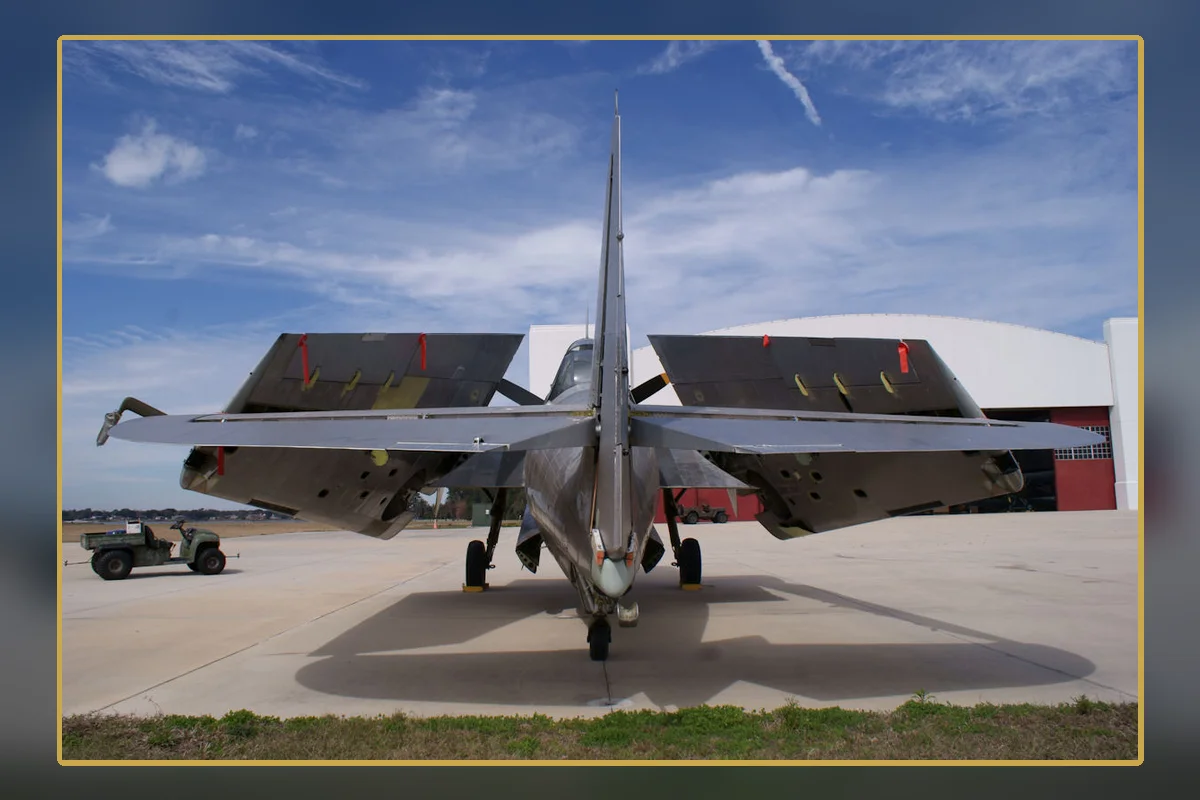
On December 5, 1945, five TBM Avenger torpedo bombers left Fort Lauderdale on a routine navigation-training flight. Radio transmissions showed growing uncertainty about position and compass readings. Weather worsened, daylight faded, and the flight leader appears to have mistaken islands or coastlines while trying to orient the group.
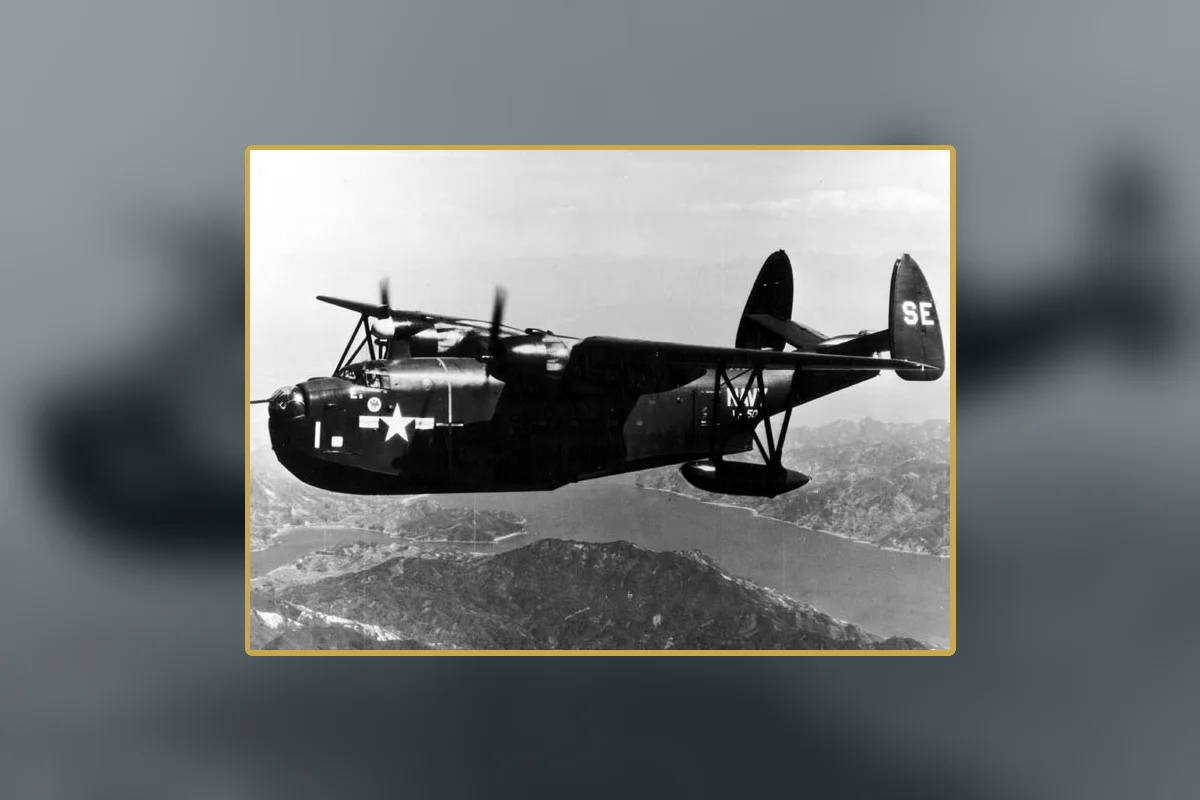
Fuel eventually would have forced the aircraft down. A PBM Mariner sent to search also disappeared; a nearby ship reported an airborne explosion, consistent with the type's known fuel-vapor risk. No confirmed wreckage from Flight 19 has been recovered, leaving exact flight paths debated.
The version that removes navigation
Popular retellings sometimes present seasoned pilots whose instruments all failed over calm water before they vanished mid-sentence. The record is less clean. The flight included trainees, the leader was unfamiliar with the local route, radio reception was imperfect, and reported directions changed. The weather and sea state deteriorated.
None of those facts makes the crews' deaths less tragic. They make the event comprehensible as a cascading navigation emergency. Once the leader believed he was over the Florida Keys rather than east of the peninsula, attempts to reach land could carry the flight farther over open ocean.
How case lists manufacture a pattern
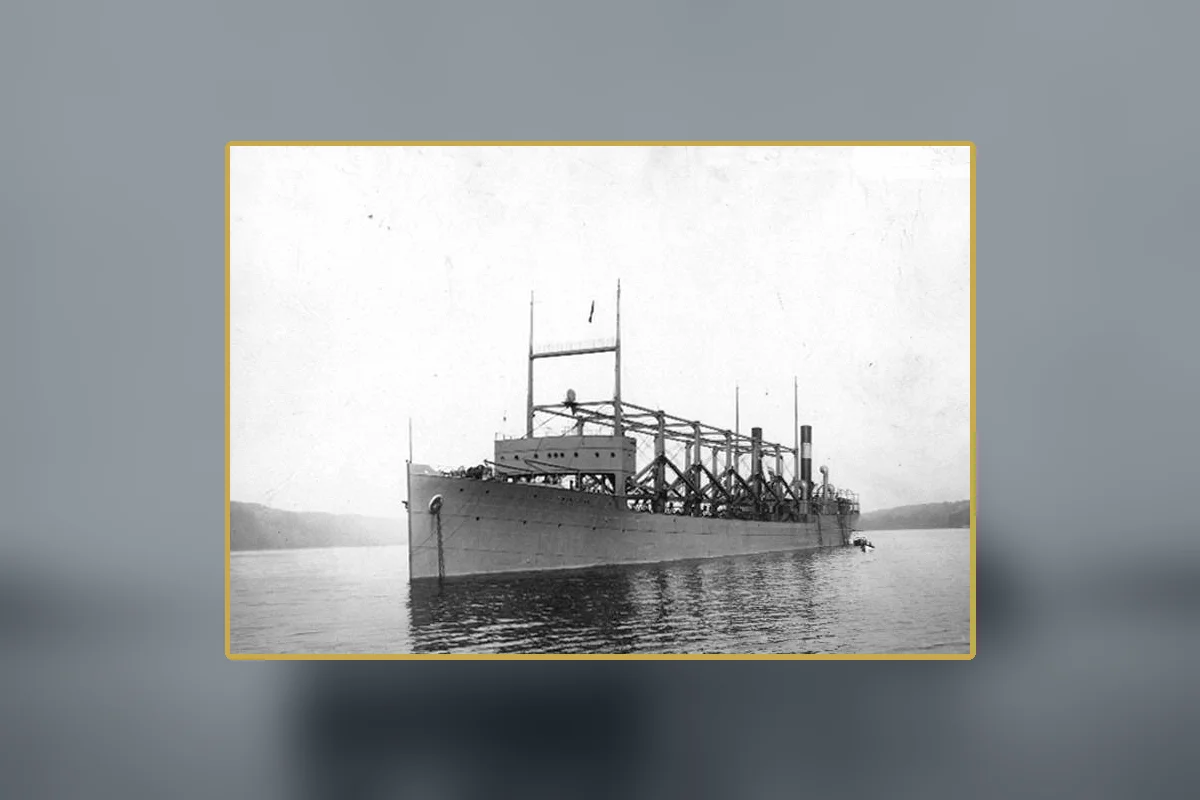
Triangle books combined famous ships such as USS Cyclops with aircraft losses, abandoned vessels, and incidents outside common boundaries. Some cases were misdated, described without storms, or presented as leaving no debris when records contained ordinary clues. A long list feels statistical even when its selection rule is invisible.
To establish a dangerous zone, researchers would need a defined area, comparable traffic exposure, consistent time period, and a rate exceeding similar waters. Anecdotes selected after the fact cannot provide that denominator. Busy shipping lanes naturally generate many incidents in absolute numbers.
Real hazards in western Atlantic water
The region includes rapidly changing weather, hurricanes, strong currents such as the Gulf Stream, deep water, reefs, and heavily traveled sea and air routes. Before satellite navigation and continuous tracking, a small position error could grow quickly. The Gulf Stream can disperse floating debris away from a casualty site.
Compass variation is not uniquely strange there, and the area does not violate physical laws. Methane eruptions, time warps, Atlantis technology, and alien intervention have been proposed without evidence tying them to the documented losses.
A myth that became a filing system
The Triangle's greatest power is organizational. Once the label exists, unrelated tragedies become entries in one story. Unsolved does not mean causally connected; five incomplete investigations can remain five separate events rather than one phenomenon.
That does not eliminate every mystery. Flight 19's wreckage has not been confirmed, Cyclops remains missing, and the sea preserves uncertainty. It replaces a supernatural zone with better questions about navigation, weather, engineering, search limits, and how publishing turns selected cases into a pattern.
What the record supports—and what it does not
No official agency recognizes a fixed Bermuda Triangle or an abnormal loss rate there. Famous disappearances are real, but they occurred under different conditions and do not establish one cause. Flight 19 is consistent with navigational disorientation, worsening weather, and fuel exhaustion, even though the wrecks remain unidentified.
Evidence ledger
- MAP — No official boundary: Popular triangles vary, allowing case lists to expand around selected disappearances.
- FLIGHT 19 — Five Avengers lost in 1945: Radio traffic records positional uncertainty before weather, darkness, and fuel closed in.
- SEARCH — A PBM Mariner also vanished: A reported explosion fits a known fuel-vapor hazard in the rescue aircraft type.
- STATISTICS — A case list is not a rate: Traffic volume and a fixed comparison area are required to show unusual danger.
- PHYSICS — Weather, current, depth: Ordinary regional hazards can complicate both survival and recovery of debris.
- MYTH CHECK — Unsolved is not one phenomenon: Separate incomplete cases do not become causally connected by drawing a triangle.
How this reconstruction was built
A claim of exceptional danger needs a fixed boundary, traffic denominator, consistent period, and comparable regions. Triangle case lists usually provide none of those controls. Individual losses should instead be returned to their own weather, navigation, engineering, and search records. Flight 19 remains incomplete because wreckage is unconfirmed; that uncertainty does not establish a regional force shared with unrelated ships and aircraft.
To audit the account, open the source links below and compare dates, quantities, and the wording used by the institutions themselves. Look for the earliest recoverable record, then distinguish it from later summaries created after the story became famous. The five visuals in this article are archival photographs, maps, documents, objects, or clearly identified editorial diagrams selected to illuminate the surviving record. Each caption identifies its source and rights information; no reconstruction is presented as a historical photograph. That transparency is part of the Lore & Archive method.
Why this story matters
The Triangle is a lesson in denominator neglect and retrospective selection. A memorable boundary can make unrelated events look connected, especially when unsolved details are presented without traffic, weather, and comparable regions.
Continue in the archive
- Roman Dodecahedrons: The Ancient Objects With No Agreed Purpose
- The Flannan Isles Lighthouse Mystery: What the Missing Keepers Left Behind
- The Antikythera Mechanism Was More Than a Curiosity
Sources and further reading
- U.S. Coast Guard Historian — Bermuda Triangle
- Naval History and Heritage Command — Bermuda Triangle bibliography
- Naval History and Heritage Command — The Lost Patrol
- Naval History and Heritage Command — Exorcizing the Devil's Triangle
Editorial note: Lore & Archive distinguishes contemporary evidence, later institutional synthesis, and unresolved inference. Where sources disagree or the record is incomplete, the uncertainty is stated rather than converted into a dramatic fact.