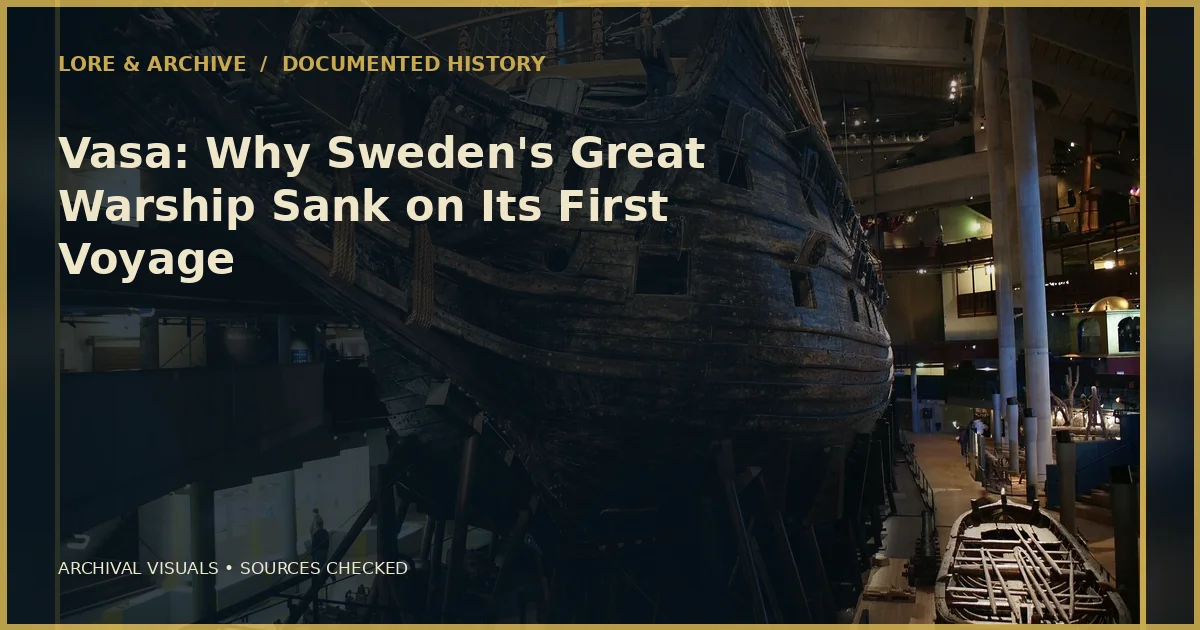
The ship did not sink because seventeenth-century builders knew nothing. It sank because political ambition, changing specifications, limited stability theory, and a failed test met one ordinary gust.
Archive record
- Launched on final voyage: August 10, 1628
- Time afloat: about 20 minutes
- Distance sailed: roughly 1,300 meters
- Raised from seabed: April 24, 1961
A floating statement of royal power
King Gustav II Adolf wanted a fleet able to project Swedish power in the Baltic. Vasa carried two enclosed gun decks, heavy cannon, and hundreds of painted carvings announcing dynasty, virtue, and military authority. The ship was both weapon and theater, built while Sweden fought abroad and naval requirements changed.
Construction was based on proportions, craft knowledge, and experience rather than modern stability calculations. Changes during the build increased height and armament. The hull did not grow enough in breadth or ballast capacity to compensate. The result could float, but its center of gravity left little margin when wind pressed the sails.
The test that warned the officers
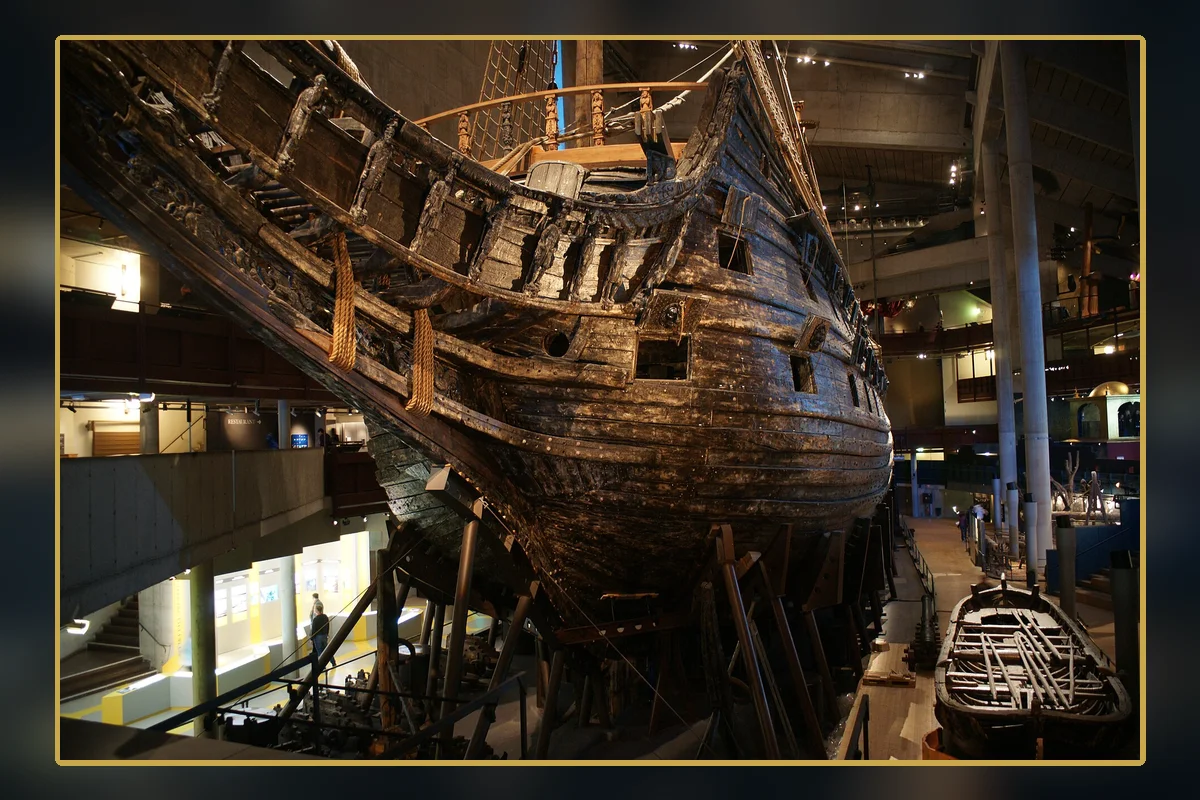
Before sailing, sailors performed a heel test by running from side to side across the upper deck. The movement was stopped after only a few crossings because the ship rolled alarmingly. Admiral Klas Fleming witnessed the result. Yet there was no simple redesign available, the king was impatient for the vessel to join the fleet, and responsibility was dispersed.
The test is often presented as a moment when everyone knowingly chose disaster. The reality was organizational. Builders, officers, suppliers, and royal demands formed a system in which warning did not translate into authority to delay. The ship sailed without the stability problem being resolved.
Twenty minutes from harbor to seabed
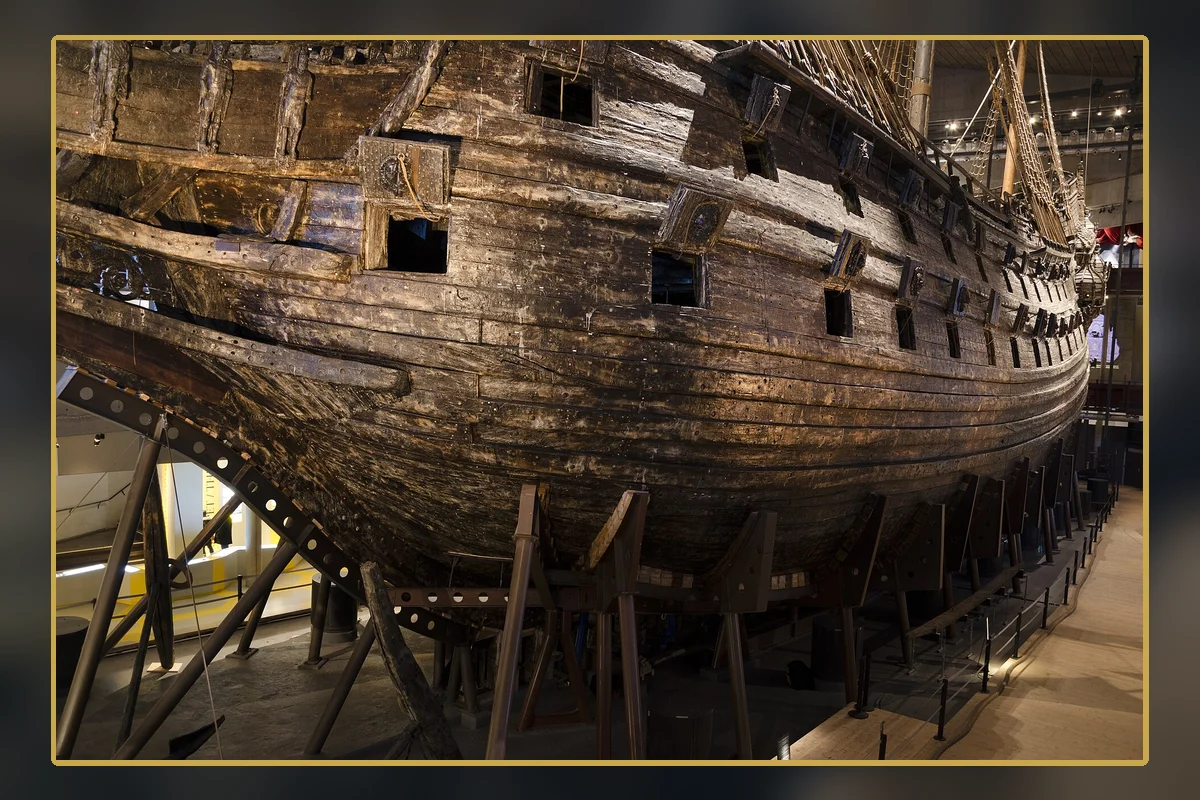
Vasa left Stockholm on August 10 with crew members and guests aboard. Gunports were open so the cannon could fire a ceremonial salute. A first gust caused a heel from which the ship recovered. A stronger gust pushed it farther; water poured through the lower gunports, adding weight faster than the ship could right itself.
The vessel sank in about 32 meters of water after traveling only around 1,300 meters. Many aboard reached nearby boats or shore, but roughly thirty people died. The loss happened in full public view, turning a symbol of royal power into an immediate administrative crisis.
An inquiry that found causes but no culprit
A formal hearing questioned the captain, officers, and shipbuilders. The captain had kept the guns secured and followed orders. The master shipwright Henrik Hybertsson had died before completion, and the design emerged from changing royal directions as well as workshop decisions. The inquiry established that the ship was unstable but punished no single person.
That outcome can look evasive. It also reflects a failure without one clean act of sabotage or negligence. Too much weight rose above the water, too little hull and ballast resisted it, and open gunports admitted the sea. The disaster belonged to the design process.
Why Vasa survived underwater
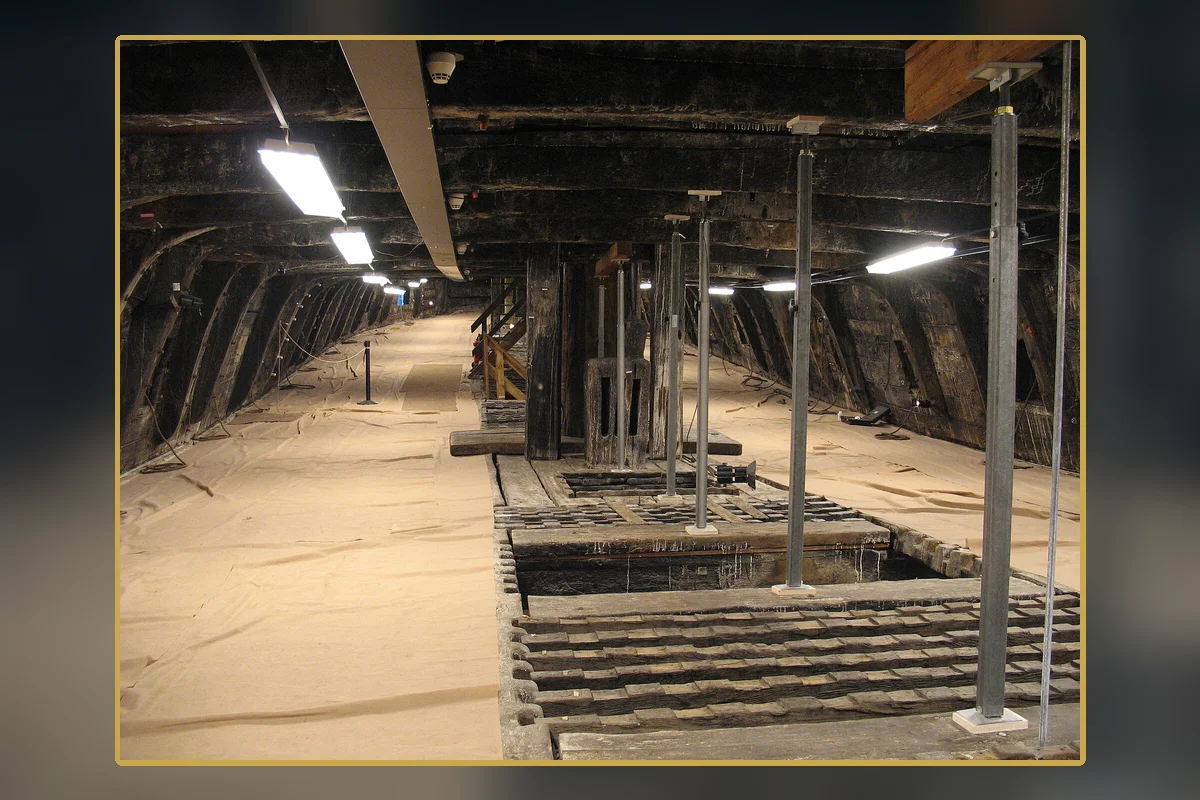
The brackish, cold Baltic contains fewer shipworms than saltier seas, and Stockholm's polluted harbor water limited some biological decay. Much of the hull remained remarkably intact. Seventeenth-century salvors recovered many cannon, but the ship itself stayed embedded in mud for more than three centuries.
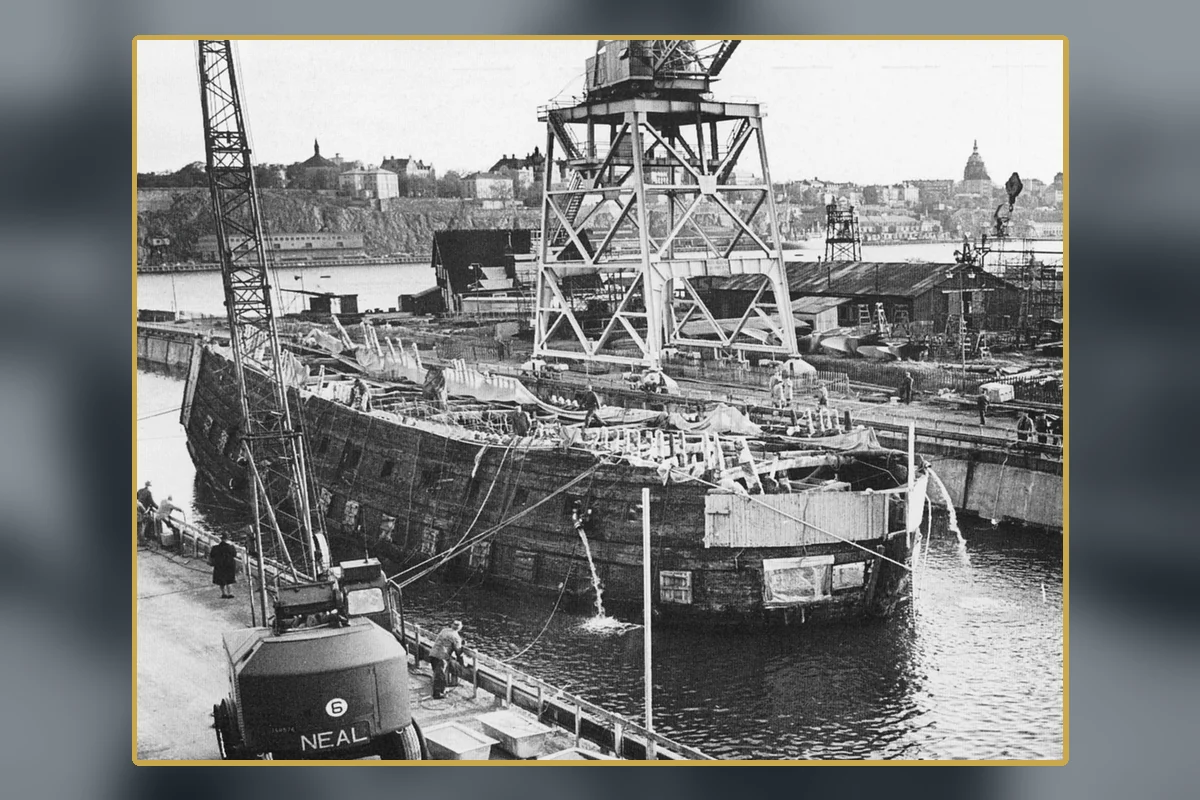
Anders Franzén searched historical records and the harbor, finding the wreck in 1956. Divers tunneled beneath it to pass lifting cables. After staged lifts, Vasa broke the surface on April 24, 1961—333 years after the sinking. The operation preserved context on a scale rarely possible for an early modern warship.
Saving a ship after raising it
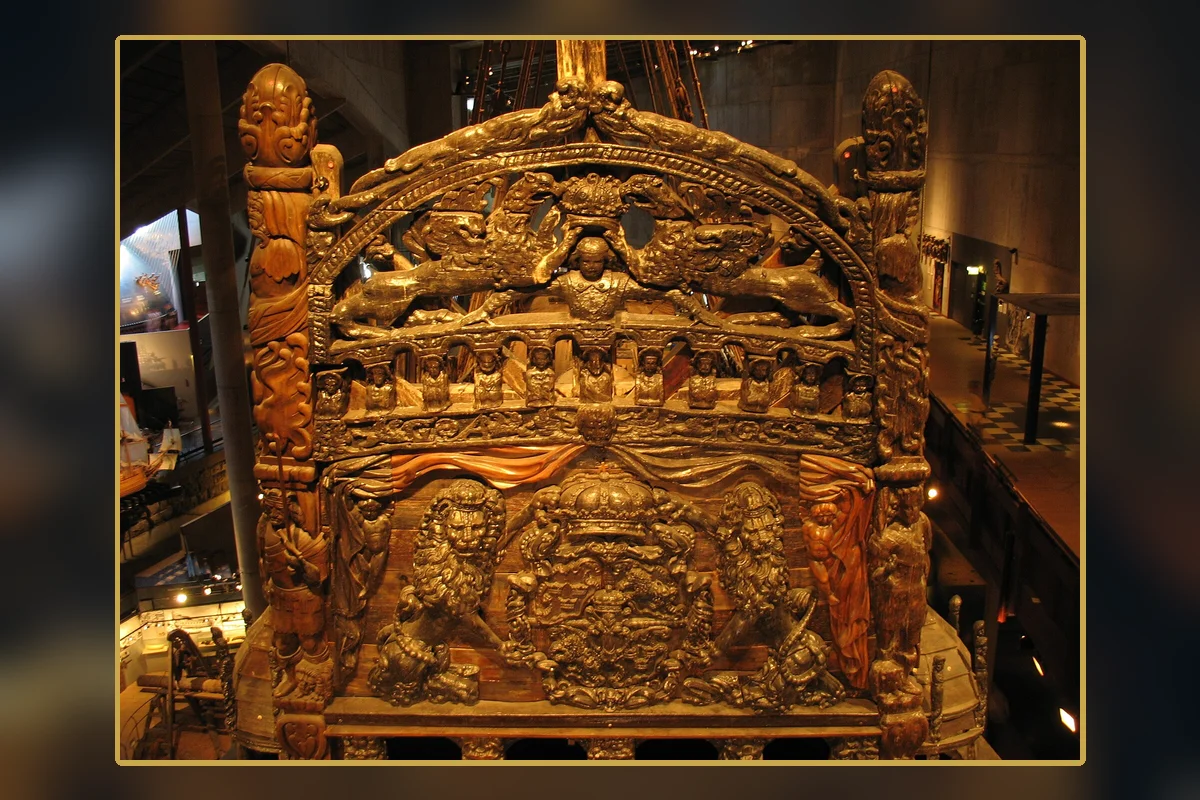
Recovery was only the beginning. Waterlogged wood can collapse and crack as it dries, so conservators sprayed the ship for years with polyethylene glycol, a wax-like material that replaces water in cells. Thousands of loose timbers and objects were documented and reassembled.
Vasa is often said to be 98 percent original, an extraordinary survival that still changes chemically. Sulfur compounds, iron, humidity, and structural stress require continuing research. The museum object is not frozen in time; it is an active conservation project created by the interaction of seventeenth-century material and twentieth-century rescue.
What the record supports—and what it does not
Vasa was not sunk by a uniquely foolish builder or by too many cannon firing at once. It was already dangerously top-heavy, the warning test failed, and water entered open lower gunports when wind heeled the ship. The failure was technical and organizational, with responsibility spread across a changing royal project.
Evidence ledger
- DESIGN — Power above the waterline: Two gun decks, heavy artillery, and ornament raised the center of gravity.
- WARNING — The heel test was stopped: Sailors running side to side made the ship roll so severely that the trial ended early.
- SINKING — Water through open gunports: A gust heeled Vasa beyond its narrow stability margin.
- VOYAGE — About 20 minutes: The ship sank roughly 1,300 meters from its starting point.
- RECOVERY — Raised after 333 years: A complex lifting operation brought Vasa to the surface in 1961.
- CONSERVATION — The rescue never really ended: Waterlogged wood still requires environmental control, research, and structural support.
How this reconstruction was built
Vasa combines an inquiry record, surviving hull geometry, recovered objects, and continuing structural analysis. The heel test and open gunports are documented; the design's stability can be tested against the ship itself. The inquiry's failure to convict one person does not erase causation. Instead, it shows a technical failure distributed across changing specifications, craft decisions, royal pressure, and a warning that no actor had enough authority to resolve.
To audit the account, open the source links below and compare dates, quantities, and the wording used by the institutions themselves. Look for the earliest recoverable record, then distinguish it from later summaries created after the story became famous. The five visuals in this article are archival photographs, maps, documents, objects, or clearly identified editorial diagrams selected to illuminate the surviving record. Each caption identifies its source and rights information; no reconstruction is presented as a historical photograph. That transparency is part of the Lore & Archive method.
Why this story matters
Vasa turns one failed voyage into an unusually complete archive of shipbuilding, labor, art, and accountability. Its survival also exposes a second engineering story: keeping a raised wreck stable for future generations.
Continue in the archive
- The Demon Core: Two Fatal Experiments and the Birth of Remote Criticality Safety
- The Great Smog of London: Five Days That Made Dirty Air Impossible to Ignore
- The Voynich Manuscript: What Is Known
Sources and further reading
Editorial note: Lore & Archive distinguishes contemporary evidence, later institutional synthesis, and unresolved inference. Where sources disagree or the record is incomplete, the uncertainty is stated rather than converted into a dramatic fact.