
The invention used eighty-eight synchronized frequency changes, inspired in part by the keys of a piano. The leap was real; the straight line from patent to smartphone was not.
Archive record
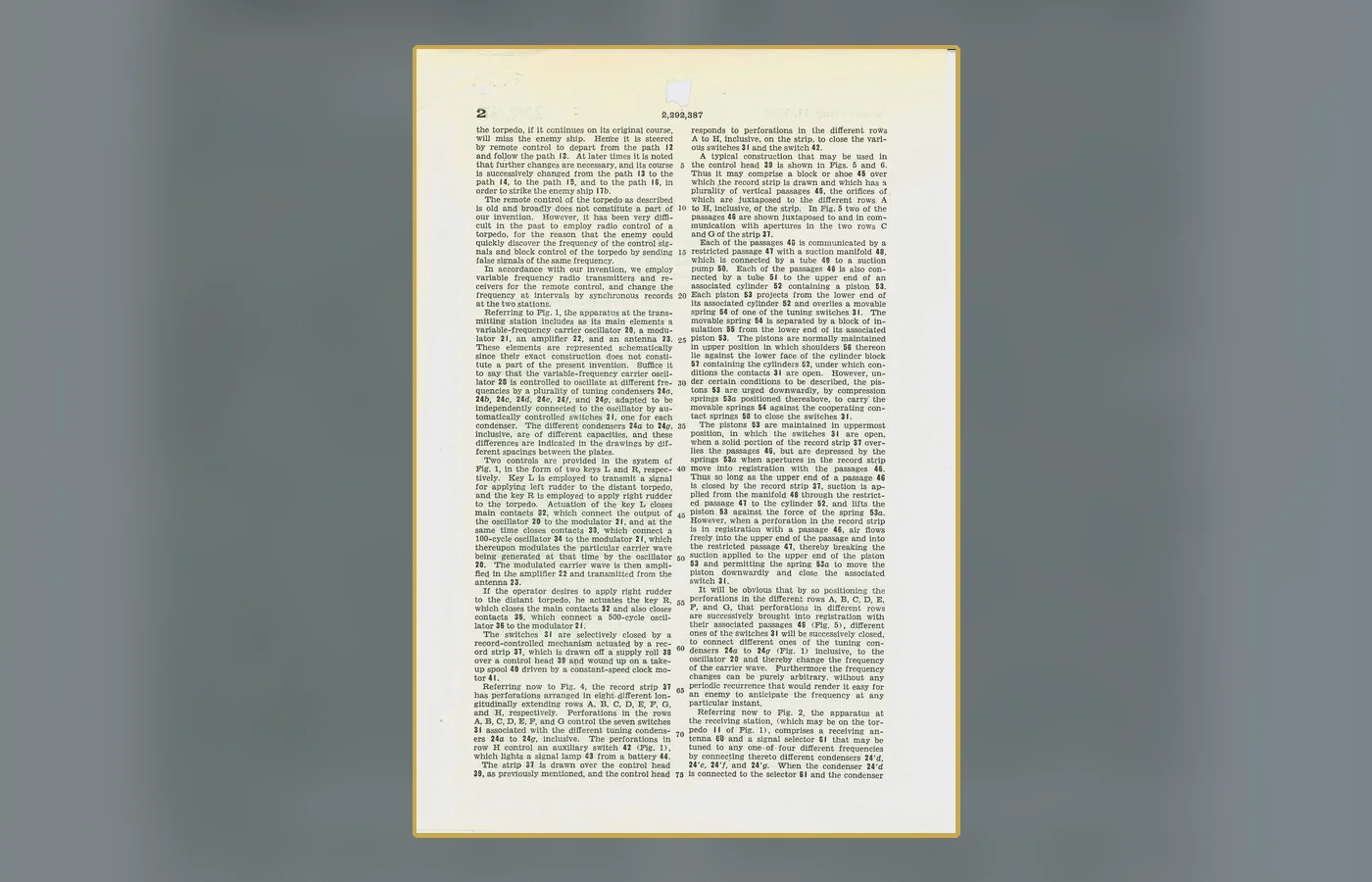
- Inventors: Hedy Kiesler Markey and George Antheil
- Patent filed: June 1941
- U.S. Patent: 2,292,387
- Purpose: jam-resistant radio guidance for torpedoes
A wartime problem outside the studio
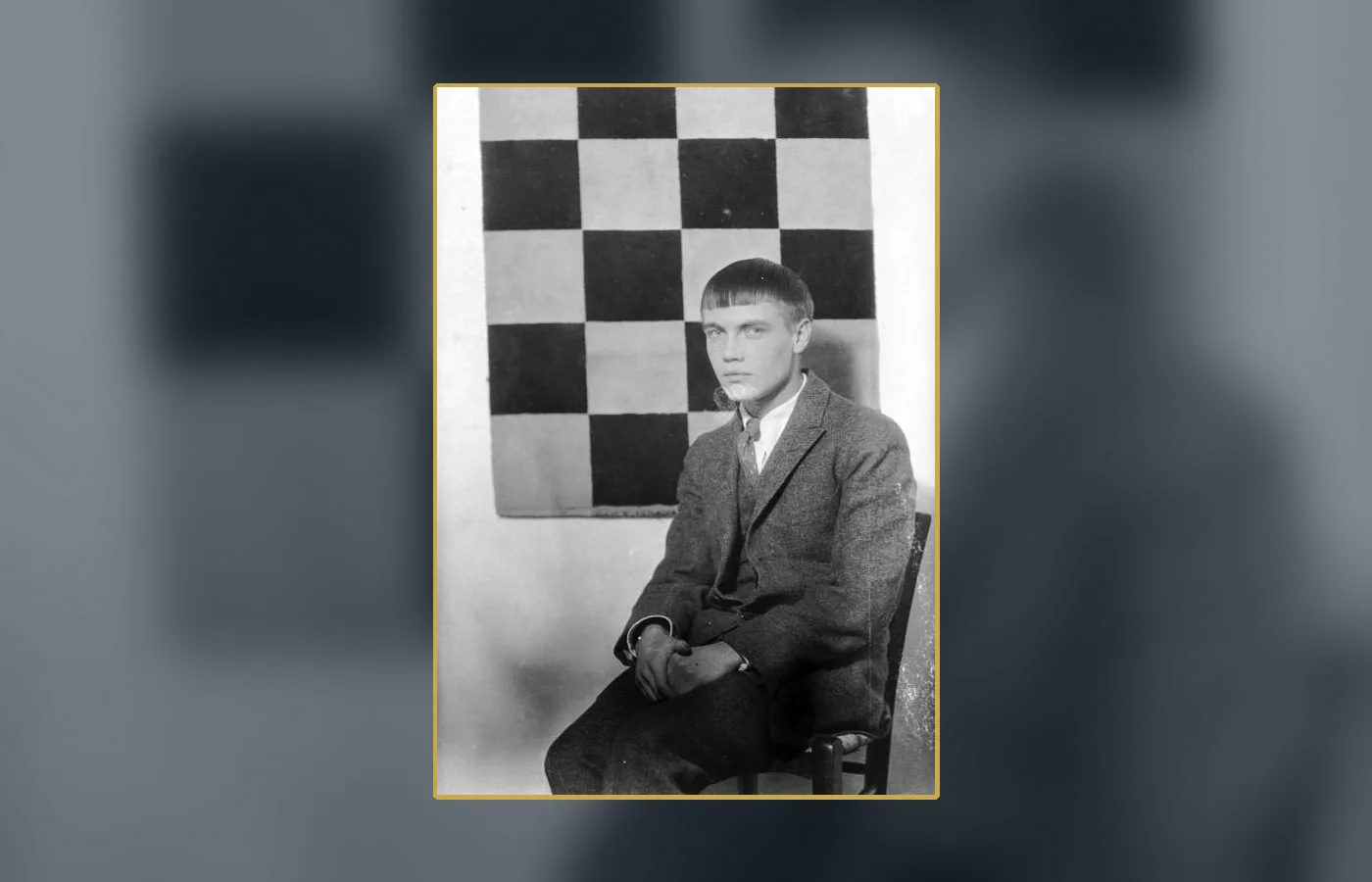
Hedy Lamarr arrived in Hollywood with knowledge of European weapons discussions acquired during a former marriage to arms manufacturer Friedrich Mandl. During World War II she wanted to contribute more than celebrity fundraising. In conversations with composer George Antheil, she focused on a vulnerable technology: radio-controlled torpedoes could be jammed if an enemy found the control frequency.
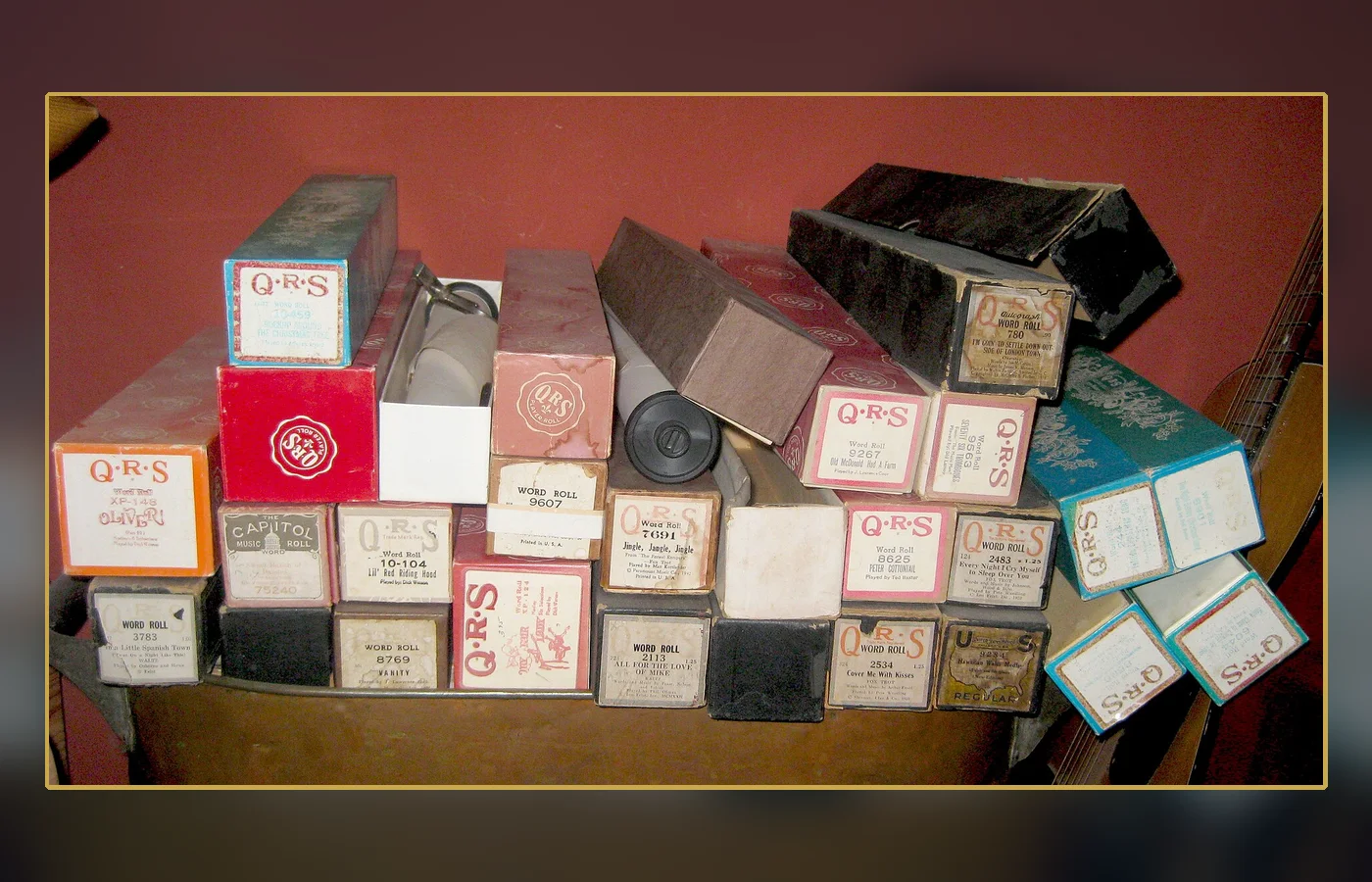
Their answer was to move the signal rapidly among frequencies in a pattern shared by transmitter and receiver. A jammer targeting one channel would lose the message as it hopped elsewhere. Antheil's experience synchronizing mechanical player pianos helped shape a scheme using eighty-eight steps—the number of piano keys.

What the patent actually described
Filed in 1941 under Lamarr's married name, Hedy Kiesler Markey, and granted in 1942, U.S. Patent 2,292,387 described a 'Secret Communication System.' Perforated rolls would coordinate changing radio frequencies at both ends of the link. The immediate application was naval: steering a torpedo while making hostile interference harder.
The invention was not Wi-Fi, Bluetooth, or a complete modern spread-spectrum radio. Those systems emerged through many later technologies, standards, and researchers. But synchronized frequency hopping is an important idea in secure and resilient communication, and the patent became part of that history.
Why the Navy did not deploy it
The Navy did not turn the piano-roll concept into an operational wartime torpedo system. Mechanical complexity, institutional skepticism, and competing priorities all played roles. Lamarr was encouraged to use her fame to sell war bonds. The patent was assigned to the Navy and expired before either inventor profited from it.
Later electronic systems made frequency agility more practical. By the late 1950s and early 1960s, related methods were being used in military communication. That later adoption validates the concept's usefulness without proving that every implementation descended directly and exclusively from Lamarr and Antheil's design.
Recognition arrives after the patent expires
For decades, Lamarr's technical work remained a footnote beside her screen career. The Electronic Frontier Foundation honored Lamarr and Antheil in 1997, and the National Inventors Hall of Fame inducted them in 2014. The correction mattered because the public image of a glamorous actress had made technical authorship seem implausible to many observers.
Yet recognition can create its own simplification. 'She invented Wi-Fi' is shareable but historically misleading. It substitutes a modern product name for a specific wartime patent and removes Antheil, later radio engineers, and standards bodies. The documented achievement is strong enough without borrowing credit from an entire field.
A better way to tell the story
Lamarr should be remembered as a co-inventor who helped formulate and patent a jam-resistant communication technique when her industry expected beauty, not engineering. Antheil should be remembered as a co-inventor whose musical mechanics contributed to synchronization. Their idea reached beyond the technology available to them.
The story becomes more remarkable when made precise. A movie star did not secretly build the internet. She identified a real military weakness, collaborated across disciplines, and secured a patent for a concept whose wider importance was recognized much later.

What the record supports—and what it does not
Hedy Lamarr did not single-handedly invent Wi-Fi. She and George Antheil co-invented a patented frequency-hopping system for torpedo guidance. It anticipated an important family of wireless techniques, but modern Wi-Fi resulted from many later inventions and standards.
Evidence ledger
- PROBLEM — Radio control could be jammed: A fixed frequency gave an adversary a clear target.
- IDEA — Transmitter and receiver hop together: A shared sequence preserves control across changing frequencies.
- PATENT — U.S. 2,292,387: The patent was granted in August 1942.
- MECHANISM — Eighty-eight synchronized steps: Player-piano rolls helped express the timing concept.
- RESULT — Not deployed during the war: The mechanical proposal did not become a Navy torpedo system.
- MYTH CHECK — Not 'the inventor of Wi-Fi': Her patent belongs to a much larger wireless history.
How this reconstruction was checked
This reconstruction begins with National Inventors Hall of Fame — Hedy Lamarr, National Inventors Hall of Fame — George Antheil, U.S. Patent 2,292,387. Those records establish the dates, people, objects, and institutional findings used above. Later retellings are useful only when they can be traced back to that record. A repeated anecdote is not treated as independent confirmation simply because it appears on several websites.
The unresolved question is kept separate from the documented mechanism. In this case, the evidence supports the following boundary: Hedy Lamarr did not single-handedly invent Wi-Fi. She and George Antheil co-invented a patented frequency-hopping system for torpedo guidance. It anticipated an important family of wireless techniques, but modern Wi-Fi resulted from many later inventions and standards. The purpose of that boundary is not to flatten the mystery. It prevents a vivid but unsupported detail from displacing the evidence that makes the story worth reading.
Every visual is either a historical photograph, document, map, object, site image, or an explicitly labeled contextual comparison. Captions identify the source and license. No AI reconstruction and no text-poster image is presented as historical evidence; the featured image is derived directly from the first archival visual without a headline overlay.
Why this story matters
Accuracy does not diminish Lamarr; it reveals a sharper achievement. The case shows how institutional stereotypes can obscure technical authorship—and how correcting an omission can itself become an overstatement.
Continue in the archive
- The Ghost Army: How Artists Made an American Division Appear From Nothing
- Project Azorian: The CIA Ship Built to Lift a Soviet Submarine
- The Demon Core Accidents
Sources and further reading
- National Inventors Hall of Fame — Hedy Lamarr
- National Inventors Hall of Fame — George Antheil
- U.S. Patent 2,292,387
Editorial note: Lore & Archive separates contemporary records, later institutional synthesis, and unresolved inference. When sources disagree or the archive is incomplete, the uncertainty is stated rather than converted into a dramatic fact.