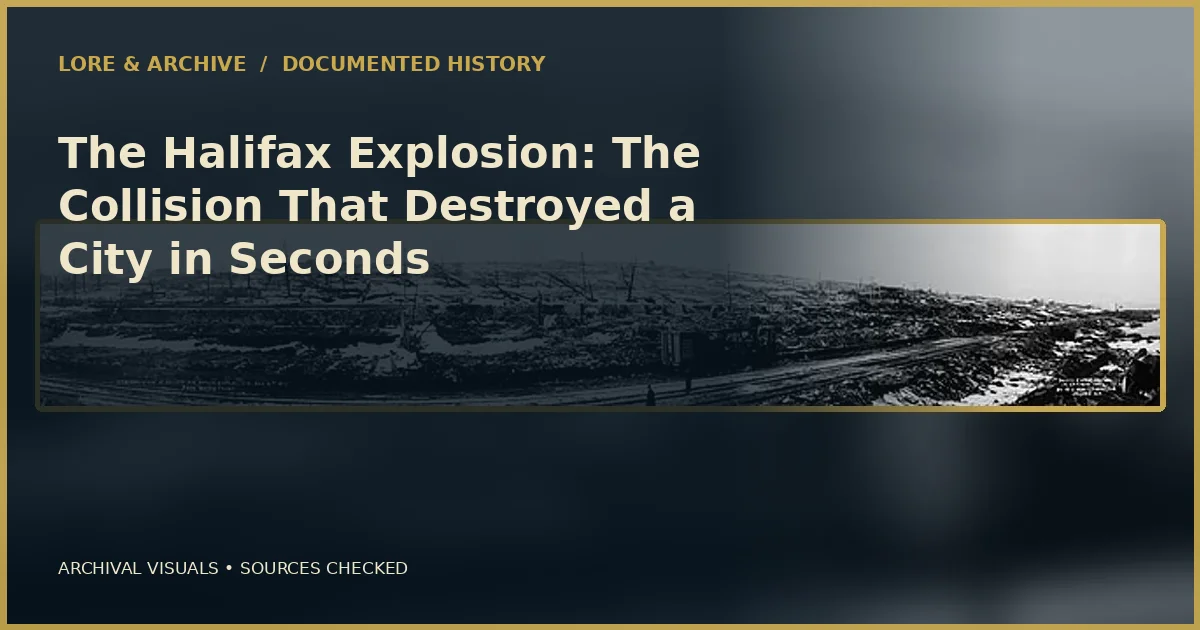
The fatal sequence lasted less than twenty minutes: a navigational conflict, a collision, a burning ship drifting toward shore, then a blast powerful enough to redraw neighborhoods.
Archive record
- Date: December 6, 1917
- Ships: SS Mont-Blanc and SS Imo
- Explosive force: estimated about 2.9 kilotons TNT equivalent
- Human toll: nearly 2,000 killed and about 9,000 injured
A narrow harbor in wartime
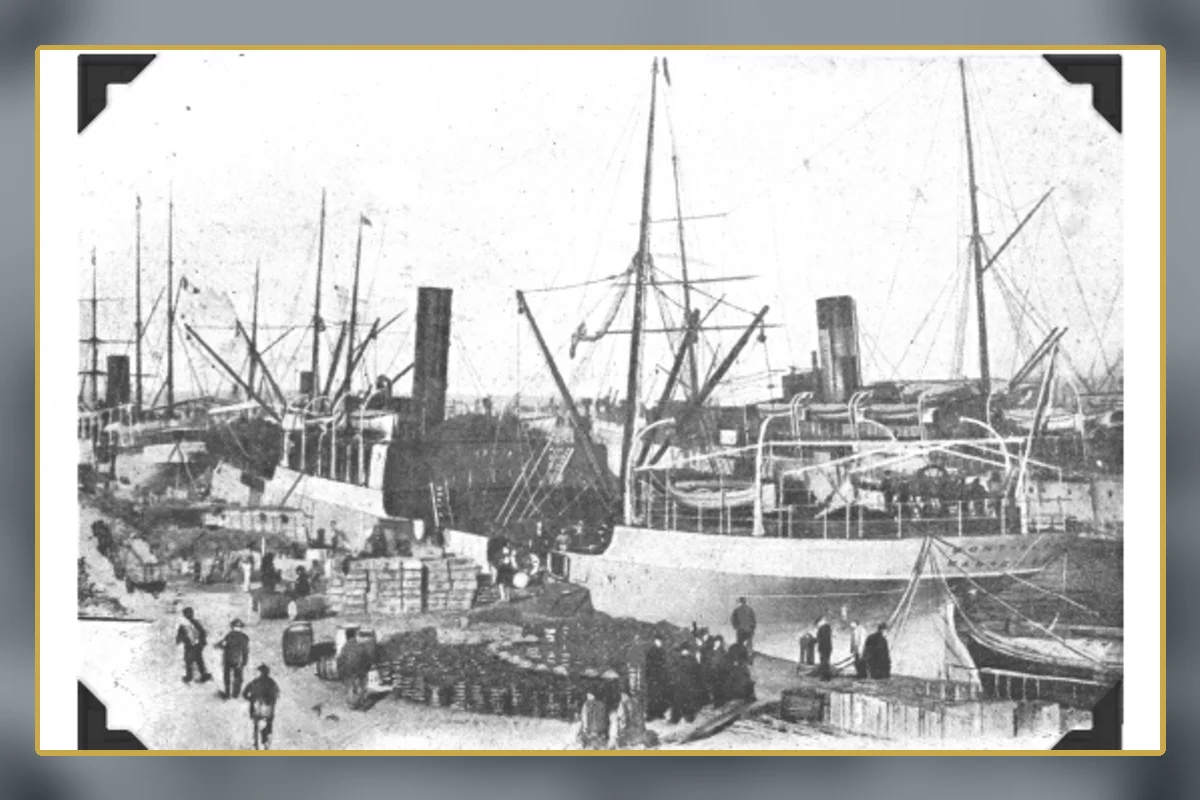
Halifax was a critical wartime port where ships assembled for Atlantic convoys. Traffic moved through the Narrows between Halifax and Dartmouth under rules designed to keep vessels apart. On the morning of December 6, the inbound French munitions ship Mont-Blanc encountered the outbound Norwegian relief ship Imo in a developing dispute over position.
Signals, speed, and last-minute maneuvers failed to resolve the conflict. Imo's bow struck Mont-Blanc's starboard side. The impact did not immediately detonate the cargo, but it toppled containers of flammable benzol. Sparks ignited a fire that spread across a deck under which lay picric acid, TNT, guncotton, and benzol.
The burning ship that looked like a spectacle
Mont-Blanc's crew understood the cargo and abandoned ship, rowing toward Dartmouth while shouting warnings that many onshore could not hear or understand. The burning vessel drifted toward Halifax's Pier 6. Ammunition exploded in the flames, attracting residents to windows and streets.
There was no citywide system capable of translating the danger into an immediate evacuation. Railway dispatcher Vincent Coleman stayed at his post long enough to warn an incoming passenger train, likely preventing it from entering the blast area. The better-known heroic act also reveals the communications gap: one operator could protect a train while entire neighborhoods remained exposed.
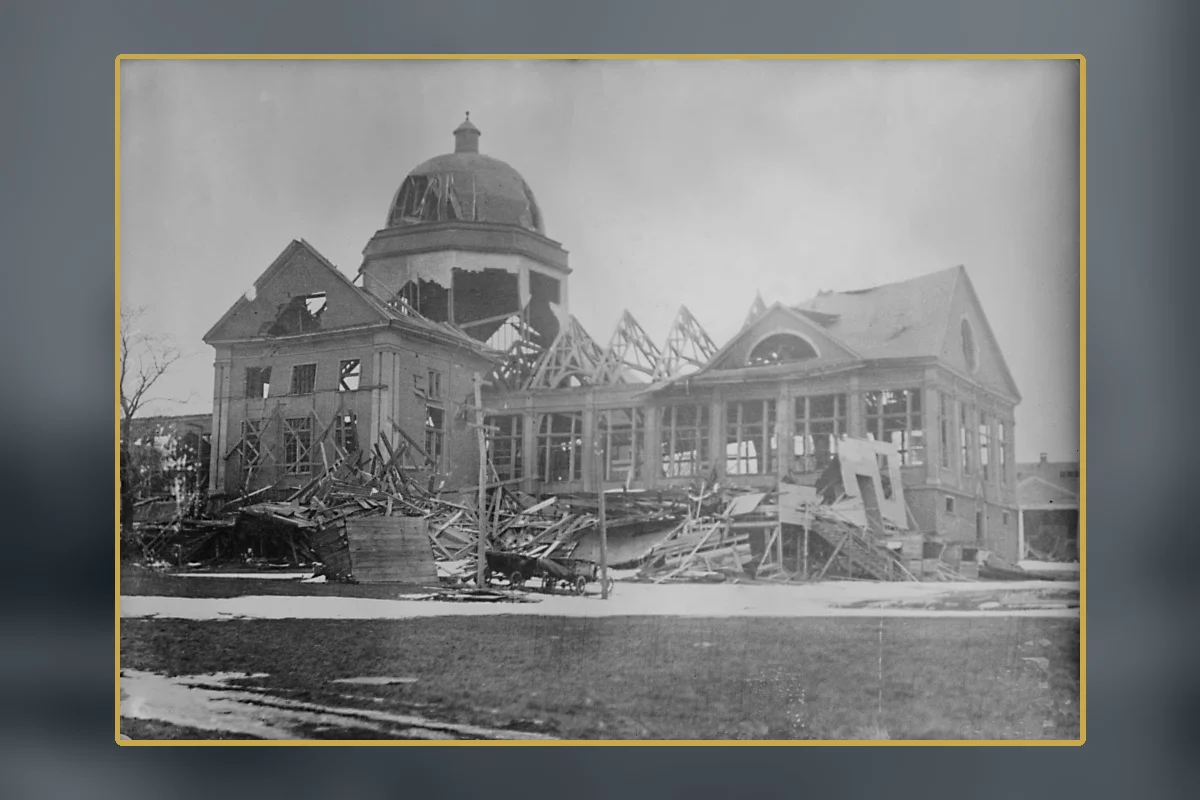
9:04:35 a.m.
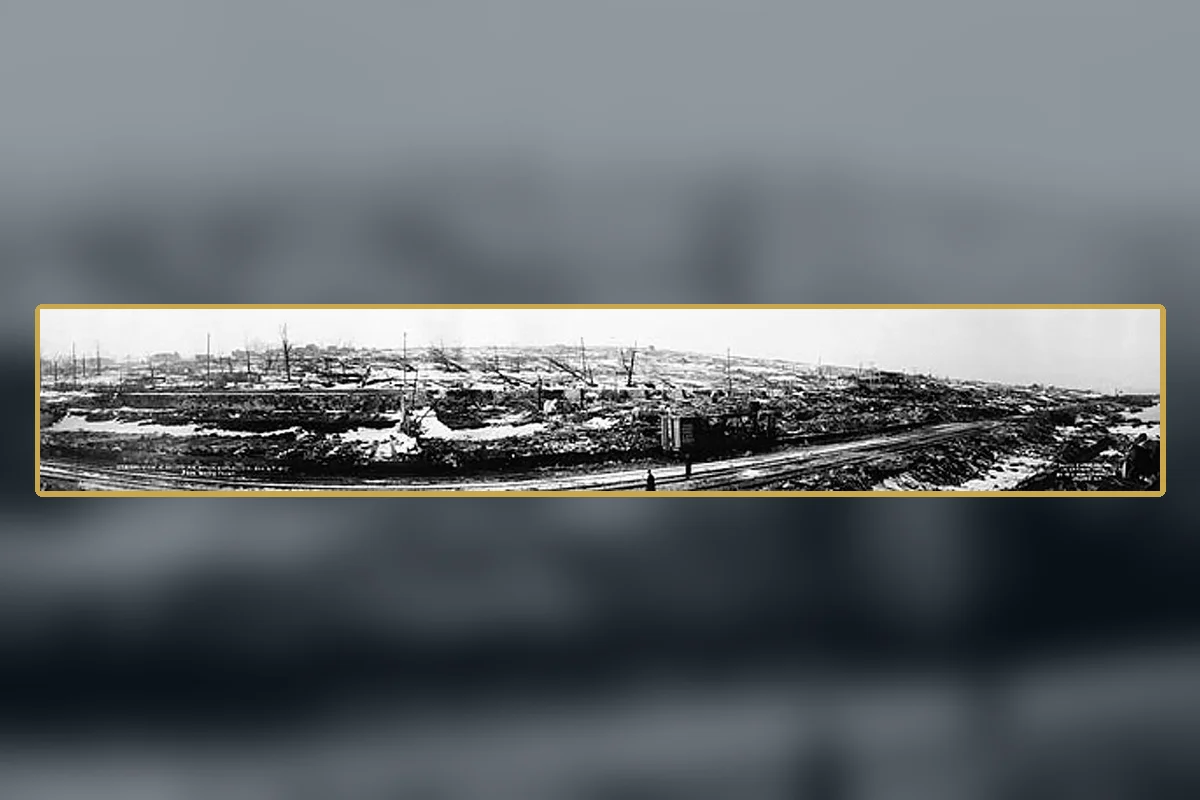
Mont-Blanc detonated with an estimated force of about 2.9 kilotons of TNT. The ship was torn apart; fragments traveled kilometers. A pressure wave flattened much of the Richmond district, while broken glass caused thousands of eye injuries among people who had watched the fire through windows.
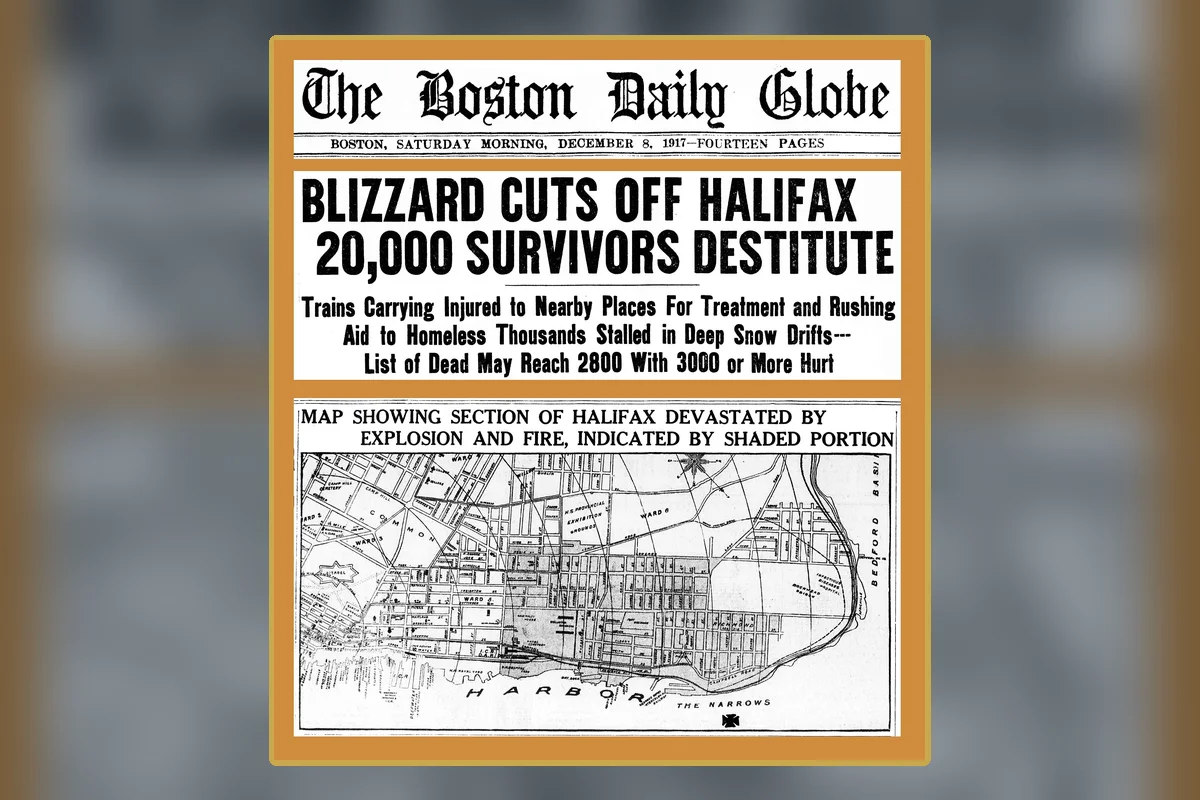
Water displaced by the blast produced a tsunami that struck both shores and devastated the Mi'kmaq community at Turtle Grove. Fires spread through wreckage. Nearly 2,000 people died, roughly 9,000 were injured, around 1,630 homes were destroyed, and thousands were left without shelter.
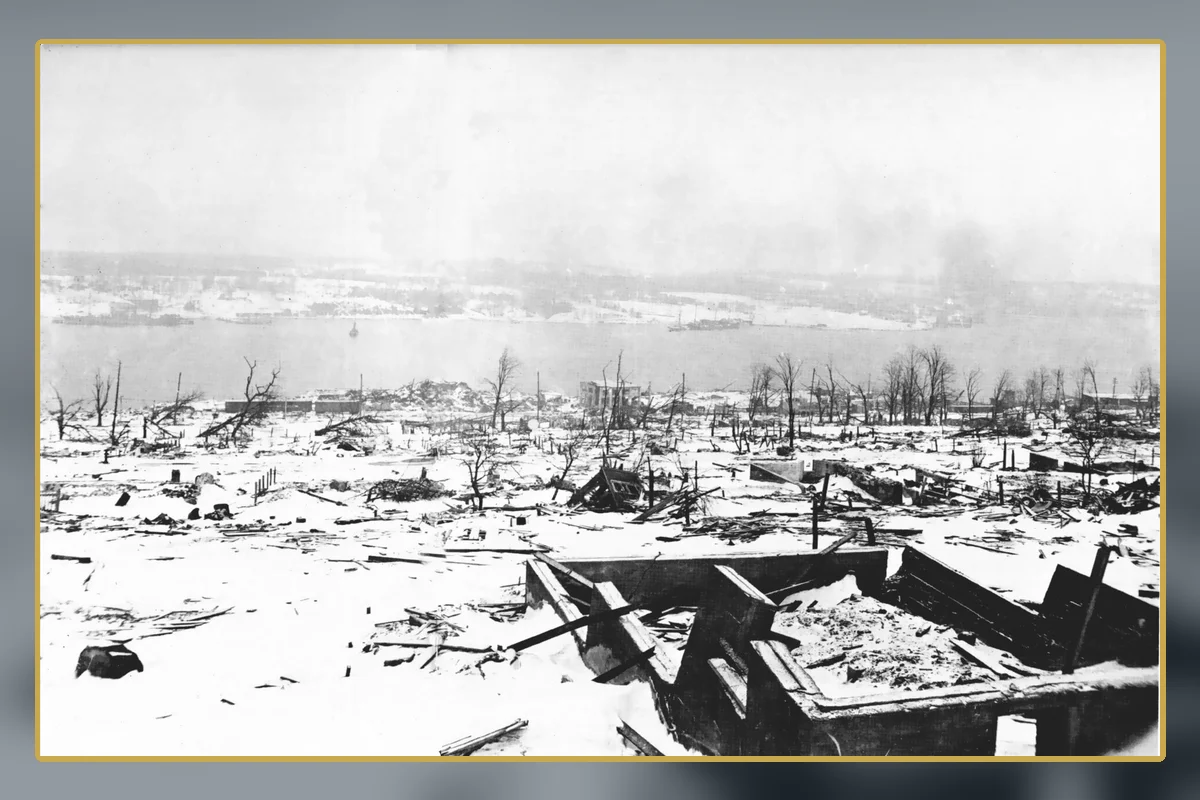
A blizzard over the ruins
Rescue began immediately among survivors, soldiers, sailors, firefighters, medical workers, and volunteers. The next day, a snowstorm buried debris and slowed movement while temperatures fell. Hospitals faced trauma on an extraordinary scale, especially eye injuries from flying glass.
Relief trains and medical teams arrived from across Canada and the northeastern United States. Boston sent assistance rapidly, beginning a remembered connection commemorated by Nova Scotia's annual gift of a Christmas tree. The symbol is genuine, but it should not obscure local, Mi'kmaq, Black, military, and international contributions to recovery.
Who was blamed?
A judicial inquiry initially placed heavy blame on Mont-Blanc's captain and pilot, and criminal charges followed. Appeals and later proceedings complicated that judgment. Maritime responsibility was distributed across navigation decisions, traffic rules, signals, and wartime harbor systems rather than reduced cleanly to one villain.
The collision's preventability is clearer than individual moral certainty. Two ships remained on a collision course long enough for evasive choices to narrow. Once benzol ignited, the lack of an effective public warning turned a shipboard emergency into a mass-casualty disaster.
Rebuilding and the architecture of memory
Reconstruction produced planned housing such as the Hydrostone district and influenced emergency medicine, public health, and urban planning. Prosthetics and care for blind survivors became major needs. Compensation, housing, and long-term disability made the disaster continue far beyond the cleared rubble.
The explosion is often described through scale comparisons, but its lasting history is social: displaced families, damaged institutions, unequal losses, and a city rebuilt while war continued. Remembering the number alone cannot show how one harbor failure rearranged thousands of lives.
What the record supports—and what it does not
The Halifax Explosion was not an instant collision blast. The impact spilled benzol, Mont-Blanc burned and drifted for nearly twenty minutes, and the cargo then detonated. That delay created both heroic warnings and fatal spectatorship. Responsibility was contested and systemic, not captured by a single enduring villain.
Evidence ledger
- COLLISION — Mont-Blanc met Imo: A navigational conflict in the Narrows ended with Imo striking the munitions ship.
- FIRE — Benzol ignited first: The cargo did not detonate on impact; the burning ship drifted toward Halifax.
- TIME — 9:04:35 a.m.: The blast released energy estimated at about 2.9 kilotons TNT equivalent.
- TOLL — Nearly 2,000 killed: About 9,000 were injured, many by glass after watching from windows.
- WARNING — Vincent Coleman's final message: The dispatcher warned an approaching train before the blast reached his station.
- AFTERMATH — A blizzard followed: Snow and cold struck the wrecked city as local and outside relief mobilized.
How this reconstruction was built
The collision and blast are reconstructed from ship movements, signals, inquiry testimony, damage mapping, and medical and relief records. Exact blame shifted through legal proceedings, but the physical chain is stable: impact, spilled benzol, fire, drift, then detonation. Community histories are essential for consequences that a blast estimate cannot show, including Turtle Grove, eye injuries, displacement, and the unequal work of recovery.
To audit the account, open the source links below and compare dates, quantities, and the wording used by the institutions themselves. Look for the earliest recoverable record, then distinguish it from later summaries created after the story became famous. The five visuals in this article are archival photographs, maps, documents, objects, or clearly identified editorial diagrams selected to illuminate the surviving record. Each caption identifies its source and rights information; no reconstruction is presented as a historical photograph. That transparency is part of the Lore & Archive method.
Why this story matters
The disaster links navigation, hazardous cargo, public warning, medical response, and urban inequality. It is a case study in how a preventable chain becomes catastrophic when no institution can interrupt it in time.
Continue in the archive
- Vasa: Why Sweden's Great Warship Sank on Its First Voyage
- The Demon Core: Two Fatal Experiments and the Birth of Remote Criticality Safety
- The Lost Colony of Roanoke: Evidence Before Legend
Sources and further reading
- Parks Canada — The Halifax Explosion
- Nova Scotia Archives — A Vision of Regeneration
- Nova Scotia Archives — First-hand narratives and records
Editorial note: Lore & Archive distinguishes contemporary evidence, later institutional synthesis, and unresolved inference. Where sources disagree or the record is incomplete, the uncertainty is stated rather than converted into a dramatic fact.