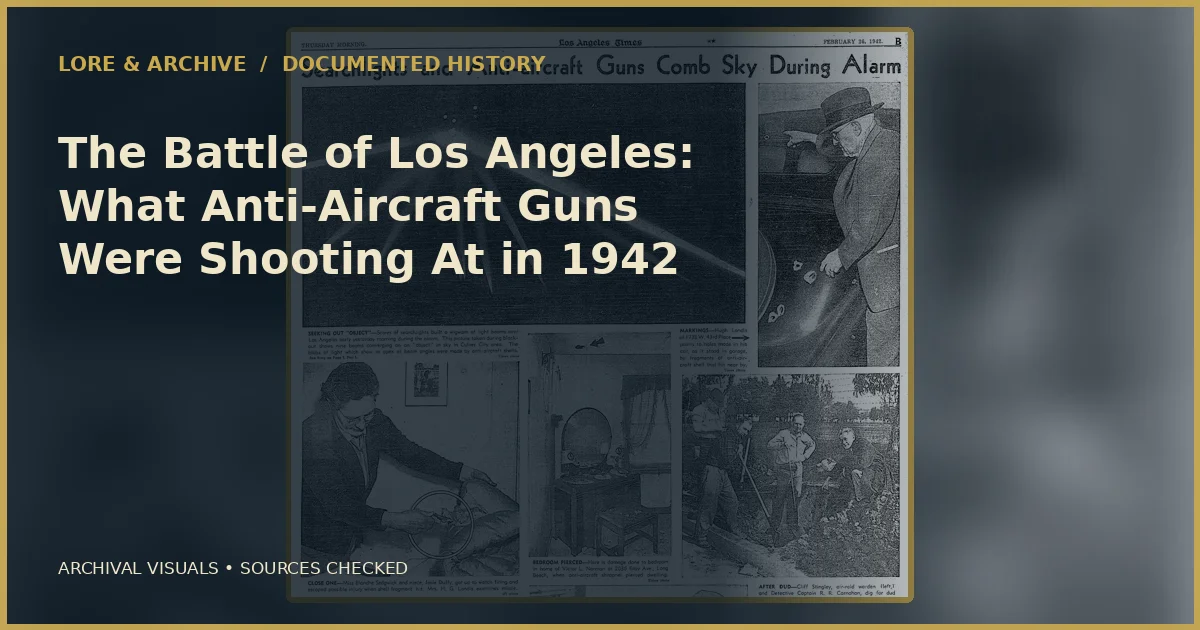
Only weeks after Pearl Harbor, a real Japanese submarine shelled the California coast. The next night's alarm turned expectation, radar uncertainty, and anti-aircraft fire into a battle without a confirmed enemy.
Archive record
- Date: early hours of February 25, 1942
- Location: Los Angeles area
- Rounds fired: more than 1,400 anti-aircraft shells
- Confirmed enemy aircraft: none
The fear before the firing
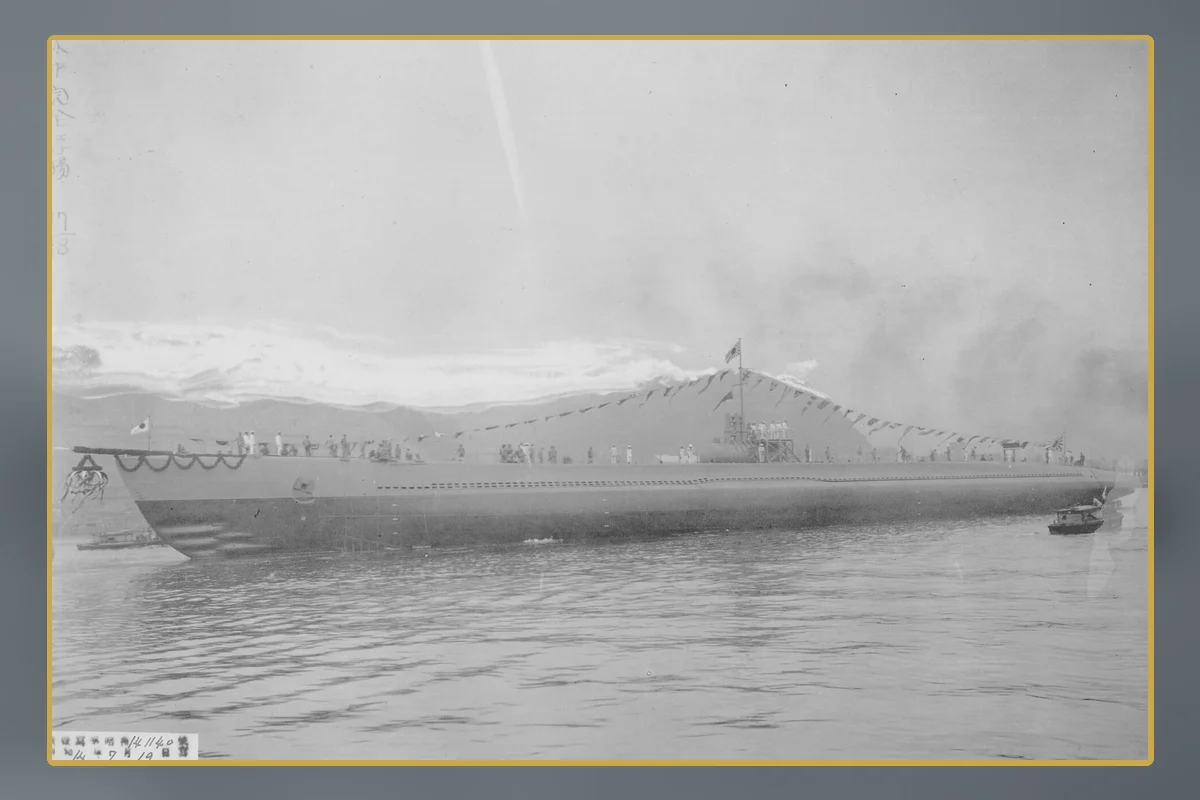
The United States had entered the war less than three months earlier. Japanese attacks on the mainland felt possible, and on February 23 submarine I-17 shelled an oil facility near Santa Barbara. The damage was limited, but the event proved that an enemy vessel could strike the California coast.
On the night of February 24–25, radar tracked a possible target approaching Los Angeles. Air-raid warnings sounded and a blackout began. Information passed through a defense network still learning to interpret radar, observer reports, and communication under pressure.
Searchlights find a shape
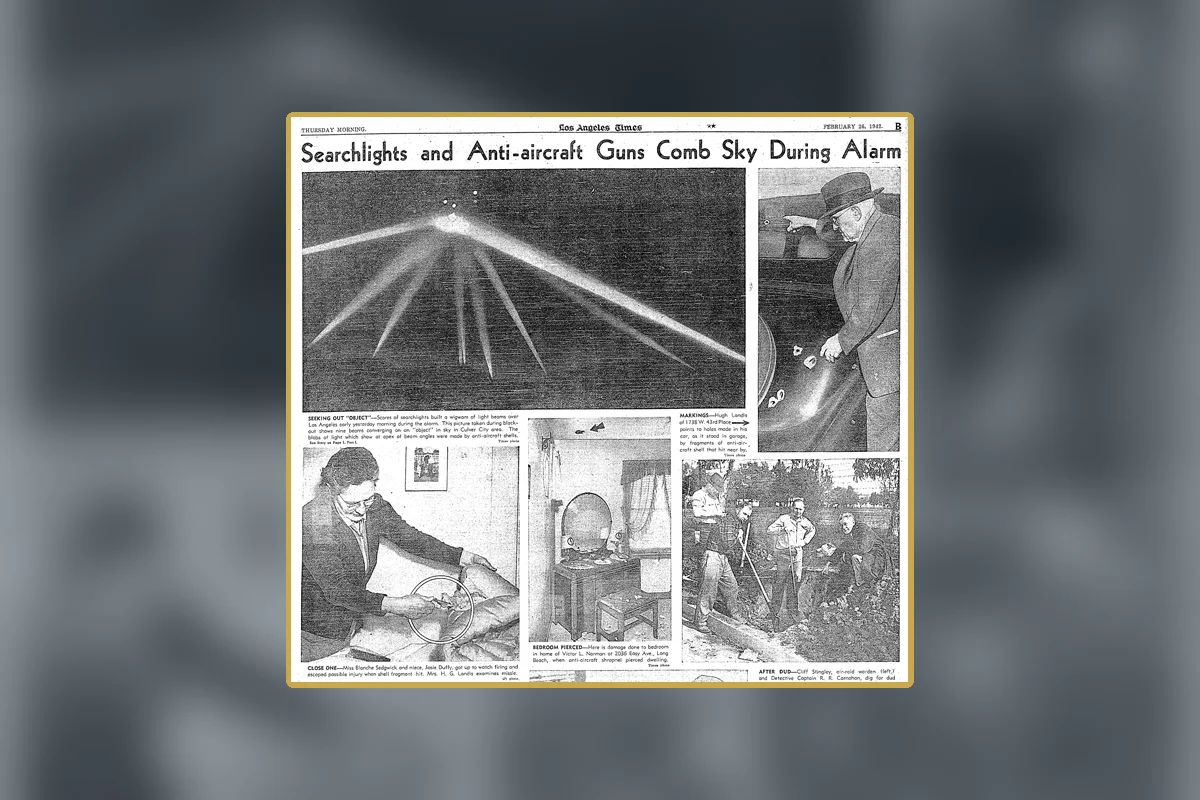
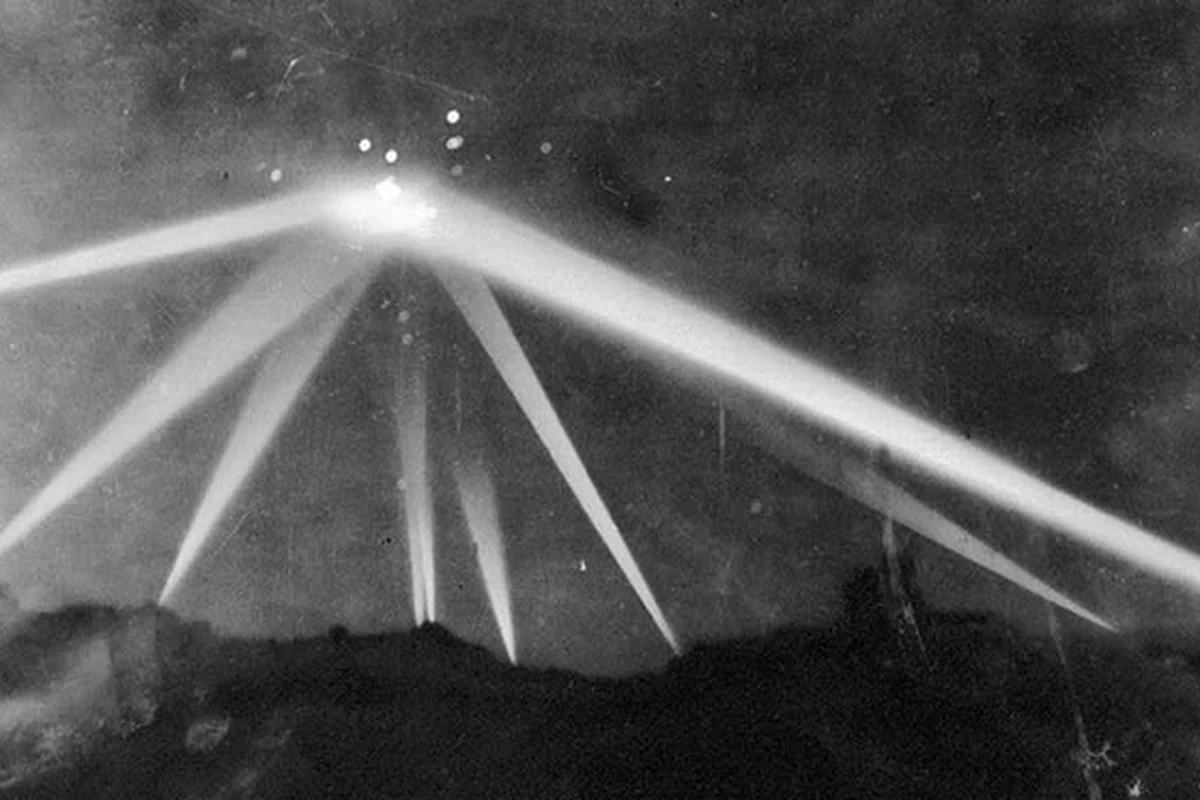
Anti-aircraft batteries opened fire around 3 a.m. Searchlights swept the sky and appeared to converge on a bright point. Gunners, officials, and residents reported objects in different numbers, sizes, altitudes, and directions. Some saw formations; others saw a balloon; many saw only bursts and beams.
Once shelling began, explosions, smoke, drifting balloons, and the illuminated fragments of the barrage generated new visual cues. A feedback loop became possible: firing confirmed to observers that a target existed, and every ambiguous shape seemed to justify more firing.
A thousand shells return to the city
More than 1,400 rounds were fired before the all-clear. No bombs fell and no enemy aircraft was shot down. Shell fragments and unexploded rounds came back over the metropolitan area, damaging buildings and vehicles. Several civilian deaths were associated with traffic accidents and heart attacks during the alert.
The danger was therefore real even if the target was not. Friendly fire need not strike an aircraft to create casualties. The episode exposed the cost of defending a populated city when target identification, command, and ammunition effects were poorly coordinated.
The photograph that acquired a saucer
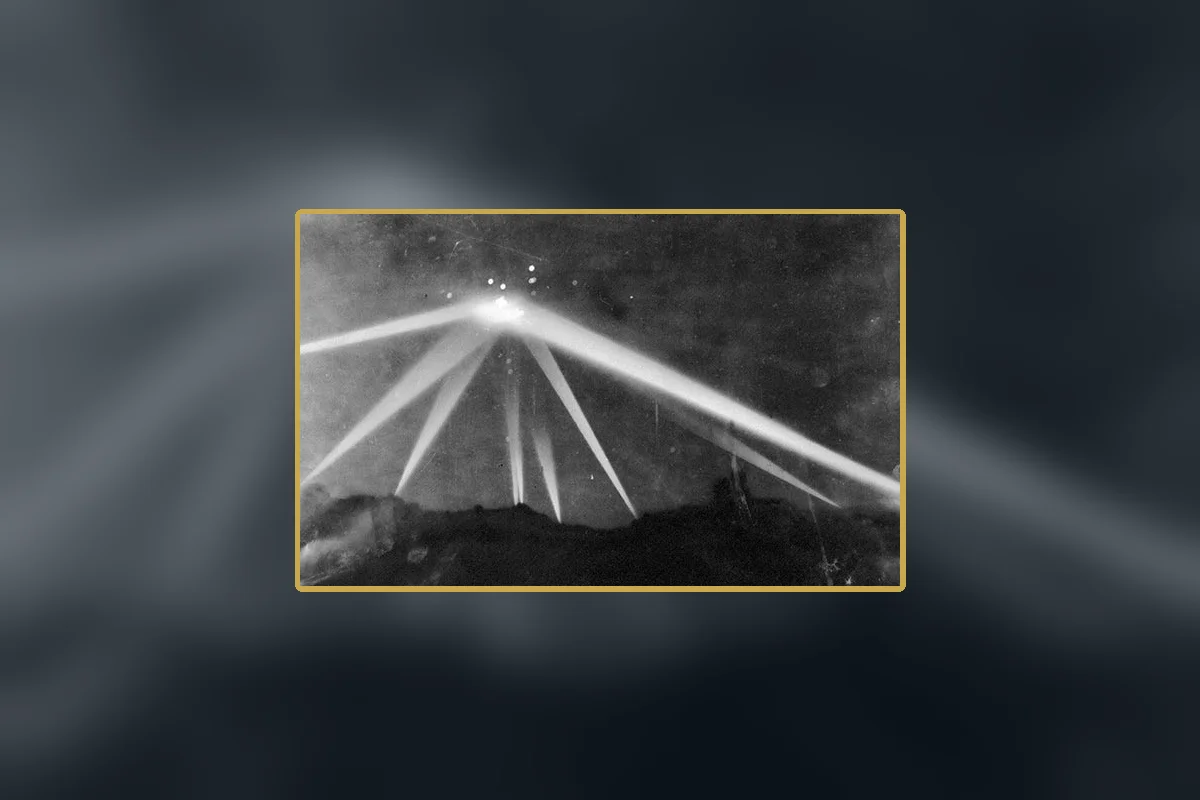
A widely reproduced Los Angeles Times photograph shows searchlight beams apparently converging on a glowing object. The newspaper image was retouched for reproduction, as press photographs often were, increasing contrast around beams and explosions. Later crops and copies made the center look more solid.
The picture documents the barrage, not an identifiable craft. Long exposure, overlapping beams, anti-aircraft bursts, smoke, and retouching can build a shape where no hard outline exists. Treating the brightest area as a vehicle reverses the burden of proof.
Official explanations changed
The Navy initially described the incident as a false alarm, while the Army suggested aircraft might have been present. Secretary of War Henry Stimson proposed that commercial planes or enemy agents could have triggered the fire. Contradictory statements deepened suspicion and reflected the uncertainty of wartime reporting.
A later U.S. Air Force historical review concluded that meteorological balloons likely initiated the alarm, with the barrage sustained by anxiety and confusion. That explanation fits common objects, radar ambiguity, and inconsistent sightings. It remains a reconstruction, not recovered physical identification.
Why the UFO label arrived later
The modern flying-saucer era began after the war, and later writers reinterpreted the 1942 incident through that lens. The dramatic image and official disagreement made ideal raw material. But no contemporary evidence establishes an extraterrestrial craft, and no object was recovered or tracked departing.
The better historical mystery is human. Under credible fear of attack, a defense system turned uncertainty into mass firing. The event shows how expectations shape perception and how institutional confusion can become proof of concealment once the original context fades.
What the record supports—and what it does not
The barrage was real; a giant object in the searchlights is not established. No confirmed enemy aircraft or extraterrestrial craft was found. Later official history favored balloons plus wartime nerves, while the iconic photograph records beams, smoke, bursts, and editorial reproduction—not a resolved silhouette.
Evidence ledger
- CONTEXT — A submarine had shelled California: The Ellwood attack one night earlier made coastal fears credible.
- ALARM — Radar and observers reported danger: The defense network acted before target identity was secure.
- BARRAGE — More than 1,400 shells: Fragments fell back over a city that no enemy bomb had struck.
- IMAGE — Searchlights created a bright center: Retouching and repeated reproduction hardened light and smoke into an apparent object.
- EXPLANATION — Weather balloons plus nerves: Later Air Force history favored ordinary balloons amplified by wartime confusion.
- MYTH CHECK — No craft was recovered: The archive documents an air raid, not an identified UFO.
How this reconstruction was built
The alert is documented through radar reports, military communications, shell counts, damage, witness statements, and press photographs. Those sources disagree on what observers saw, which is itself evidence of confusion. The iconic image reliably shows a barrage; it cannot identify a solid object at the beam intersection. Later balloon explanations fit the context but should still be presented as reconstruction, not a recovered target. Conflicting official statements reveal uncertainty during wartime, not by themselves a coordinated concealment. Damage records also keep attention on the shells that definitely returned to the city.
To audit the account, open the source links below and compare dates, quantities, and the wording used by the institutions themselves. Look for the earliest recoverable record, then distinguish it from later summaries created after the story became famous. The five visuals in this article are archival photographs, maps, documents, objects, or clearly identified editorial diagrams selected to illuminate the surviving record. Each caption identifies its source and rights information; no reconstruction is presented as a historical photograph. That transparency is part of the Lore & Archive method.
Why this story matters
This incident is a case study in feedback under uncertainty. A recent enemy shelling made alarms rational; firing then created more ambiguous evidence. The result was dangerous without requiring an actual attacker.
Continue in the archive
- USS Cyclops: How the Navy's Largest Unexplained Loss Vanished Without a Signal
- Codex Gigas: The Giant Medieval Book Behind the Devil's Bible Legend
- The Great Molasses Flood Was Preventable
Sources and further reading
Editorial note: Lore & Archive distinguishes contemporary evidence, later institutional synthesis, and unresolved inference. Where sources disagree or the record is incomplete, the uncertainty is stated rather than converted into a dramatic fact.