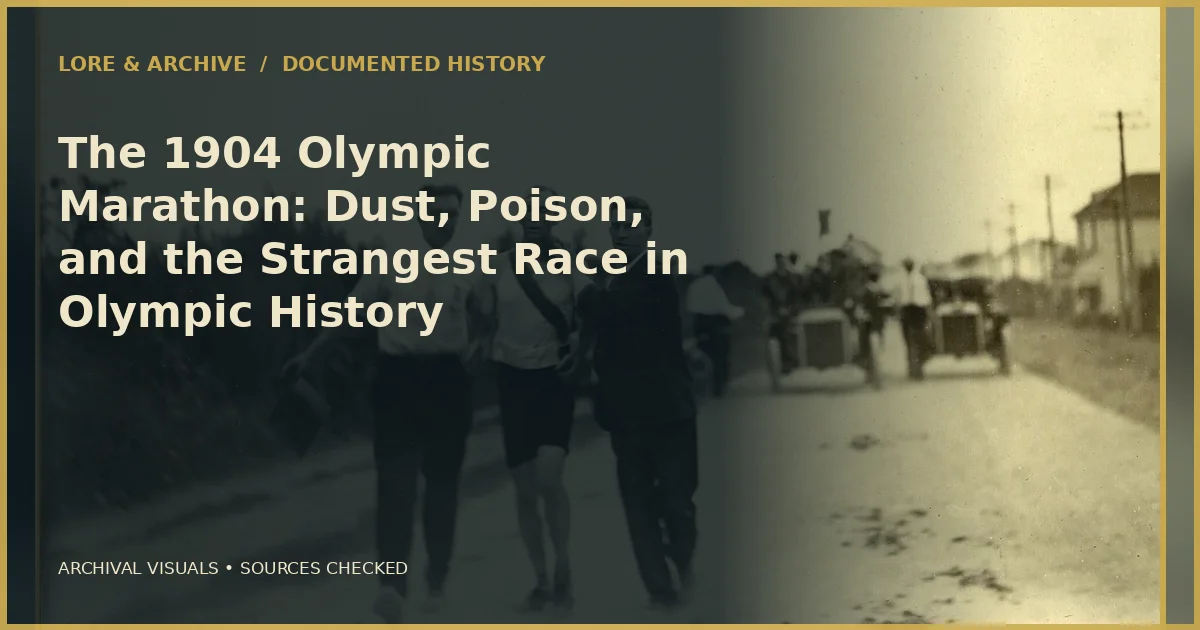
The race sounds like a comedy assembled from impossible details. Its archive tells a harsher story: organizers treated human endurance as an experiment while athletes crossed a hot, dusty course with almost no water.
Archive record
- Date: August 30, 1904
- Course: about 24.85 miles near St. Louis
- Finishers: 14 of 32 starters
- Official winner: Thomas Hicks of the United States
A course designed to produce suffering
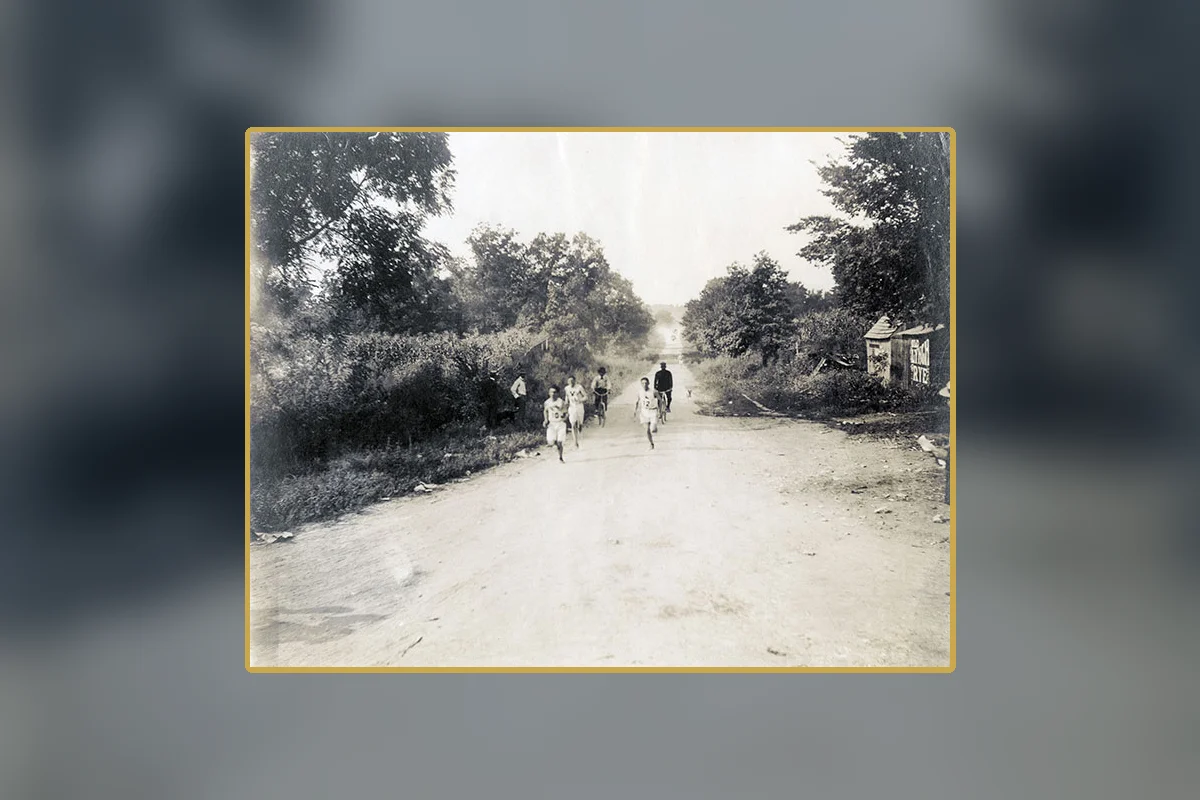
The marathon began in the afternoon heat on roads churned into dust by automobiles carrying officials, doctors, and reporters. Seven steep hills interrupted the route. Traffic was not fully excluded, and runners encountered pedestrians, wagons, and animals. The field itself was unusually mixed: experienced distance runners competed beside athletes with little marathon preparation.
Organizers provided only limited water, roughly around miles six and twelve, because James Sullivan—chief of the physical-culture department—wanted to observe the effects of purposeful dehydration. Dust coated mouths and lungs while temperatures climbed. What now looks like obvious mismanagement was partly intentional: the race doubled as a dangerous theory about athletic performance.
The runner who crossed the line first—but did not win
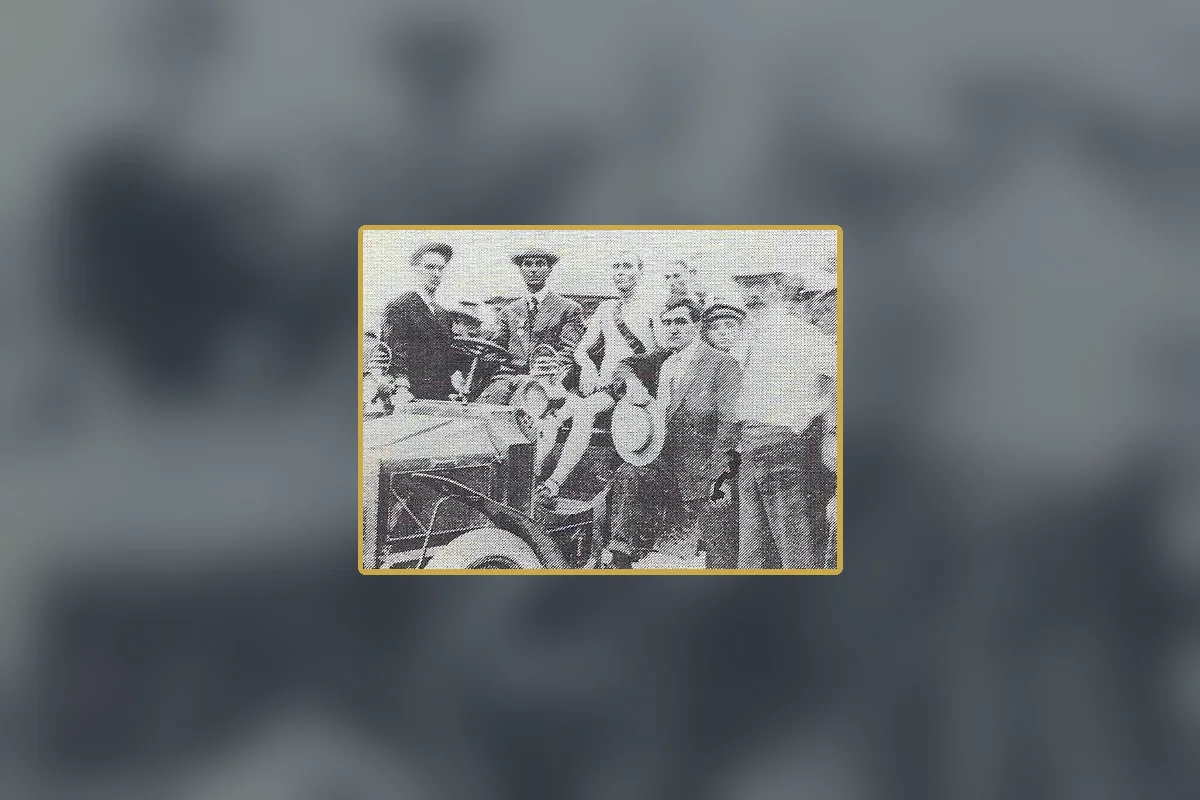
Fred Lorz stopped running after cramps and rode in a car for many miles. When the vehicle failed, he reentered the course and jogged toward the stadium. He crossed the finish line to cheers and briefly played along with the apparent victory. Officials soon learned what had happened and disqualified him.
Retellings sometimes portray Lorz as executing a sophisticated fraud. Contemporary accounts also support a more comic performance: he said the finish was a joke. Either way, the episode exposed how poorly the course was supervised. A runner could vanish into a support car, reappear, and reach the ceremonial finish before officials established where he had been.
Thomas Hicks and the legal poison
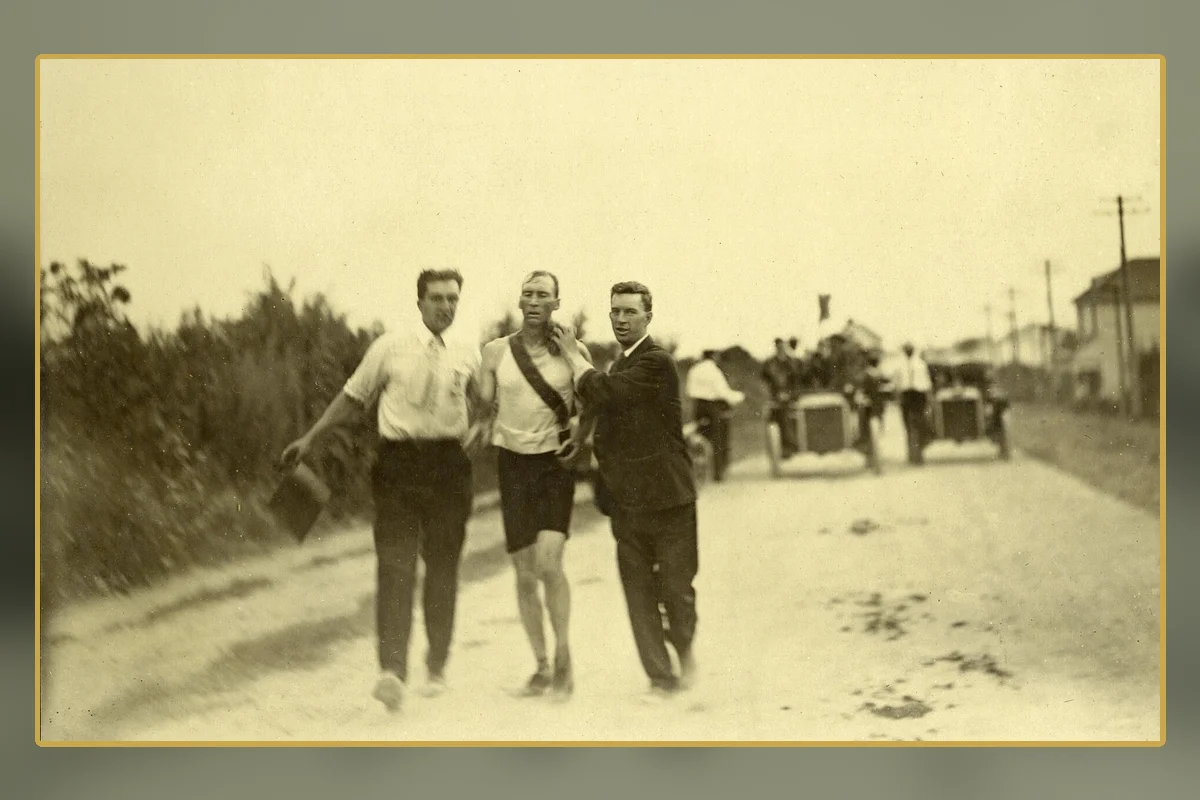
Thomas Hicks remained on foot but reached the late miles in severe distress. His handlers gave him small doses of strychnine mixed with egg white, followed later by brandy. Strychnine was then used as a stimulant in tiny quantities, even though larger doses cause convulsions and death. Hicks was carried by his handlers at moments but moved under his own power across the line.
His winning time was slow by elite standards, and he required immediate care. The episode is sometimes called the first Olympic doping case, but modern anti-doping rules did not yet exist. The useful lesson is not a retroactive violation; it is how experimental medicine, coaching, and competition combined without a safety framework.
Cuban trousers, dogs, and a stolen peach
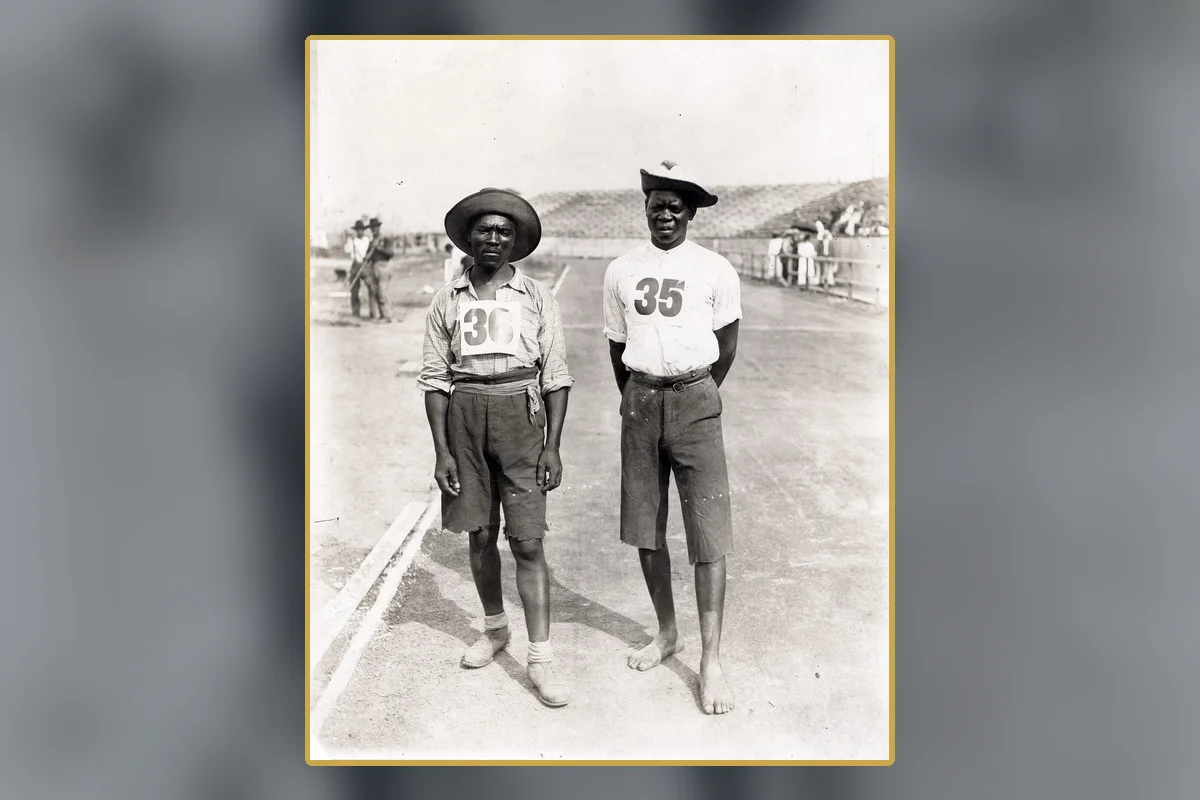
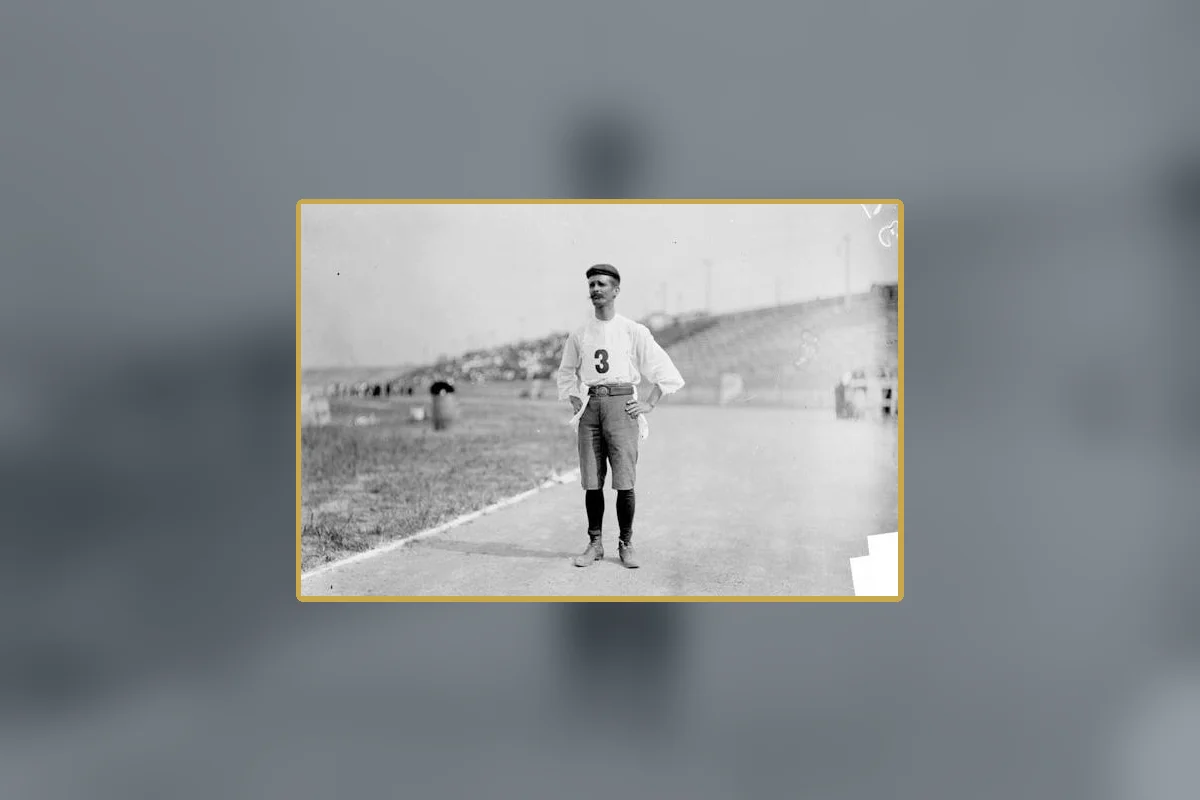
Félix Carvajal, a Cuban mail carrier who had raised travel money through public demonstrations, arrived in street clothes. Another athlete helped cut his trousers at the knee. Carvajal reportedly paused to talk with spectators, sampled fruit from an orchard, suffered stomach trouble, and still finished fourth. His story survives because improvisation briefly outperformed professional preparation.
South African runner Len Tau lost time after dogs chased him off course. Several runners suffered from the dust; one developed dangerous internal injuries after swallowing so much. Each anecdote is individually strange, yet together they point to the same structural failure: the race environment was not controlled enough to provide either fairness or basic medical safety.
The people often edited out of the spectacle
The 1904 Games were entangled with the Louisiana Purchase Exposition and its racist displays. Indigenous people and athletes from colonized populations were treated as objects in so-called Anthropology Days, events staged to support ideas of white superiority. The marathon's diversity cannot be separated from the fair's unequal power and sensational presentation.
Albert Corey, a French immigrant running for a Chicago club, finished second; records have long differed over whether his medal belonged to France, the United States, or a mixed team. The ambiguity shows how modern national medal tables can flatten athletes whose identities and affiliations did not fit later categories.
Why the race matters beyond its punch lines
Fourteen finishers, improvised stimulants, almost no water, cars on the road, and inconsistent oversight make the event irresistible as a list of bizarre facts. But comedy alone lets the organizers off too easily. The athletes' suffering was intensified by deliberate dehydration and by a course that would not meet modern expectations.
The 1904 marathon captures sport before standardized medical care, anti-doping rules, traffic control, and international administration. Its strangest details are authentic. Their meaning becomes clearer when they are read as evidence of an institution still deciding whether athletes were participants to protect or bodies available for experiment.
What the record supports—and what it does not
The race was not merely a lovable circus in which everyone cheated. Lorz was disqualified, Hicks used a then-permitted stimulant under his handlers' direction, and many absurd incidents flowed from poor course control. The documented comedy sits inside a serious history of dehydration experiments, racial spectacle, and weak athlete protection.
Evidence ledger
- COURSE — Heat, hills, and road dust: Officials' vehicles stirred dust while athletes crossed an open course in afternoon heat.
- EXPERIMENT — Water was deliberately limited: Organizers wanted to test purposeful dehydration, with aid stations spaced far apart.
- DISQUALIFIED — Fred Lorz rode in a car: He reentered after the car failed and crossed first, but officials removed him from the result.
- WINNER — Strychnine and brandy: Thomas Hicks's handlers used small stimulant doses in an era before modern anti-doping rules.
- FIELD — Only 14 finished: Thirty-two athletes started; fewer than half completed the punishing route.
- RECORD — Absurd facts, serious failure: The anecdotes document weak oversight and risky ideas about athlete care.
How this reconstruction was built
The marathon survives through official results, period reporting, athlete recollections, and later Olympic histories. The comic incidents are unusually well attested, but quotations and precise mile-by-mile sequences often vary. The stable pattern is more important: an open dusty road, extreme heat, deliberately scarce water, weak supervision, and improvised stimulants. Those shared conditions explain why so many unrelated oddities could occur in a single race.
To audit the account, open the source links below and compare dates, quantities, and the wording used by the institutions themselves. Look for the earliest recoverable record, then distinguish it from later summaries created after the story became famous. The five visuals in this article are archival photographs, maps, documents, objects, or clearly identified editorial diagrams selected to illuminate the surviving record. Each caption identifies its source and rights information; no reconstruction is presented as a historical photograph. That transparency is part of the Lore & Archive method.
Why this story matters
The event earns attention because it reveals how rules become visible through failure. Modern marathons look orderly partly because races like St. Louis demonstrated what happens when water, medical supervision, a closed course, and consistent officiating are treated as optional.
Continue in the archive
- Codex Gigas: The Giant Medieval Book Behind the Devil's Bible Legend
- Operation Mincemeat: The Dead Man, the False Papers, and a Wartime Deception
- The Antikythera Mechanism Was More Than a Curiosity
Sources and further reading
Editorial note: Lore & Archive distinguishes contemporary evidence, later institutional synthesis, and unresolved inference. Where sources disagree or the record is incomplete, the uncertainty is stated rather than converted into a dramatic fact.