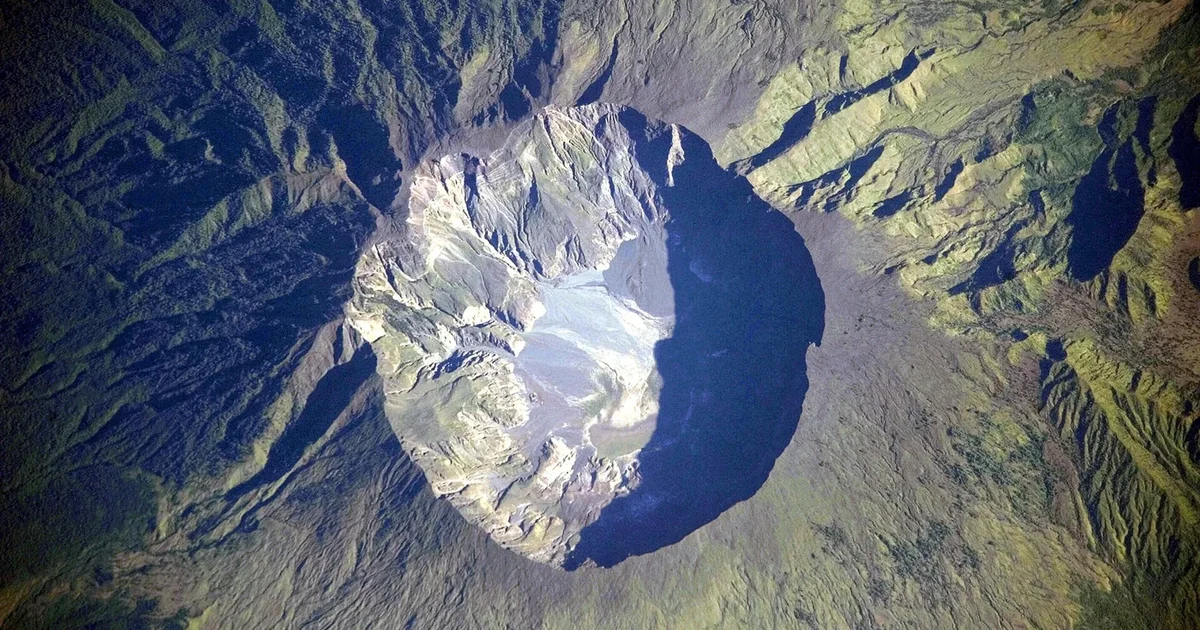
Tambora did not coat the world in ash. Sulfur high in the atmosphere formed a veil of aerosols that reflected sunlight, shifting probabilities across a climate already prone to unusual weather.
Archive record
- Eruption: April 1815
- Volcano: Mount Tambora, Sumbawa, Indonesia
- Climate anomaly: 1816
- Scale: largest observed eruption in recorded history
The eruption before the missing summer
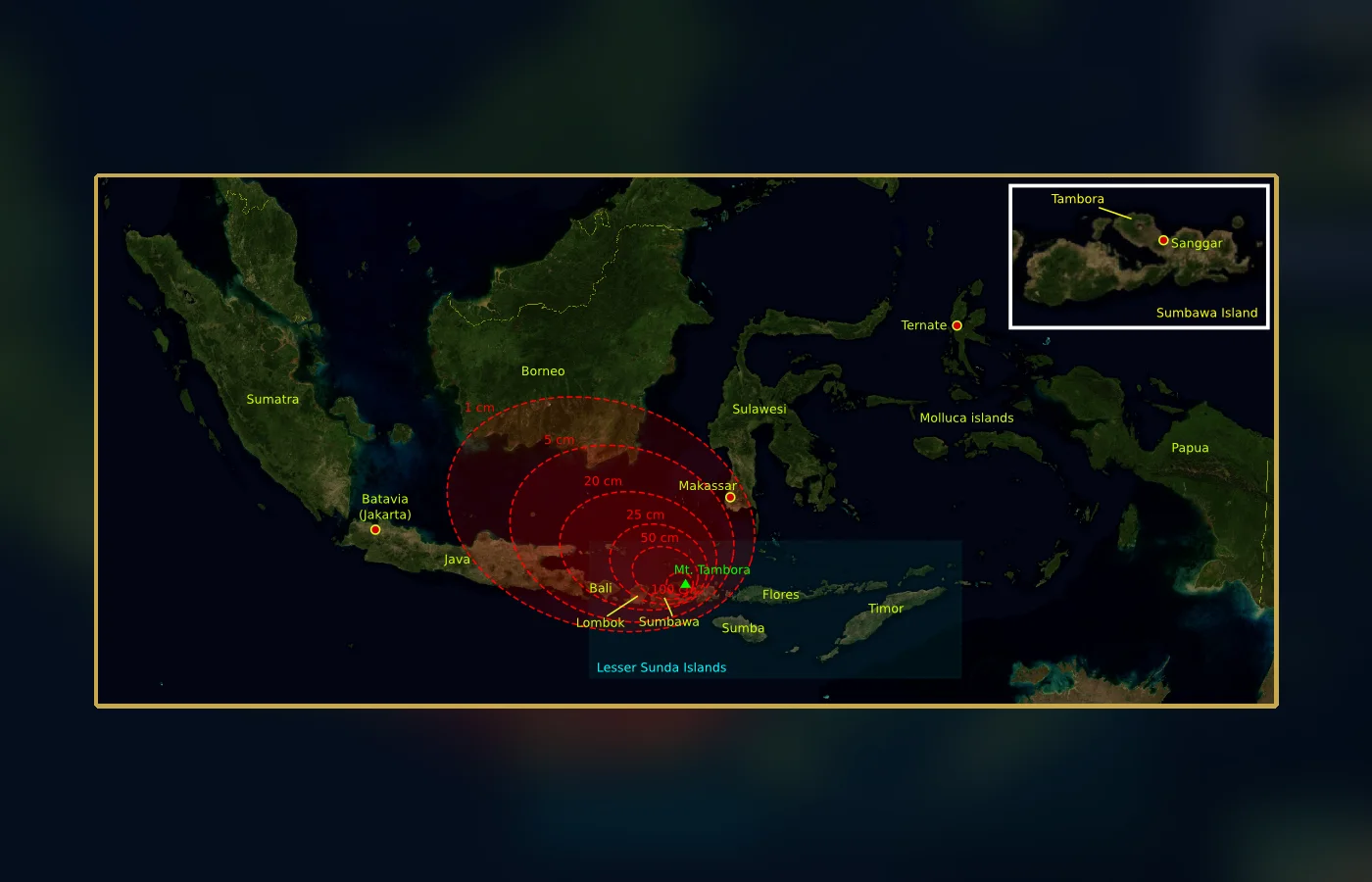
Mount Tambora erupted catastrophically in April 1815. The summit collapsed into a caldera, pyroclastic flows devastated Sumbawa, and ash destroyed crops and water supplies. Tens of thousands died from the eruption and the famine and disease that followed in the region.
News moved slowly, and many people in Europe and North America experiencing bad weather in 1816 did not know an Indonesian volcano had altered the atmosphere. The distance between cause and consequence made the year feel uncanny rather than connected.
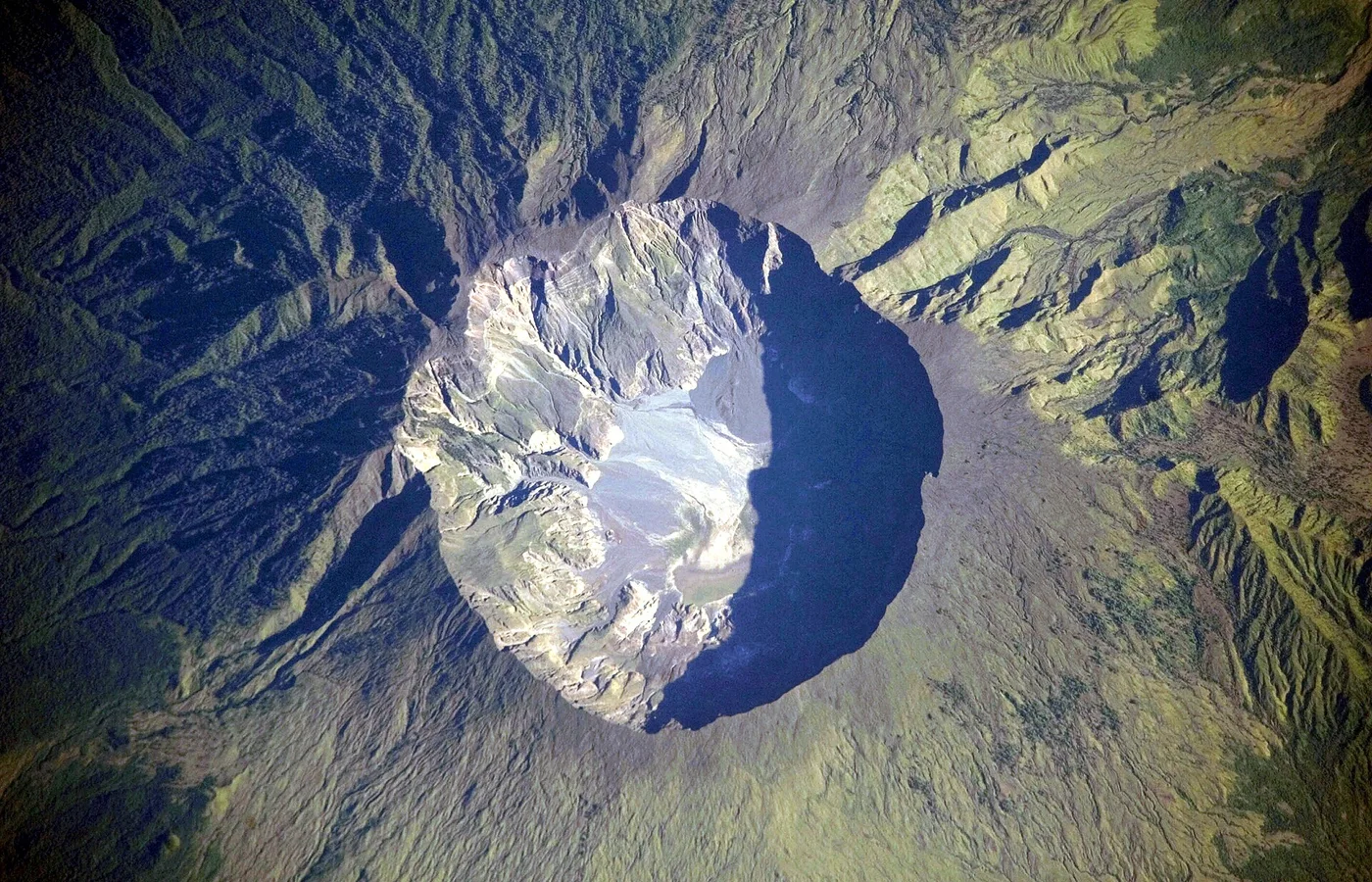
How a volcano cools places its ash never reaches
Tambora injected sulfur dioxide into the stratosphere. Chemical reactions produced sulfate aerosols that reflected part of incoming sunlight and persisted far longer than ordinary lower-atmosphere ash. The result was a temporary reduction in global temperatures, with strong regional and seasonal variation.
This mechanism does not mean every storm or frost in 1816 was directly 'caused' by Tambora. Volcanic forcing changed the climate background on which natural weather variability operated. Patterns in ocean and atmosphere could amplify or redirect the effects.
Frost, snow, and harvest failure
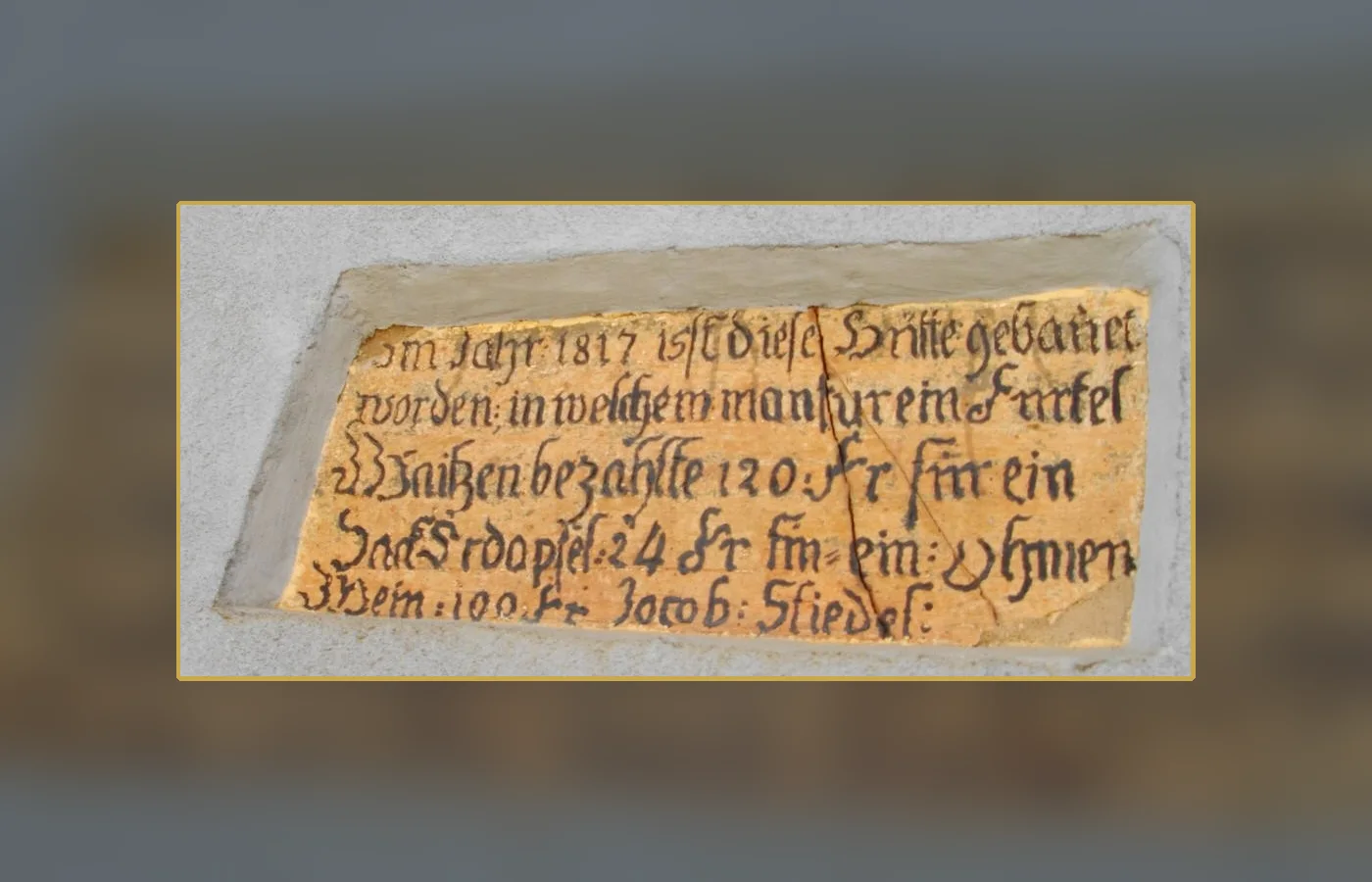
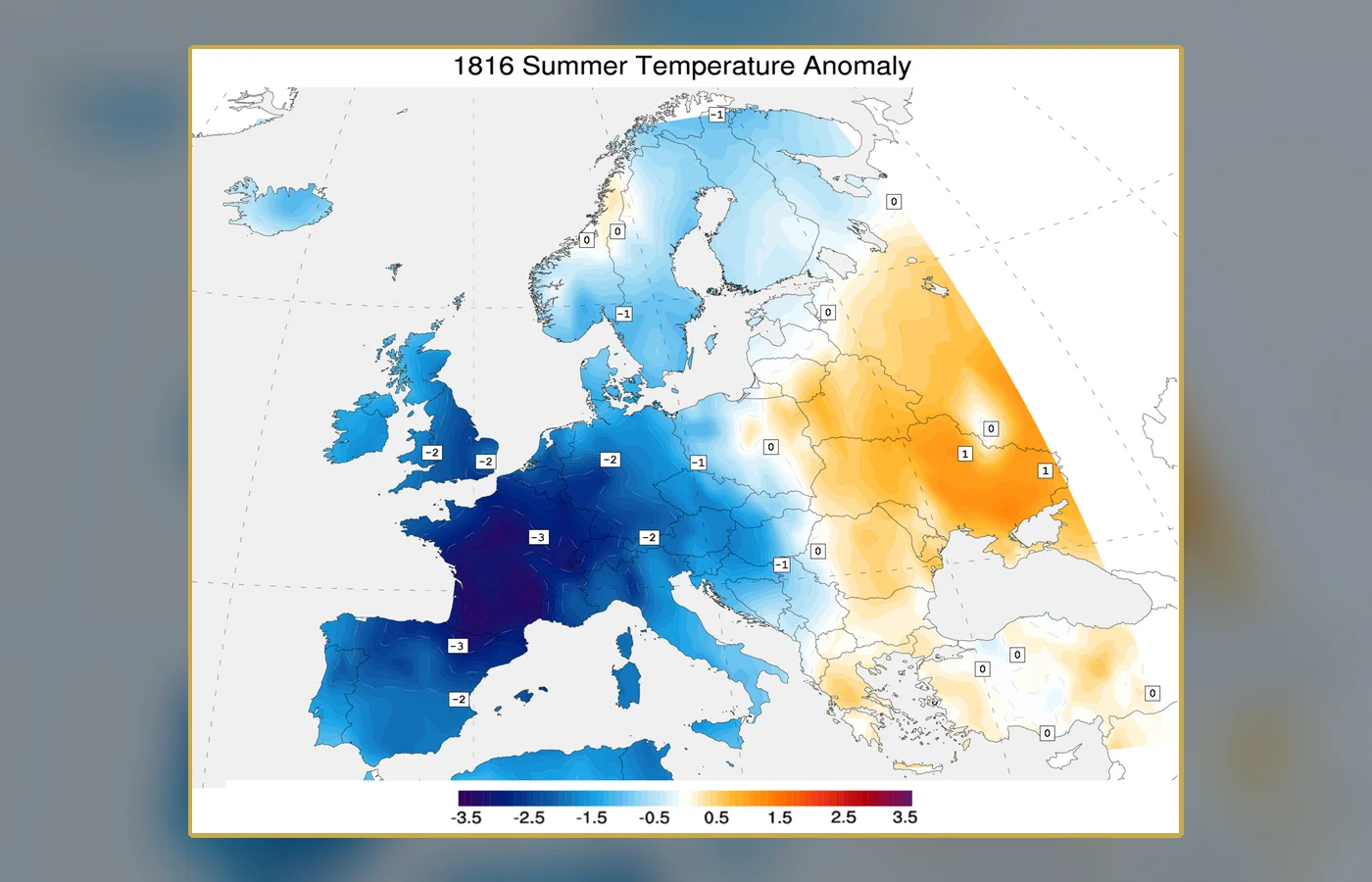
New England experienced repeated cold spells, including June snow and frost that damaged corn and other crops. Farmers replanted only to lose later growth. Food prices rose, livestock feed became scarce, and some families moved west in search of more reliable land.
Across Europe, cold and wet conditions contributed to poor harvests, hunger, unrest, and disease. Effects differed by place; some regions experienced drought or other anomalies. 'Year Without a Summer' is an effective label, not a literal description of every day or every country.
Paintings, bicycles, and Frankenstein
The year's cultural afterlife is filled with tempting causal chains. Gloomy weather at Lake Geneva kept Mary Shelley and companions indoors during part of the summer when Frankenstein took shape. High grain and horse-feed prices are sometimes linked to Karl Drais's development of an early two-wheeled vehicle.
These connections are plausible contexts, not single-cause inventions. Shelley had intellectual, personal, and literary influences beyond rain; transport experimentation had many motives. Good history shows how environmental pressure enters a life without claiming it mechanically produces one masterpiece or machine.
A global event reconstructed from local records
Scientists combine ice cores, tree rings, sediment, instrumental measurements, harvest records, prices, diaries, and ship observations to reconstruct the period. Sulfate layers identify major eruptions; biological and documentary records show how climate effects became social effects.
The chain is the lesson: eruption, aerosols, altered energy balance, regional weather, crop response, markets, migration, and health. No link is identical everywhere. Tambora's aftermath matters because it demonstrates how one geophysical event can travel through systems for years without looking the same in any two communities.
What the record supports—and what it does not
1816 was not uniformly wintry everywhere, and Tambora did not single-handedly cause every frost, famine, migration, artwork, or invention associated with the year. It was a major climate forcing acting through regional weather and existing social vulnerability.
Evidence ledger
- ERUPTION — April 1815: Tambora devastated Sumbawa and injected sulfur high into the atmosphere.
- MECHANISM — Sulfate aerosols reflected sunlight: Stratospheric particles cooled the climate temporarily.
- NEW ENGLAND — Frost and June snow: Repeated cold damaged crops during the growing season.
- EUROPE — Cold, wet, and hungry: Harvest failures amplified prices, disease, and unrest.
- CULTURE — Context, not single cause: Weather shaped the summer in which Frankenstein developed.
- EVIDENCE — Ice cores to diaries: Global and local records reconstruct the chain.
How this reconstruction was checked
This reconstruction begins with NASA Earth Observatory — Mount Tambora, NOAA Climate.gov — The Year Without a Summer. Those records establish the dates, people, objects, and institutional findings used above. Later retellings are useful only when they can be traced back to that record. A repeated anecdote is not treated as independent confirmation simply because it appears on several websites.
The unresolved question is kept separate from the documented mechanism. In this case, the evidence supports the following boundary: 1816 was not uniformly wintry everywhere, and Tambora did not single-handedly cause every frost, famine, migration, artwork, or invention associated with the year. It was a major climate forcing acting through regional weather and existing social vulnerability. The purpose of that boundary is not to flatten the mystery. It prevents a vivid but unsupported detail from displacing the evidence that makes the story worth reading.
Every visual is either a historical photograph, document, map, object, site image, or an explicitly labeled contextual comparison. Captions identify the source and license. No AI reconstruction and no text-poster image is presented as historical evidence; the featured image is derived directly from the first archival visual without a headline overlay.
Why this story matters
The story gives readers a rigorous version of a global butterfly effect. It replaces the weak claim 'a volcano created Frankenstein' with a documented chain that is more surprising and more useful.
Continue in the archive
- New England's Dark Day: When Noon Required Candles
- The Peshtigo Fire: America's Deadliest Wildfire Happened the Same Night as Chicago's
- The Great Smog of London
Sources and further reading
Editorial note: Lore & Archive separates contemporary records, later institutional synthesis, and unresolved inference. When sources disagree or the archive is incomplete, the uncertainty is stated rather than converted into a dramatic fact.