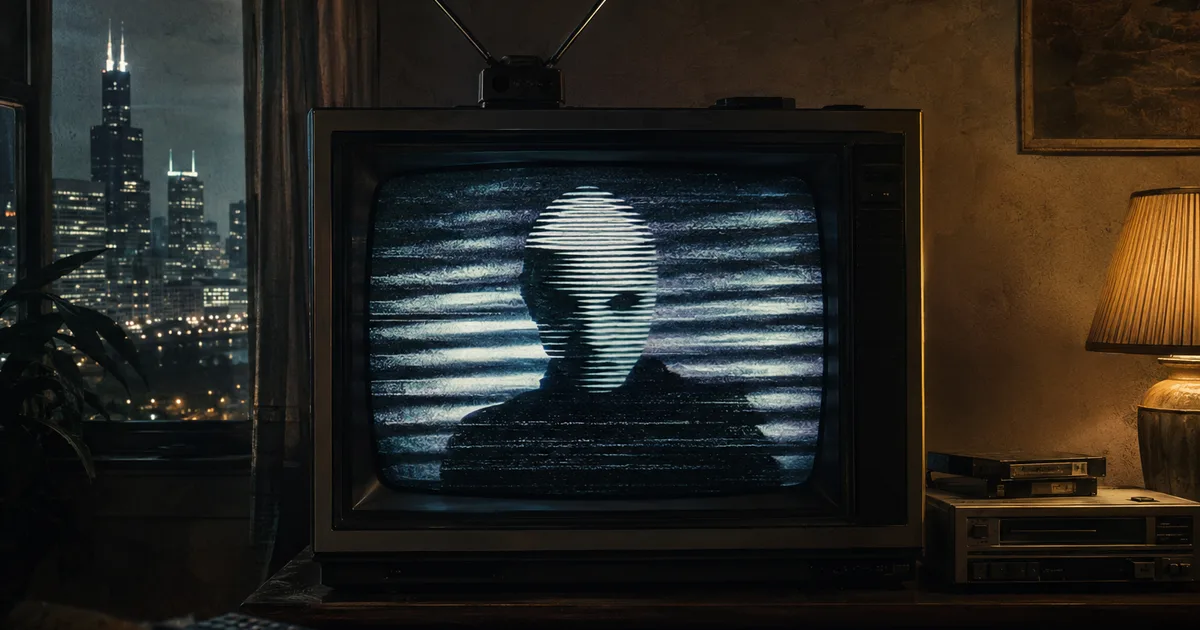
On Sunday night, November 22, 1987, Chicago television viewers watched the ordinary logic of broadcasting come apart. During WGN’s evening news, the screen went dark and returned with a masked figure rocking in front of corrugated metal. About two hours later, the same imitation of the television character Max Headroom appeared on WTTW during Doctor Who—this time with distorted speech and a complete, carefully staged performance.
The second interruption lasted only about 90 seconds. It was long enough to become one of American television’s most enduring unsolved intrusions. The Federal Communications Commission investigated, engineers studied how two legitimate signals had been overpowered, and viewers preserved recordings. No one was publicly identified.
The archive record
- Date: November 22, 1987
- First intrusion: WGN-TV’s 9 p.m. newscast, lasting roughly 25–30 seconds
- Second intrusion: WTTW’s broadcast of Doctor Who, lasting roughly 90 seconds
- Likely method: A stronger unauthorized signal overpowered a studio-to-transmitter microwave link
- Investigation: The FCC examined the case
- Result: The perpetrator or perpetrators have never been publicly identified
The first interruption: WGN loses the picture
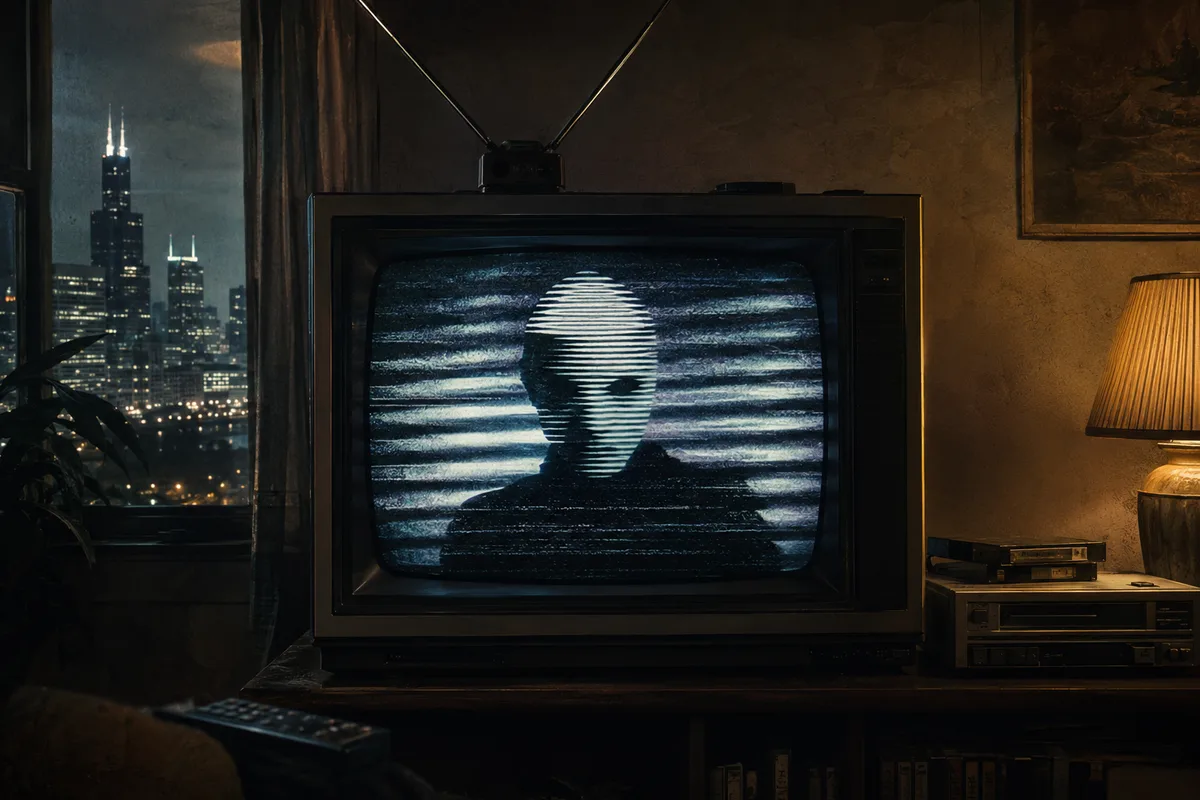
The first intrusion arrived during the sports segment of WGN-TV’s 9 p.m. news. Viewers had been watching highlights when the broadcast failed. A person wearing a Max Headroom mask and dark glasses appeared against a moving sheet of corrugated metal meant to imitate the character’s geometric television background. The audio was mostly an abrasive buzz.
WGN’s engineers reacted quickly. By changing the frequency used to send programming from the studio to the station’s transmitter, they forced the pirate image off the air. The station returned to its sportscast after roughly half a minute. Presenter Dan Roan’s visible confusion became part of the surviving record: the people inside the station had been surprised along with everyone watching at home.
If the intruders had stopped there, the event might have survived as an obscure technical prank. They did not stop.
The second interruption: 90 seconds on WTTW
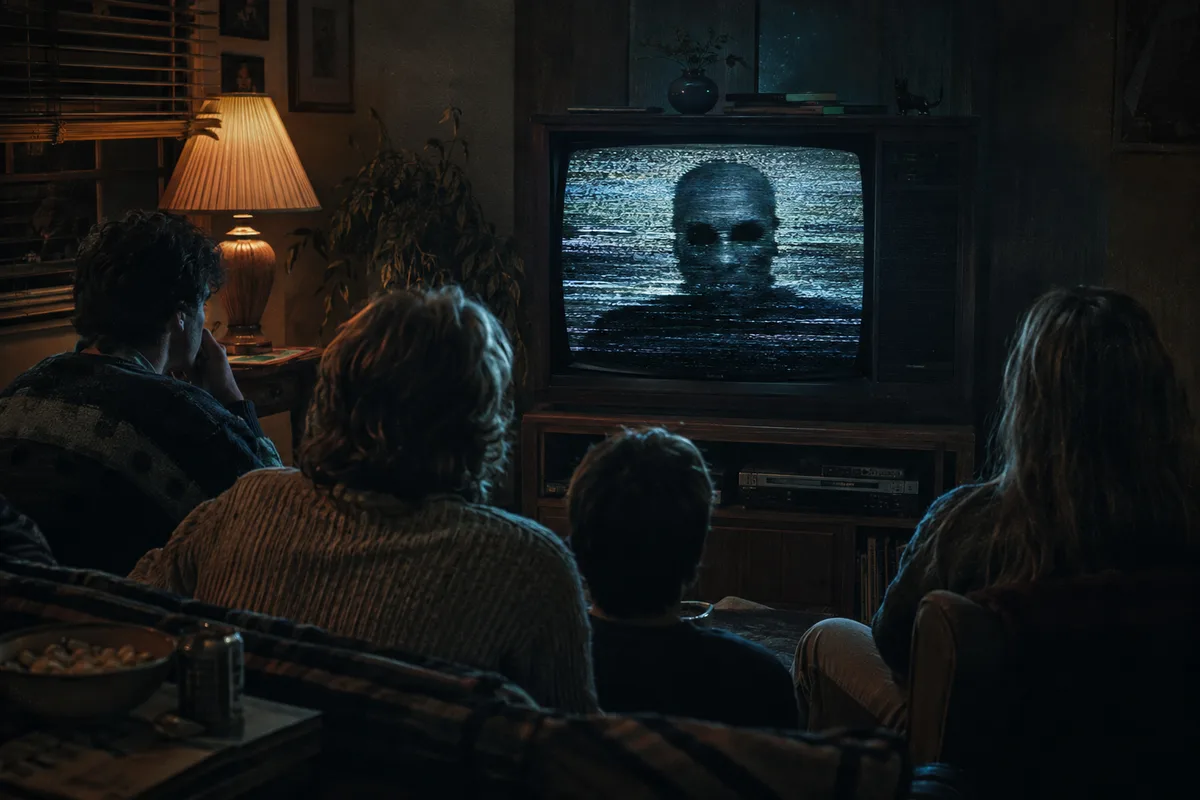
At approximately 11:10 p.m., viewers of Chicago’s PBS station WTTW were watching a rerun of the Doctor Who serial “Horror of Fang Rock.” Static cut into the episode. The masked figure returned, now accompanied by warped, partly intelligible audio.
The performance was not a simple message. It was a barrage of local references, advertising fragments, television jokes, props, laughter, and deliberately juvenile behavior. The figure mocked a Chicago sportscaster, alluded to Max Headroom’s association with Coca-Cola while holding a rival can, hummed part of an old cartoon theme, and ended with an accomplice entering the frame. The material became increasingly inappropriate before the pirate signal vanished and Doctor Who returned.
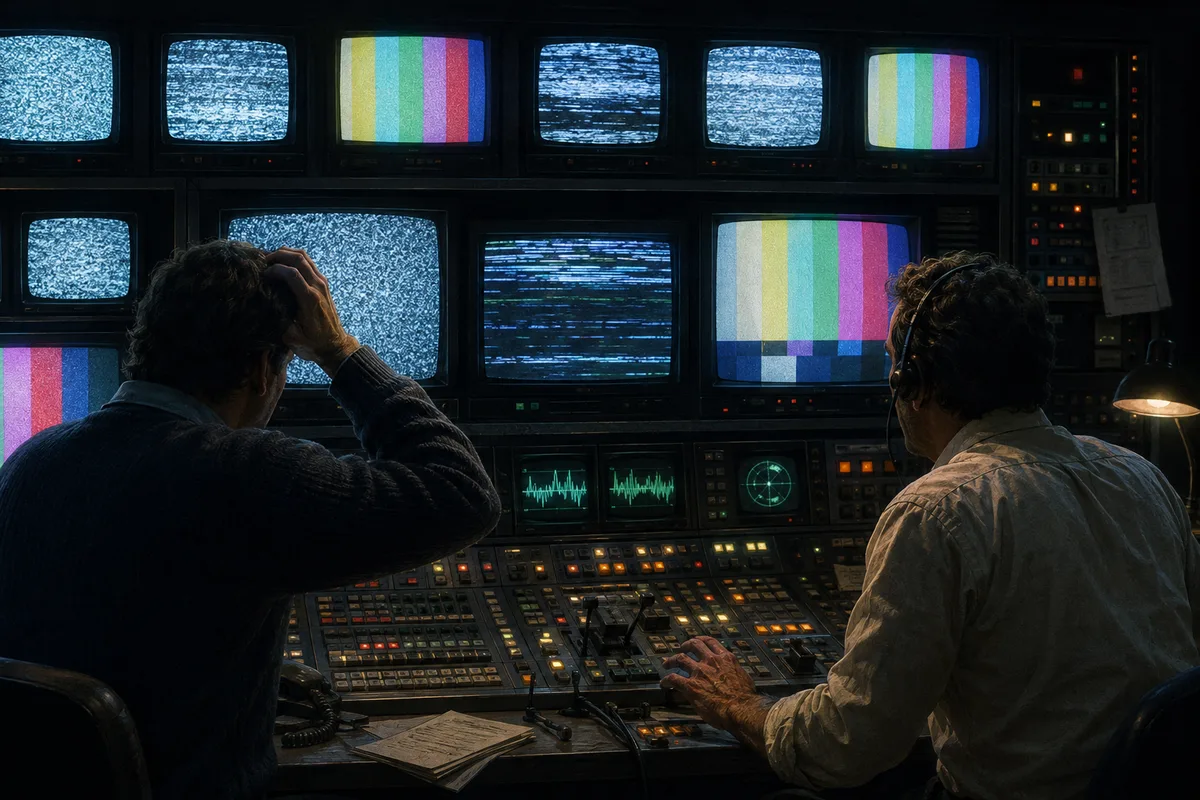
Inside WTTW, staff tried to respond but could not regain control before the transmission ended on its own. The station later reconstructed the event partly through recordings made by viewers. In 1987, home VCRs turned a fleeting act of signal piracy into a replayable artifact.
The mystery survives because the evidence is unusually vivid: viewers across Chicago could see the performance, yet the people who created it remained outside the frame.
Why Max Headroom was the perfect mask
Max Headroom was a fictional television personality designed to look computer-generated, though actor Matt Frewer performed beneath prosthetics and carefully controlled video effects. The character embodied the anxieties and visual language of 1980s television: synthetic, glitching, commercial, and slightly hostile.
An impostor interrupting a real station therefore completed the joke. In the fiction, Max existed inside a television system that he could mock and disrupt. On November 22, someone turned that fiction back on the broadcasters. The choice of disguise supplied instant recognition while ensuring that the actual face remained hidden.
How could someone hijack a television station in 1987?
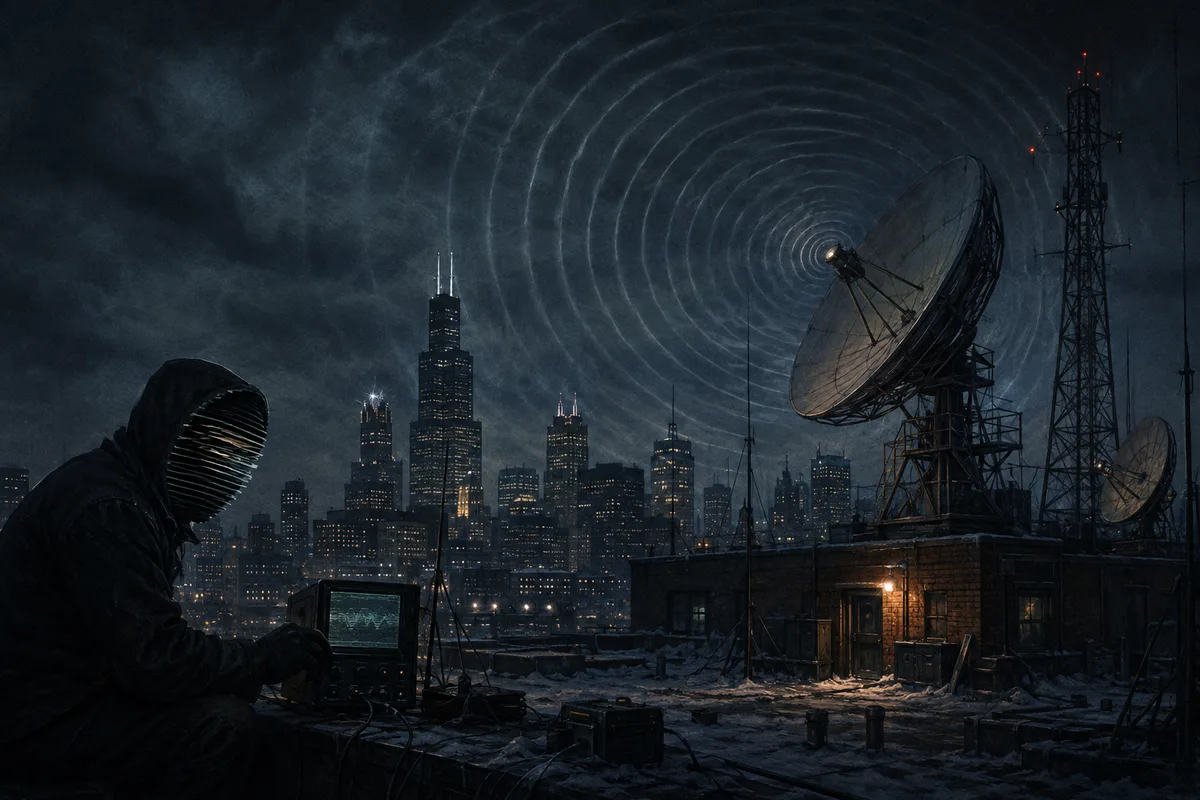
The most widely accepted technical explanation involves the studio-to-transmitter link, often shortened to STL. A television station’s studio did not necessarily occupy the same building as its high-power broadcast antenna. Programming traveled from the studio to the transmitter through a directional microwave signal. The transmitter then sent that programming across the viewing area.
If an unauthorized operator transmitted on the same link frequency with a signal stronger at the receiver than the station’s own feed, the receiver could accept the pirate video instead. The intruder would not need to break into the studio or seize the main broadcast tower. The attack would happen in the air between them.
That explanation fits what WGN did to stop the first interruption: its engineers changed the link frequency. It also fits contemporary statements that the source was probably local and required knowledge of broadcast equipment. WTTW engineer Al Skierkiewicz later said the operation would have demanded sophisticated technical understanding, possibly combining broadcast, satellite, or amateur-radio expertise.
Important uncertainty remains. The public record does not identify the exact equipment, rooftop, vehicle, or route used. “They overpowered the microwave link” is a strong technical reconstruction, not a recovered confession or a photograph of the apparatus.
What the intruders probably needed
- Knowledge of the frequencies or a way to locate them
- A video source containing the prerecorded performance
- Microwave transmitting equipment and a directional antenna
- A position with a workable line of sight toward the relevant receiving sites
- Enough power and accuracy to overcome the legitimate link
- At least one accomplice, because another person appears to participate in the recorded performance
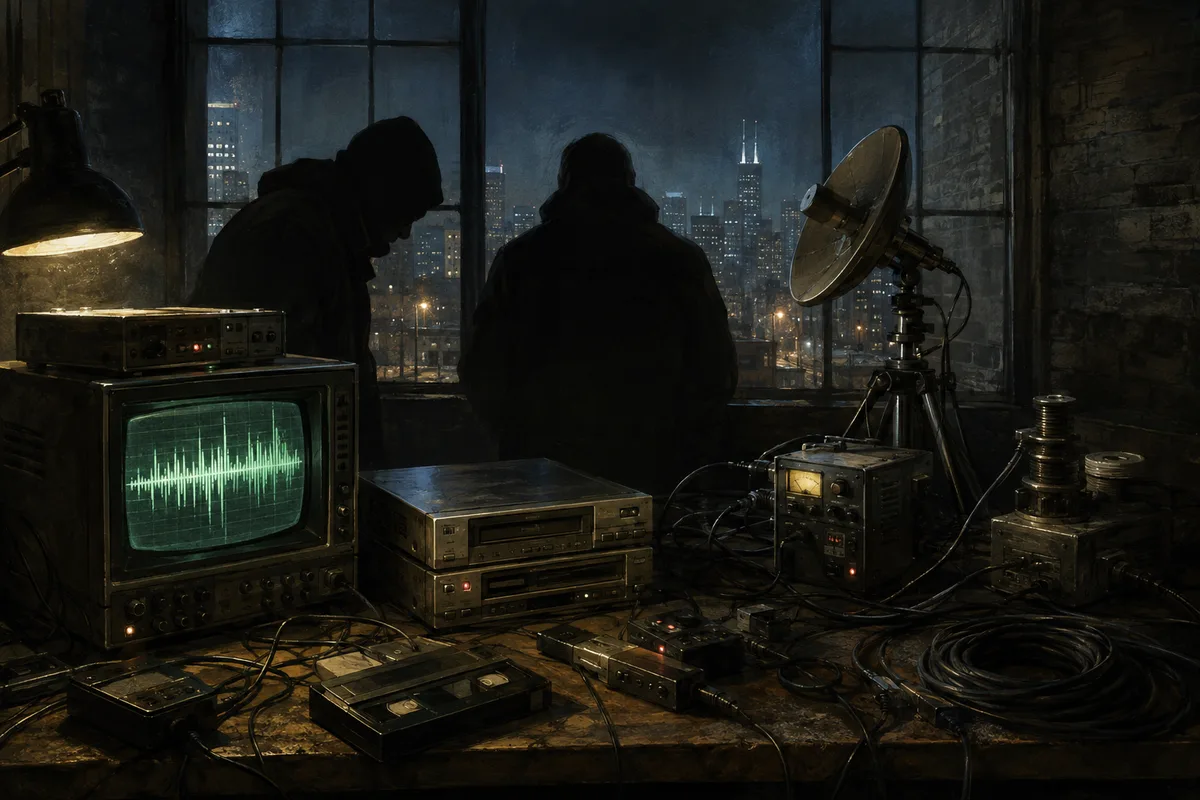
Early descriptions emphasized expensive professional hardware. Later technical commentary suggested that used or surplus equipment could have reduced the cost. Either way, the act required more than placing a home antenna near a television set. It combined preparation, local knowledge, radio technique, timing, and nerve.
The investigation that went nowhere
The FCC opened an investigation. Contemporary reporting warned that deliberate broadcast interference was a federal offense and could bring fines or imprisonment. The short duration of the signals, however, made the source difficult to trace. Direction-finding works best when investigators have enough time to measure a transmission while it is still active. Here, the longest event ended after a minute and a half.
No group issued a verifiable claim of responsibility. No equipment was publicly tied to the broadcast. No motive emerged that explained every reference in the performance. The intruders may have been broadcasting professionals, electronics enthusiasts, students, disgruntled insiders, or people who crossed more than one of those circles. The evidence does not select a name.
What we know—and what remains speculation
| Question | Best-supported answer |
|---|---|
| Were there two interruptions? | Yes. WGN and WTTW were affected on the same night. |
| Was the second performance live? | Not established. It could have been prerecorded and then transmitted. |
| Did the same people attack both stations? | Very likely, but not judicially proven. The same visual setup appeared in both. |
| Was the station hacked through a computer network? | No evidence supports that modern meaning of “hack.” The intrusion was a radio-frequency takeover. |
| Did investigators identify a suspect? | No publicly confirmed identification. |
| Do online suspect theories solve the case? | No. None has produced independently verified evidence sufficient to close it. |
Why the mystery outlived analog television
The technical conditions that made the intrusion possible belonged to a particular era. Broadcasting was powerful but geographically exposed; a station’s microwave links crossed open air, and a well-placed rival signal could exploit that path. Modern digital systems, authentication, monitoring, and changed distribution networks make an exact repeat far more difficult.
But the deeper fear has aged well. Viewers trust the screen to tell them who is speaking and who controls the channel. For 90 seconds, that authority belonged to someone unknown. The masked figure did not steal money, release a manifesto, or explain a grievance. It simply demonstrated control—and disappeared.
That absence of a clean motive keeps the incident unsettling. A demand can be analyzed. A culprit can be judged. The Max Headroom intrusion offers only a performance, a method reconstructed from engineering, and a question that survived every replay: who wanted Chicago to see this?
Continue in the archive
- The Voynich Manuscript Still Resists a Definitive Reading
- Mary Celeste: What the Evidence Says About the Famous Empty Ship
- The Day the BBC Decided There Was No News
Sources and further reading
- WTTW, recollections from station staff and viewers
- United Press International, November 23, 1987 report
- United Press International, November 24, 1987 follow-up
- WTTW, “Max Headroom Attack!” video feature
Editorial note: The likely microwave-link method is identified as a technical reconstruction. Unverified internet accusations against named individuals have been excluded.